


















Lesson 13 of 46 · Crystal Structures and Defects
Miller Indices: Naming Planes and Directions
Learn to write crystal directions [uvw] and planes (hkl), find angles and interplanar spacing in cubic crystals, and compare planar densities of FCC and BCC.
When a metal deforms, atoms slide along certain planes and in certain directions. When X-rays reflect from a crystal, they reflect from certain families of planes. To talk about these planes and directions without drawing a picture every time, crystallographers use a short code of three integers, the Miller indices. It looks like arithmetic homework, but the code is a real working language: it appears on every diffraction pattern, every slip-system table and every datasheet for a single-crystal wafer. In this lesson you learn to write and read it for cubic crystals.
What you will learn
- How to find the indices
[uvw]of a direction and(hkl)of a plane. - How to read negative indices and families such as
and<111>. - How to calculate interplanar spacing and the angle between directions in cubic crystals.
- How planar density differs between planes, and why close-packed planes matter.
Key terms
Direction [uvw]: the smallest set of integers proportional to a vector in the crystal, written in square brackets.
Plane (hkl): the reciprocals of the intercepts of the plane with the axes, cleared of fractions, in round brackets.
Family or <uvw>: all planes or directions equivalent by the symmetry of the crystal.
Interplanar spacing d_hkl: the distance between adjacent parallel planes of the family.
Directions
Place the origin at a lattice point and choose axes along the cell edges, with lengths measured in units of the lattice parameters. To find a direction:
- Take the vector from the tail to the head: subtract tail coordinates from head coordinates.
- Write the three components in units of a, b and c.
- Multiply or divide to get the smallest integers.
- Write them in square brackets without commas. A negative integer gets a bar above it:
[1 1̄ 0]is a vector with components 1, −1 and 0.
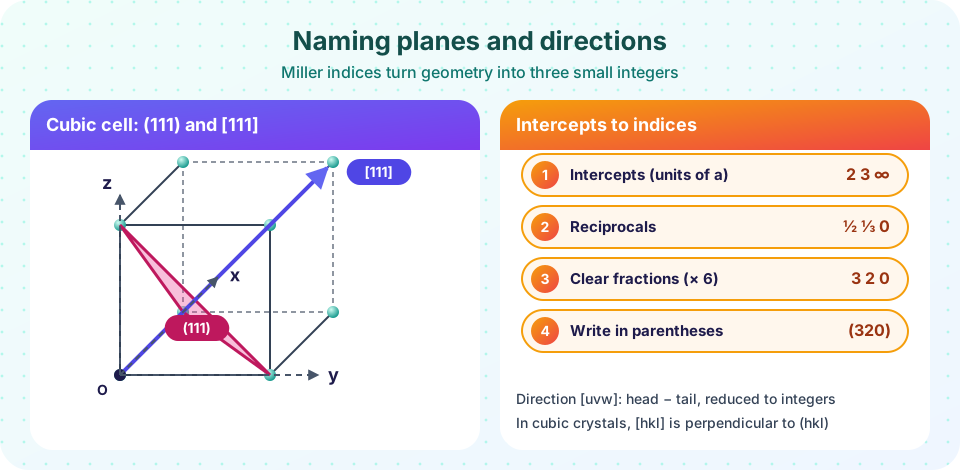
Examples in a cubic cell: the cell edge along x is [100]; the face diagonal in the xy plane is [110]; the body diagonal is [111]. A vector from the origin to the point (1/2, 1, 0) has components (1/2, 1, 0), which times 2 gives [120]. In a cubic crystal the direction [110] has the same properties as [101], [011], [1 1̄ 0] and others; the set of all of them is written <110>.
Planes
A plane intercepts the three axes at distances x, y, z in units of a, b and c (infinity if parallel to an axis).
- Find the intercepts.
- Take reciprocals:
1/x, 1/y, 1/z. A plane parallel to an axis gets 0 there. - Clear fractions by multiplying by the smallest common factor.
- Write the result in parentheses,
(hkl).
A plane with intercepts 1, ∞, ∞ becomes (100), the face of the cube. Intercepts 1, 1, ∞ give (110). Intercepts 1, 1, 1 give (111). Intercepts 1/2, 1, ∞ have reciprocals 2, 1, 0, giving (210). The worked example of the picture, intercepts 2, 3, ∞, has reciprocals 1/2, 1/3, 0; multiplying by 6 gives (3 2 0). If the plane passes through the origin, shift the origin or use a parallel plane, since parallel planes have the same indices. All planes (hkl) that are equivalent under cubic symmetry form the family : for example contains (100), (010), (001) and their negatives, six planes in all.
Two useful facts hold for cubic crystals only: the direction [hkl] is perpendicular to the plane (hkl), and the spacing between neighboring planes of a family is
d_hkl = a / √(h² + k² + l²).
For copper (a = 0.3615 nm) the (111) planes are 0.3615/√3 = 0.2087 nm apart. Larger indices mean closer planes. The angle θ between two directions [u₁v₁w₁] and [u₂v₂w₂] follows from the dot product,
cos θ = (u₁u₂ + v₁v₂ + w₁w₂) / (√(u₁² + v₁² + w₁²) √(u₂² + v₂² + w₂²)).
Between [100] and [111] this gives cos θ = 1/√3, so θ = 54.74°. This number turns up in diffraction and in slip.
Press Run (or Ctrl + Enter) to see the result here.
Program input · what you'd type while the program runs
Type the answers before you press Run, one per line. Each time the program reads a line (with input()), it gets the next line from this box.
Hexagonal crystals
For hexagonal crystals such as magnesium and titanium, a fourth index is used, giving Miller-Bravais indices (hkil) with i = −(h + k). The extra index makes equivalent planes look equivalent: the six prism faces of the hexagon all have the same type of index. The close-packed basal plane is (0001).
Planar density and why close-packed planes matter
Different planes of the same crystal contain different numbers of atoms per unit area. The planar density is the number of atoms whose centers lie in the plane, per unit area. Slip, the motion of dislocations (chapter 4), is easiest on the planes with the highest planar density and in the directions of highest linear density, because they are the most widely spaced and have the weakest resistance to sliding. For FCC the (111) planes are the close-packed ones: each contains 2 atoms in a triangle of area (√3/2) a², so PD(111) = 4/(√3 a²) = 2.31/a². In terms of R, PD = 1/(2√3 R²) = 0.289/R², which is the density of a close-packed layer. BCC has no close-packed plane; its densest plane (110) reaches only 0.265/R². That is one reason why the slip behavior of BCC and FCC metals differs.
Press Run (or Ctrl + Enter) to see the result here.
Program input · what you'd type while the program runs
Type the answers before you press Run, one per line. Each time the program reads a line (with input()), it gets the next line from this box.
Common misconceptions
"A plane (hkl) has intercepts h, k and l." The indices are the reciprocals of the intercepts, cleared of fractions. A plane with intercepts 2, 3, ∞ is (320), not (23∞).
"Indices of planes and directions work the same way." Directions use vector components (no reciprocals); planes use reciprocals of intercepts.
"[hkl] is always perpendicular to (hkl)." This holds only in cubic crystals; in other systems the lattice is skewed.
Check your understanding
Quick check · 5 questions
of 5 answered You scored / 5 · perfect!
-
1. A plane has intercepts 1, 1 and infinity. Its Miller indices are
Reciprocals are 1, 1 and 0, so the plane is (110). -
2. The direction from (0,0,0) to (1,1,0) in a cubic cell is
The components are 1, 1, 0 in units of the cell edges. -
3. What is the spacing of the (200) planes in a cubic crystal with a = 0.40 nm?
d = a / √(4 + 0 + 0) = a/2 = 0.20 nm. -
4. Which statement is true for cubic crystals only?
Perpendicularity of [hkl] and (hkl) depends on the equal, perpendicular axes of the cubic system. -
5. Which plane of FCC has the highest planar density?
(111) is the close-packed plane.
Summary
- Directions
[uvw]come from head minus tail, reduced to integers; planes(hkl)come from reciprocal intercepts. - Families
and<uvw>collect symmetry-equivalent planes and directions. - In cubic crystals
d_hkl = a / √(h² + k² + l²), and[hkl]is perpendicular to(hkl). - The angle between
[100]and[111]is 54.74°. - Close-packed planes (FCC and HCP) have the highest planar density; BCC has none.
Track your progress
Create a free account to tick off lessons and pick up where you left off on any device.
of Materials Science lessons completed