


















Lesson 16 of 46 · Crystal Structures and Defects
Chapter 3 Review: Crystal Structures and Defects
Review lattices, unit cells, packing, Miller indices, density, Bragg diffraction and crystal defects, with formulas, a calculator and a ten-question quiz.
Chapter 3 gave you a language and a toolkit for the arrangement of atoms. You can describe a crystal by its unit cell, count atoms and neighbors, name planes and directions, predict density, read an X-ray pattern, and explain why imperfections are both unavoidable and useful. These ideas are the base for everything mechanical in chapter 4: strength and ductility are properties of dislocations moving on close-packed planes through grains that vary in size.
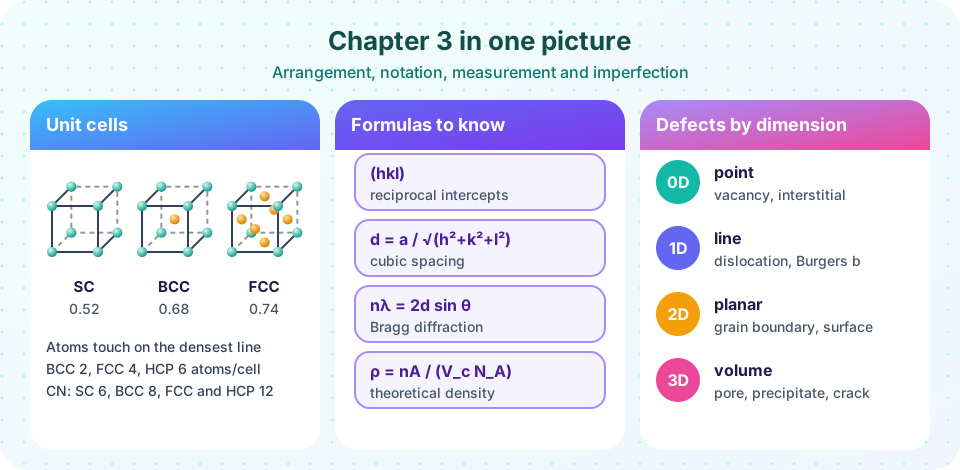
Recap table
| Lesson | Key ideas | Formulas and numbers to remember |
|---|---|---|
| Overview | Crystalline versus amorphous; lattice plus basis; 7 systems, 14 Bravais lattices | Cubic: a = b = c, angles 90° |
| Unit cells and packing | SC, BCC, FCC, HCP; touching direction; holes; polymorphism | Atoms per cell 1, 2, 4, 6; APF 0.52, 0.68, 0.74, 0.74; a = 4R/√3 (BCC), a = 2R√2 (FCC) |
| Miller indices | Directions [uvw], planes (hkl), families, planar density |
d = a/√(h²+k²+l²); angle [100] to [111] = 54.74° |
| Density and diffraction | Theoretical density, Bragg's law, selection rules | ρ = nA/(V_c N_A); nλ = 2d sinθ; FCC all odd or even, BCC h+k+l even |
| Crystal defects | Vacancies, interstitials, dislocations, grain boundaries | N_v/N = exp(−Q_v/k_B T); σ_y = σ₀ + k d^(−1/2) |
Try it
The first tool summarizes a cubic metal from its lattice parameter. Edit the entries or add your own element (you need the structure, lattice parameter in nm and molar mass in g/mol).
Press Run (or Ctrl + Enter) to see the result here.
Program input · what you'd type while the program runs
Type the answers before you press Run, one per line. Each time the program reads a line (with input()), it gets the next line from this box.
The second tool generates practice problems on plane spacing. Change the seed to get new ones, work each answer by hand, and compare.
Press Run (or Ctrl + Enter) to see the console output here.
No output.
Check your understanding
Quick check · 10 questions
of 10 answered You scored / 10 · perfect!
-
1. How many atoms does a BCC unit cell contain?
8 corners × 1/8 + 1 center atom = 2. -
2. In an FCC crystal the atoms touch along
The face diagonal is a√2 = 4R, which gives a = 2R√2. -
3. A plane with intercepts 1/2, 1 and ∞ has Miller indices
Reciprocals are 2, 1 and 0. -
4. What is the spacing of the (111) planes in copper (a = 0.3615 nm)?
d = 0.3615/√3 = 0.2087 nm. -
5. Which pair of structures has the same coordination number and packing factor?
Both have coordination number 12 and APF 0.74. -
6. Bragg's law relates
nλ = 2d sinθ. -
7. Which reflection is NOT allowed for a BCC lattice?
BCC allows h + k + l even; 1 + 1 + 1 = 3 is odd. -
8. The vacancy fraction at temperature T is proportional to
It follows an Arrhenius law. -
9. Which is a line defect?
Dislocations are one-dimensional defects. -
10. A higher ASTM grain-size number G means
N = 2^(G−1) grains per square inch at 100×, so a larger G means more and smaller grains.
Summary
- A crystal is a lattice plus a basis; seven systems and 14 Bravais lattices cover all crystals.
- SC, BCC, FCC and HCP contain 1, 2, 4 and 6 atoms per cell; FCC and HCP are close-packed (APF 0.74, CN 12).
- Miller indices name planes and directions; in cubic crystals
d = a/√(h²+k²+l²). - Density follows from the cell, and X-ray diffraction measures the cell via
nλ = 2d sinθ. - Defects (vacancies, dislocations, grain boundaries, precipitates) control diffusion, strength and ductility.
Track your progress
Create a free account to tick off lessons and pick up where you left off on any device.
of Materials Science lessons completed