


















Lesson 29 of 46 · Metals and Alloys
Steels, cast irons and non-ferrous alloys
Sort the real alloy families: plain and alloy steels, stainless steel, gray and ductile cast iron, and aluminum, copper, titanium and magnesium alloys, with how precipitation hardening works.
So far you have worked with the idealized Fe–C system. Real alloys contain manganese, chromium, silicon, nickel and other additions, and they are sold by grade and designation. This lesson tours the families you will meet in practice, and explains what makes each one suited to its jobs.
You will also learn precipitation hardening, the mechanism that gives aluminum aircraft alloys most of their strength, and see how the best material changes when you care about strength per kilogram rather than strength alone.
What you will learn
- Classify plain carbon, alloy, stainless and tool steels.
- Compare gray, ductile, white and malleable cast irons.
- Describe precipitation hardening step by step.
- Compare non-ferrous alloys using specific strength.
Key terms
Stainless steel: steel with at least about 10.5 wt% chromium, which forms a thin protective oxide film.
Graphite flakes / nodules: the shape of free carbon in cast irons; it controls brittleness.
Precipitation hardening: strengthening by fine particles that form during aging of a supersaturated solution.
Specific strength: strength divided by density.
Brass / bronze: copper alloyed mainly with zinc / with tin.
Steels
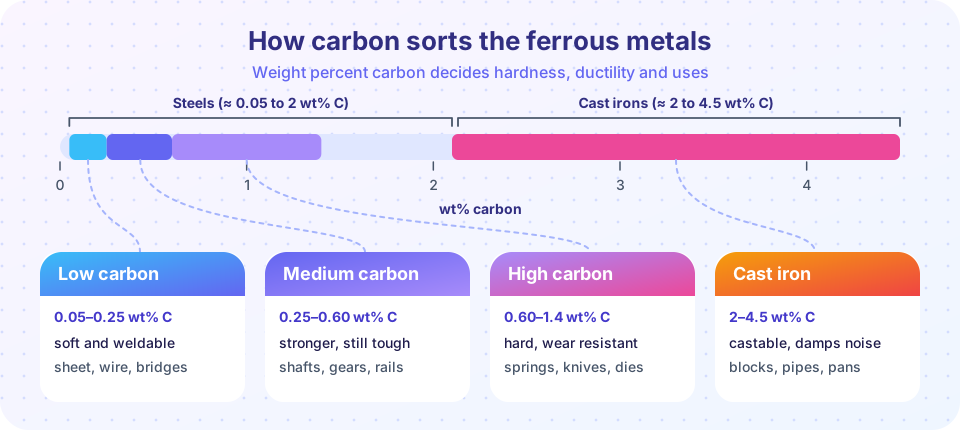
Plain carbon steels contain iron, carbon and small amounts of manganese. Low-carbon grades (below about 0.25 wt% C) are soft, formable and weldable: car body sheet, wire, structural sections. Medium-carbon steels (0.25 to 0.6 wt% C) respond well to quench and temper and are used for shafts and gears. High-carbon steels (above 0.6 wt% C) are hard and wear resistant for springs, blades and rails.
Alloy steels add chromium, nickel, molybdenum, vanadium and others. Their main job is to improve hardenability (martensite to greater depth) and to keep strength at temperature. High-strength low-alloy (HSLA) steels use tiny additions of niobium or vanadium plus controlled rolling for a fine grain, getting more strength than plain steel at low carbon, so they stay weldable.
Stainless steels need at least about 10.5 wt% chromium. The chromium forms an invisible, self-healing oxide layer that resists corrosion. Ferritic grades are chromium-only and magnetic. Austenitic grades, such as type 304 (roughly 18% Cr, 8% Ni), keep the FCC structure at room temperature because of the nickel, so they are tough, non-magnetic and formable. Martensitic grades can be hardened by heat treatment for cutlery and valves.
Tool steels contain carbide-forming elements (tungsten, molybdenum, vanadium, chromium) so that hard carbides survive tempering; they cut and form other metals.
Cast irons
Cast irons contain about 2 to 4 wt% carbon plus silicon. They melt at lower temperatures than steel (see the eutectic at 4.30 wt% C) and flow well into molds, so they are cheap to cast. What matters is where the carbon ends up:
- Gray iron: carbon forms graphite flakes. The flakes are crack starters, so it is weak and brittle in tension, but strong in compression and excellent at damping vibration. Engine blocks, machine bases, brake discs.
- Ductile (nodular) iron: a small magnesium addition makes graphite grow as round nodules. Cracks are blunted, giving much better strength and ductility. Crankshafts, gears, water pipes.
- White iron: rapid cooling gives iron carbide rather than graphite. Extremely hard and brittle; wear parts, and the starting point for malleable iron.
- Malleable iron: white iron annealed for a long time so cementite breaks down into compact graphite clusters, giving moderate ductility.
Non-ferrous alloys
Aluminum is FCC, light (2.70 g/cm³), corrosion resistant and easy to extrude and roll. Pure aluminum is weak, so the strong grades are alloys: 2xxx (copper), 6xxx (magnesium and silicon, such as 6061) and 7xxx (zinc and magnesium, used for aircraft structure). The heat-treatable grades gain their strength from precipitation hardening.
Copper alloys combine electrical and thermal conductivity with corrosion resistance. Brass is Cu–Zn (plumbing fittings, musical instruments); bronze is mainly Cu–Sn (bearings, bells, marine hardware).
Titanium (4.51 g/cm³) pairs high strength with excellent corrosion resistance and biocompatibility. Ti-6Al-4V is the standard alloy for aircraft parts and implants but is expensive to extract and machine.
Magnesium (1.74 g/cm³) is the lightest structural metal, used in castings where weight matters. Nickel alloys and superalloys keep their strength at temperatures where steel softens, as in jet turbine blades, thanks to ordered Ni₃Al-type precipitates.
Precipitation hardening
Take an Al–Cu alloy with a few percent copper. The Al–Cu phase diagram shows that copper dissolves in aluminum at high temperature but is much less soluble at room temperature. The treatment exploits that:
- Solution treat: heat into the single-phase region so all the copper dissolves.
- Quench: cool rapidly to trap the copper in a supersaturated solid solution.
- Age: hold at room temperature or a moderate temperature (often 120 to 200 °C). Copper-rich clusters and then fine precipitates form, evenly spread through every grain.
The precipitates are small and numerous, spaced tens of nanometers apart. Dislocations must cut through them or bend around them, so the alloy is far stronger than either the solution or the equilibrium coarse mixture. Age too long ("overaging") and the particles coarsen and strength drops. The "T6" in 6061-T6 names a solution-treated and artificially aged temper.
Strength per kilogram
For a part that must carry load with minimal mass, compare specific strength. A lightweight alloy can beat a stronger but denser one. Use the next TryIt to compare approximate typical values.
Common misconceptions
"Stainless steel never rusts." The oxide film can break down in chlorides or crevices; stainless resists, it is not immune.
"Cast iron and steel are the same thing." The graphite in cast iron makes it behave very differently, usually brittle in tension unless the graphite is nodular.
"Aluminum is weak." Pure aluminum is soft, but aged aluminum alloys can match mild steel in strength at a third of the weight.
Try it
Press Run (or Ctrl + Enter) to see the result here.
Program input · what you'd type while the program runs
Type the answers before you press Run, one per line. Each time the program reads a line (with input()), it gets the next line from this box.
Press Run (or Ctrl + Enter) to see the result here.
Program input · what you'd type while the program runs
Type the answers before you press Run, one per line. Each time the program reads a line (with input()), it gets the next line from this box.
Check your understanding
Quick check · 5 questions
of 5 answered You scored / 5 · perfect!
-
1. What is the minimum chromium content that makes a steel 'stainless'?
At roughly 10.5 wt% Cr enough chromium forms a continuous protective oxide film. -
2. Which cast iron has round graphite nodules and good ductility?
A small magnesium addition makes graphite grow as nodules, which blunt cracks. -
3. What is the correct order of precipitation hardening?
Dissolve the solute, trap it by quenching, then let fine precipitates form during aging. -
4. Why is gray iron good for machine bases?
Flake graphite damps vibration; the material is cheap to cast and strong under compression. -
5. Which has the highest specific strength among these: Al 6061-T6 (276 MPa, 2.70), mild steel (350 MPa, 7.87), copper (70 MPa, 8.96)?
276/2.70 ≈ 102 versus 350/7.87 ≈ 44 and 70/8.96 ≈ 8 kN·m/kg.
Summary
- Plain carbon steels are sorted by carbon; alloy, HSLA, stainless and tool steels add elements for hardenability, corrosion resistance and wear.
- Cast irons differ in graphite shape: flakes (gray), nodules (ductile), none (white).
- Aluminum, copper, titanium, magnesium and nickel alloys fill the weight, conductivity and temperature niches.
- Precipitation hardening: solution treat, quench, age; overaging softens.
- Compare materials by specific strength when mass matters.
Track your progress
Create a free account to tick off lessons and pick up where you left off on any device.
of Materials Science lessons completed