


















Lesson 14 of 46 · Crystal Structures and Defects
Theoretical Density and X-ray Diffraction
Calculate the theoretical density of a crystal from its unit cell, apply Bragg's law to find plane spacing, and index X-ray powder diffraction peaks for FCC and BCC.
You now know how atoms are arranged. Two questions follow. If I know the arrangement, can I predict a measurable property such as density? And if I only have a sample, how do I find the arrangement? The first question is answered by counting the atoms in a unit cell. The second is answered by X-ray diffraction, the technique that revealed the structure of crystals in 1912 and remains the main tool for identifying crystalline phases. Both rest on the same idea: a crystal is a repeating box, and the box tells you everything.
What you will learn
- How to compute theoretical density from the unit cell, and why measured values differ.
- Why a wave of the right wavelength diffracts from a crystal, and Bragg's law.
- How to compute the diffraction angle for a given plane and wavelength.
- How to identify BCC and FCC from the pattern of peaks.
Key terms
Theoretical density: the density of a perfect crystal, ρ = n A / (V_c N_A).
Diffraction: constructive and destructive interference of waves scattered by a regular array of objects.
Bragg angle θ: the angle between the incoming beam and the reflecting planes; the detector sits at 2θ from the beam direction.
Selection rules: restrictions on which (hkl) reflections appear, imposed by the lattice centering.
Theoretical density
A unit cell holds n atoms (or formula units) of molar mass A (g/mol) in a volume V_c. The mass in the cell is n A / N_A grams, so
ρ = n A / (V_c N_A).
Worked example: copper. FCC, so n = 4. The lattice parameter is a = 0.3615 nm = 3.615 × 10⁻⁸ cm, so V_c = a³ = 4.724 × 10⁻²³ cm³. The molar mass is 63.55 g/mol. Then
ρ = 4 × 63.55 / (4.724 × 10⁻²³ × 6.022 × 10²³) = 8.94 g/cm³,
matching the measured 8.96. For hexagonal crystals the volume is V_c = (3√3/2) a² c. For compounds, A becomes the mass of one formula unit, and n counts formula units: NaCl has 4 per cell. The calculated value is slightly higher than the measured one for real samples, because real crystals have vacancies, porosity and impurities. When a ceramic part has a measured density of 95 % of theoretical, the missing 5 % is pore volume.
Press Run (or Ctrl + Enter) to see the result here.
Program input · what you'd type while the program runs
Type the answers before you press Run, one per line. Each time the program reads a line (with input()), it gets the next line from this box.
Why crystals diffract X-rays
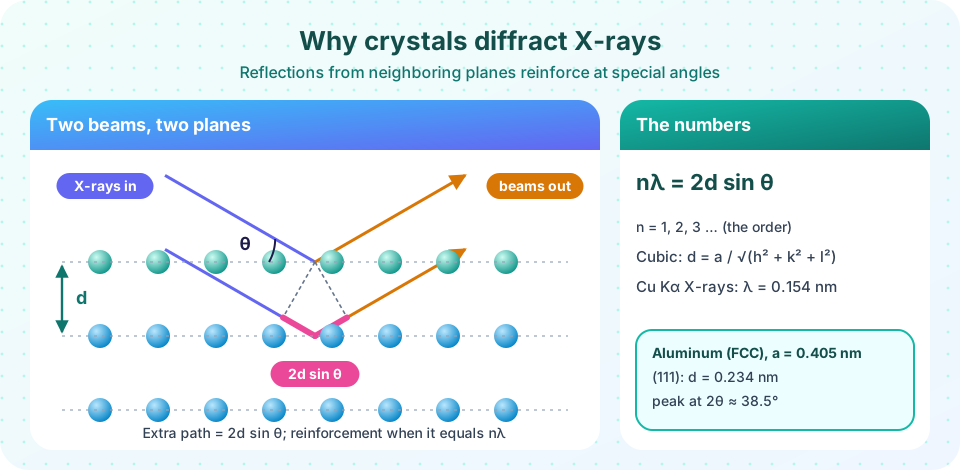
X-rays are electromagnetic waves with wavelengths around 0.1 nm, which is comparable to the spacing of atoms. When an X-ray beam hits a crystal, every atom scatters a little of it in all directions. Because the atoms form a regular array, the scattered waves usually cancel each other. In a few special directions they all line up in phase and add up to a strong beam. W. H. Bragg and W. L. Bragg worked out the condition in 1913 by treating the scattering as reflection from parallel planes of atoms.
Consider two adjacent planes a distance d apart and a beam striking them at glancing angle θ. The beam reflected from the lower plane travels farther than the one reflected from the upper plane by 2d sin θ. The two reflected waves reinforce when this extra path is a whole number of wavelengths:
n λ = 2 d sin θ, with n = 1, 2, 3, …
This is Bragg's law. For cubic crystals, combine it with d = a / √(h² + k² + l²) to get the position of each peak. The law also shows why visible light cannot work: with λ = 500 nm and d = 0.2 nm the equation has no solution, because sin θ would exceed 1. You need λ ≤ 2d. Neutrons and electrons with similar wavelengths diffract in the same way.
Worked example: aluminum, FCC with a = 0.405 nm, with Cu Kα X-rays (λ = 0.15406 nm). For the (111) planes d = 0.405/√3 = 0.2338 nm. Then sin θ = 0.15406/(2 × 0.2338) = 0.3295, so θ = 19.24° and 2θ = 38.5°, which is where a diffractometer shows aluminum's first peak.
Powder diffraction and selection rules
In a powder diffractometer the sample is a fine powder or a polycrystal, so some grain is always oriented correctly for each family of planes. The detector sweeps through 2θ and records the intensity. Peaks appear at the Bragg angles of all allowed (hkl).
Not every (hkl) gives a peak. In a lattice with centering, waves reflected from the extra atoms cancel some reflections. The rules for cubic lattices are simple:
| Lattice | Allowed reflections | First reflections |
|---|---|---|
| Simple cubic | all (hkl) |
100, 110, 111, 200, 210… |
| BCC | h + k + l even |
110, 200, 211, 220, 310… |
| FCC | h, k, l all odd or all even |
111, 200, 220, 311, 222… |
Because d depends on N = h² + k² + l², and sin²θ is proportional to N, the ratios sin²θ / sin²θ₁ reveal the structure. For FCC they follow N = 3, 4, 8, 11, 12, which gives ratios of 1, 1.33, 2.67, 3.67, 4. For BCC, N = 2, 4, 6, 8, 10, so the ratios are 1, 2, 3, 4, 5. A pattern whose first two peaks differ by a factor of 1.33 in sin²θ is FCC; if they differ by 2 it is BCC. Once the structure is known, the angles give a.
Press Run (or Ctrl + Enter) to see the result here.
Program input · what you'd type while the program runs
Type the answers before you press Run, one per line. Each time the program reads a line (with input()), it gets the next line from this box.
The heights in this plot are schematic: they combine the number of equivalent planes with the standard Lorentz and polarization factors but leave out the atomic scattering factor, so real patterns will differ in detail. The positions, which depend only on the lattice parameter and structure, are accurate.
What diffraction tells you
A diffraction pattern is a fingerprint. Databases hold the patterns of tens of thousands of crystalline substances, so measured peaks can be matched to identify phases in a steel, a mineral or a drug tablet. The peak positions give the lattice parameter to better than 0.01 %, which reveals alloying (a dissolved larger atom expands the cell) and stress (strained planes shift the peaks). Broad peaks indicate tiny crystallites or strain, and the Scherrer equation estimates crystallite size from the width. An amorphous sample such as glass gives only a broad hump.
Common misconceptions
"X-rays bounce off the surface like light off a mirror." The Bragg picture treats scattering as reflection from planes inside the crystal; at most angles the waves cancel, and only at the Bragg angles do they add.
"The detector angle is θ." The detector sits at 2θ from the incident beam direction; θ is the angle to the planes.
"A missing peak means a missing plane." Selection rules remove peaks because of destructive interference within the cell, not because the planes do not exist.
Check your understanding
Quick check · 5 questions
of 5 answered You scored / 5 · perfect!
-
1. What is the theoretical density formula for a crystal?
Mass of the cell is n A / N_A; divide by its volume. -
2. Bragg's law is
The extra path for the lower plane is 2d sin θ. -
3. Which reflections appear for a BCC lattice?
BCC centering cancels reflections with an odd sum. -
4. First peaks with sin²θ ratios 1 : 1.33 : 2.67 : 3.67 indicate
These ratios follow N = 3, 4, 8, 11 for FCC. -
5. Why can visible light not be used to determine crystal structure by diffraction?
Bragg's law requires λ ≤ 2d, so wavelengths near 0.1 nm are needed.
Summary
ρ = nA/(V_c N_A)predicts density; real samples are slightly less dense because of defects and pores.- Bragg's law
nλ = 2d sinθlinks wavelength, plane spacing and diffraction angle; the detector sits at2θ. - Selection rules give BCC (
h + k + leven) and FCC (all odd or all even) distinct peak sequences. - The ratios of
sin²θidentify the structure; the positions give the lattice parameter. - Diffraction identifies phases, measures lattice parameter, strain and crystallite size.
Next: Crystal Defects
Track your progress
Create a free account to tick off lessons and pick up where you left off on any device.
of Materials Science lessons completed