


















Lesson 7 of 46 · Atomic Structure and Bonding
Atoms and Periodic Trends
Review atomic structure, electron configurations and valence electrons, then use ionization energy and electronegativity trends to predict how elements bond.
An atom is mostly empty space with a tiny, dense nucleus of protons and neutrons and a cloud of electrons around it. For materials, only the outermost electrons matter. They are the ones that are lent, borrowed or shared when atoms bond, and their number and energy follow clear patterns across the periodic table. If you can read those patterns you can predict, before looking anything up, that sodium and chlorine will form a salt, that carbon and silicon will make strong networks, and that copper will conduct.
What you will learn
- The structure of an atom, isotopes, and atomic mass in g/mol.
- How electrons fill shells and subshells, and how to write a configuration.
- What valence electrons are and why they control bonding.
- How ionization energy, atomic size and electronegativity change across the periodic table.
Key terms
Atomic number (Z): the number of protons, which defines the element.
Isotopes: atoms of the same element with different numbers of neutrons.
Ionization energy: the energy needed to remove the outermost electron from a neutral atom (in eV or kJ/mol).
Electronegativity: a number (Pauling scale) describing how strongly an atom attracts bonding electrons.
Inside the atom
A proton carries charge +e with e = 1.602 × 10⁻¹⁹ C; an electron carries −e; a neutron is neutral. A proton or neutron has a mass of about 1 u (1.661 × 10⁻²⁷ kg), and an electron only 1/1836 of that, so nearly all the mass sits in the nucleus. The number of protons, Z, defines the element: Z = 6 is carbon whatever else is true. The mass number A is protons plus neutrons. Carbon-12 and carbon-14 are isotopes: both have Z = 6, with 6 and 8 neutrons. The atomic mass you find on the periodic table (12.011 g/mol for carbon) is the average over the natural isotopes.
In the quantum picture electrons are not little planets but standing waves described by four quantum numbers. Principal quantum number n = 1, 2, 3, … sets the shell and the rough energy and size. The orbital quantum number l = 0, 1, 2, … (labeled s, p, d, f) sets the shape of the subshell. Two more numbers specify the orientation and the spin. The Pauli exclusion principle says no two electrons in an atom may share all four numbers, which limits an s subshell to 2 electrons, a p subshell to 6, a d subshell to 10 and an f subshell to 14.
Filling the shells
Electrons occupy the lowest available energy first. For most elements the filling order is
1s, 2s, 2p, 3s, 3p, 4s, 3d, 4p, 5s, 4d, 5p, …
(a memory aid: subshells fill in order of increasing n + l, and for equal n + l, lower n first). Hund's rule says electrons spread over equal-energy orbitals with parallel spins before they pair up. So sodium (Z = 11) is 1s² 2s² 2p⁶ 3s¹, abbreviated [Ne] 3s¹, and chlorine (Z = 17) is [Ne] 3s² 3p⁵. Iron (Z = 26) is [Ar] 3d⁶ 4s². Two well-known exceptions in the transition metals are chromium, [Ar] 3d⁵ 4s¹, and copper, [Ar] 3d¹⁰ 4s¹, where half-filled and filled d subshells are slightly favored.
Valence electrons are those in the outermost shell (and, for transition metals, also the unfilled d electrons). Sodium has one, magnesium two, aluminum three, silicon four, phosphorus five, sulfur six, chlorine seven. A full outer shell (two for helium, eight for neon and argon) is very stable, which is why noble gases hardly bond.
Press Run (or Ctrl + Enter) to see the result here.
Program input · what you'd type while the program runs
Type the answers before you press Run, one per line. Each time the program reads a line (with input()), it gets the next line from this box.
Periodic trends
The periodic table is organized so that elements in a column (group) have the same number of valence electrons and similar chemistry. Three trends matter most for materials.
Atomic size. Going down a group, atoms get larger because new shells are added. Going across a period, atoms get smaller because the nuclear charge grows while electrons are added to the same shell, pulling the cloud inward.
Ionization energy. Removing an outer electron takes less energy when it is far from the nucleus and shielded, so ionization energy decreases down a group and rises across a period. For sodium it is 5.14 eV and for chlorine 12.97 eV. The small dips (for example at oxygen) come from electron pairing.
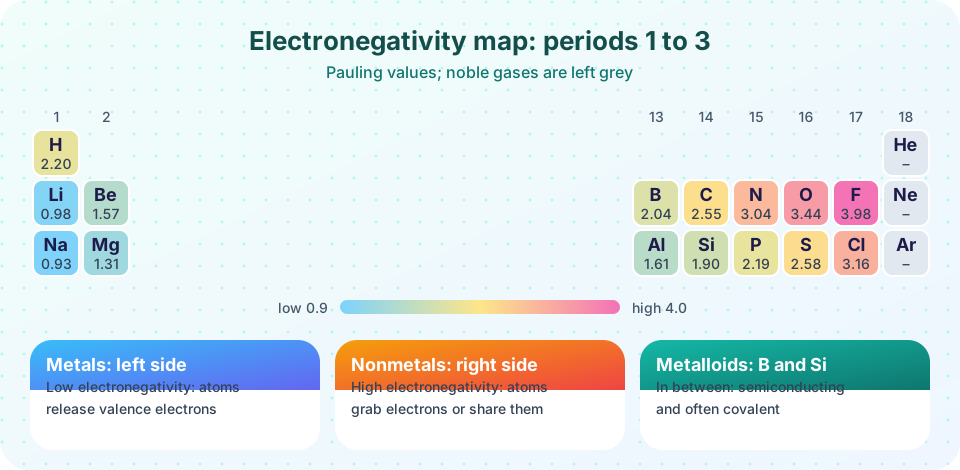
Electronegativity follows the same direction: it is lowest at the lower left (cesium 0.79) and highest at the upper right (fluorine 3.98). Linus Pauling defined the scale from bond energies. Metals, whose atoms hold their valence electrons loosely, have values below about 2. Nonmetals have values above about 2. This difference decides the type of bond: a large difference between two atoms leads to electron transfer (ionic), a small difference to sharing (covalent), and two low-electronegativity atoms to pooling (metallic).
Press Run (or Ctrl + Enter) to see the result here.
Program input · what you'd type while the program runs
Type the answers before you press Run, one per line. Each time the program reads a line (with input()), it gets the next line from this box.
Why materials scientists care
The patterns have consequences that you can already predict. Elements on the left with one or two valence electrons and low electronegativity (Na, Mg, Al) form metals. Elements on the right (O, Cl) pull electrons strongly, so metals and nonmetals form ionic ceramics such as MgO and NaCl. Carbon and silicon sit in the middle with four valence electrons, so they share electrons in strong directional bonds (diamond, silicon, silicon carbide, and the long chains of polymers). Transition metals such as iron and tungsten have partly filled d subshells that add to the pooled electrons, which helps explain their high melting points and strength.
Common misconceptions
"Electrons orbit the nucleus like planets." The planetary picture is a useful cartoon. Electrons are described by probability distributions (orbitals), and their energies are quantized.
"Ionization energy and electronegativity are the same thing." They are related but not identical: one is the energy to remove an electron from a free atom, the other is a measure of attraction in a bond.
"Atoms get bigger across a period because they have more electrons." They get smaller, because the nuclear charge grows faster than the screening by electrons in the same shell.
Check your understanding
Quick check · 5 questions
of 5 answered You scored / 5 · perfect!
-
1. How many valence electrons does silicon (Z = 14) have?
The configuration is [Ne] 3s² 3p², so four electrons are in the outer shell. -
2. What is the electron configuration of sodium?
Sodium has Z = 11: 1s² 2s² 2p⁶ 3s¹, which is [Ne] 3s¹. -
3. Across a period from left to right, electronegativity generally
Increasing nuclear charge with the same shell pulls bonding electrons more strongly. -
4. Which element has the highest electronegativity?
Fluorine, 3.98 on the Pauling scale, is the highest. -
5. Isotopes of an element differ in
Isotopes have the same Z but different numbers of neutrons.
Summary
- Z defines the element; isotopes differ in neutron number; atomic mass is an isotope average in g/mol.
- Electrons fill 1s, 2s, 2p, 3s, 3p, 4s, 3d, 4p…, with at most 2, 6, 10 and 14 in s, p, d and f subshells.
- Valence electrons control bonding; full outer shells are stable.
- Atomic size falls across a period and rises down a group; ionization energy and electronegativity do the opposite.
- Metals have low, nonmetals high electronegativity, and the difference predicts the bond type.
Next: Primary Bonds
Track your progress
Create a free account to tick off lessons and pick up where you left off on any device.
of Materials Science lessons completed