


















Lesson 42 of 46 · Projects and Practice
Failure case studies: fracture, fatigue and cold
Learn from famous engineering failures: brittle fracture of Liberty ships, fatigue cracks in the Comet, the cold O-rings of Challenger, with Paris-law and transition-temperature calculations.
Materials science is learned from successes and from broken parts. Every famous failure turned an abstract concept (a ductile-to-brittle transition, fatigue, a polymer's glass transition) into something with a human cost, and every one changed the way engineers design, test and inspect.
This lesson revisits four well-known cases, links each to the concepts of this course, and lets you run the two calculations that failure analysts use most: the critical crack size from fracture toughness and the fatigue life from the Paris law. The case descriptions are summaries of widely reported investigations; where the cause is still debated, we say so.
What you will learn
- Link each case study to a materials mechanism.
- Describe the ductile-to-brittle transition and why BCC steels have one.
- Explain the three regions of fatigue crack growth and the Paris law.
- Compute a critical crack size and a fatigue life.
Key terms
Ductile-to-brittle transition temperature (DBTT): the temperature below which a material (typically BCC steel) fractures with little absorbed energy.
Fatigue: progressive crack growth under repeated loading, even far below the yield stress.
Paris law: da/dN = C (ΔK)^m, the crack growth per cycle.
Critical crack size (a_c): the crack length at which fast fracture occurs, a_c = (1/π)(K_Ic / (Y σ))².
Case 1: Liberty ships (1940s) and brittle fracture
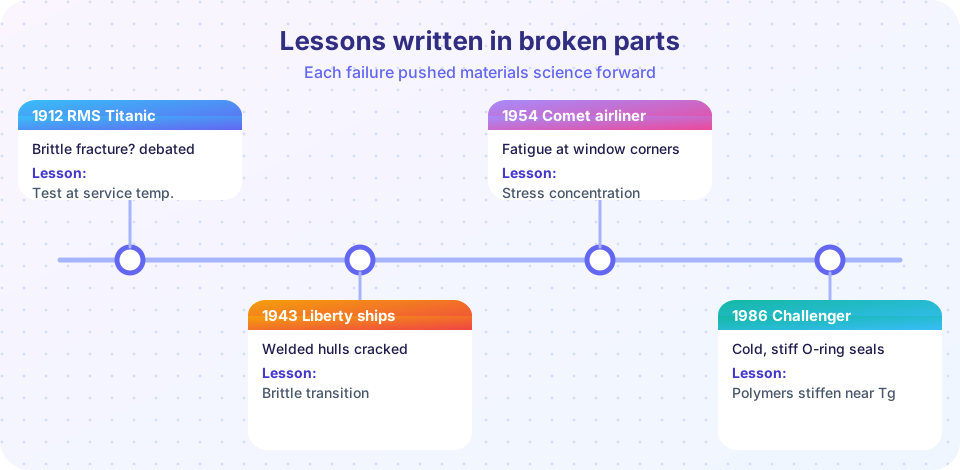
During the Second World War, the United States built thousands of welded cargo ships called Liberty ships, at unprecedented speed. A number of them suffered sudden brittle fractures, and some, such as the SS Schenectady in January 1943 while moored in harbor, broke in two. Investigations pointed to a combination: steel of low notch toughness at the cold water temperature, sharp stress concentrations at hatch corners and weld defects, and residual stress from welding. The lessons: specify and test toughness (the Charpy impact test) at the lowest service temperature, round off sharp corners, and design welds and crack arrestors carefully.
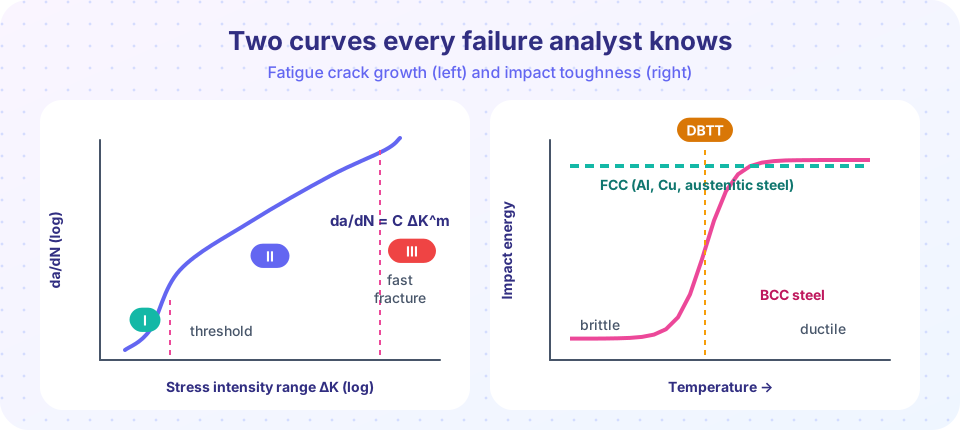
The underlying mechanism is the ductile-to-brittle transition of body-centered cubic metals. Their yield stress rises steeply as temperature falls, until it exceeds the stress needed to cleave the crystal; the fracture mode switches from tearing with plenty of plastic deformation to cleavage with very little. FCC metals (aluminum, copper, austenitic stainless steel) do not show this transition.
Case 2: Comet (1954) and fatigue
Two early de Havilland Comet jet airliners broke up in flight in 1954. Investigators, who recovered wreckage from the sea and fatigue-tested an entire fuselage in a water tank, traced the failures to fatigue cracks starting at the corners of the square-cornered windows. Pressurization cycles on each flight repeatedly stressed those corners, where the stress is concentrated several times above the average. Modern airliners have rounded windows, and design philosophy now assumes cracks will exist and uses inspection intervals and damage tolerance.
Fatigue crack growth has three regions on a log-log plot of growth rate against stress-intensity range ΔK. Below a threshold the crack does not grow. In the middle region the data fall on a straight line, the Paris law da/dN = C ΔK^m, with m typically 2 to 4 for metals. Near the fracture toughness the growth accelerates to fast failure.
Case 3: Challenger (1986) and a polymer in the cold
The Space Shuttle Challenger was lost shortly after launch on a morning when the temperature was far below that of any previous launch. The investigation concluded that rubber O-ring seals in a joint of a solid rocket booster had lost resilience in the cold and failed to seal the joint, allowing hot gas to escape. The materials lesson is the glass transition: an elastomer is rubbery only above its Tg, and as temperature falls toward it the seal stiffens and responds more slowly to the joint movement. Material properties must be known across the whole operating range, not only at the standard test temperature.
Case 4: Titanic (1912), a case that remains debated
Analyses of steel recovered from the Titanic wreck have led some investigators to suggest brittle behavior of the steel at the icy water temperature and the role of rivet quality in how the hull plates separated. Others stress the role of the collision itself and the limits of conclusions drawn from small recovered samples. It is a good reminder that engineering forensic work can be uncertain, and that reading materials evidence takes careful, repeated testing.
Two calculations
Critical crack size. A steel plate with K_Ic = 50 MPa·√m carries a tensile stress of 100 MPa. With Y = 1.12 (an edge crack), a_c = (1/π) (50 / (1.12 × 100))² ≈ 0.063 m = 63 mm. Any crack shorter than this survives this load, but fatigue will grow it.
Fatigue life. Integrating the Paris law from an initial crack a₀ to a_c gives, for m = 3, N = 2 / [(m−2) C (Y Δσ √π)^m] × (a₀^(−1/2) − a_c^(−1/2)). Run it in the TryIt below with illustrative constants.
Common misconceptions
"Fatigue failure needs a stress above the yield strength." Fatigue cracks grow at stresses far below yield, because the stress at the crack tip is much higher than the nominal value.
"A failed part must have been made of bad material." Often the material met its specification; the design, the temperature or the loading history was the problem.
"All steels have a ductile-brittle transition." Austenitic (FCC) stainless steels do not; BCC and some HCP metals do.
Try it
Press Run (or Ctrl + Enter) to see the result here.
Program input · what you'd type while the program runs
Type the answers before you press Run, one per line. Each time the program reads a line (with input()), it gets the next line from this box.
Press Run (or Ctrl + Enter) to see the result here.
Program input · what you'd type while the program runs
Type the answers before you press Run, one per line. Each time the program reads a line (with input()), it gets the next line from this box.
Check your understanding
Quick check · 5 questions
of 5 answered You scored / 5 · perfect!
-
1. What mechanism explains the sudden brittle fracture of some Liberty ships in cold water?
At low temperature the steel's notch toughness was low, and weld defects and sharp corners raised local stresses. -
2. Where did the fatigue cracks that downed Comet airliners start?
Square window corners concentrated the pressurization stress. -
3. Which law describes the stable region of fatigue crack growth?
da/dN = C ΔK^m. -
4. The Challenger investigation concluded that cold affected what?
As temperature approaches Tg, an elastomer stiffens and seals less well. -
5. Which metals do NOT show a ductile-to-brittle transition?
FCC metals keep high ductility and toughness at low temperature.
Summary
- Failures show mechanisms at work: brittle fracture (DBTT), fatigue (Paris law), polymer stiffening near Tg.
- Critical crack size:
a_c = (1/π)(K_Ic/(Yσ))²; fatigue life by integratingda/dN = C ΔK^m. - Design answers: test at service temperature, avoid sharp corners, inspect for cracks, assume damage exists.
Next: Practice problem set
Track your progress
Create a free account to tick off lessons and pick up where you left off on any device.
of Materials Science lessons completed