


















Lesson 1 of 46 · Getting Started
Course Map: Welcome to Materials Science
Who this materials science course is for, what you need to know first, how to study it, and a map of all nine chapters from atoms to engineered products.
Every object you use was a choice between materials. The frame of your bicycle could be steel, aluminum, titanium or carbon fiber. The screen of your phone is glass, the chip behind it is silicon, and the case around it is a polymer or a metal alloy. Materials science is the study of why those substances behave the way they do, and how to pick, shape and improve them. This course takes you from the atom up to the finished part, using the same ideas that engineers use at work.
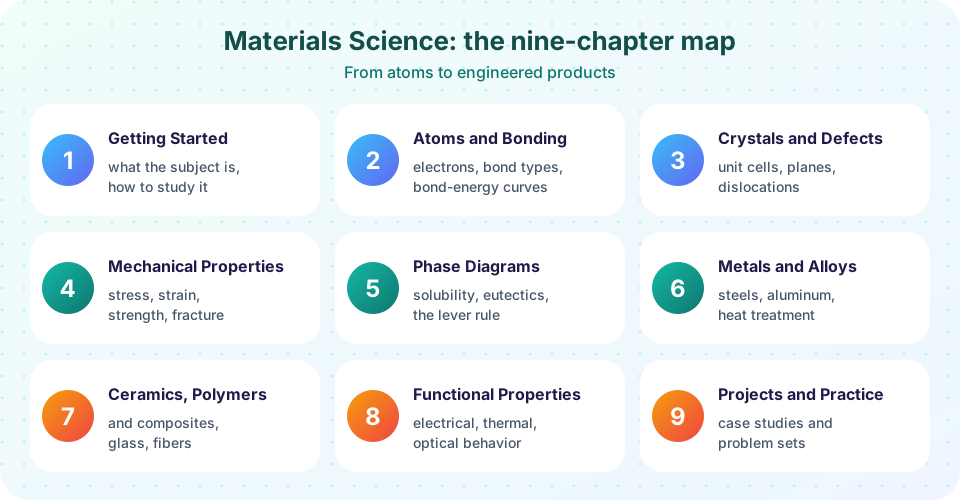
What you will learn
- What materials science is and why structure controls properties.
- How atoms bond, how they stack into crystals and what defects do.
- How to read and use a stress-strain curve, and how materials fail.
- How alloys, ceramics, polymers and composites are built and chosen.
- How to do the calculations with real numbers and small programs.
Key terms
Material: a substance chosen to make a part, such as steel, glass or nylon.
Microstructure: the arrangement of grains, phases and defects seen under a microscope.
Property: a measurable response of a material, for example density, stiffness or conductivity.
Processing: everything done to a material to shape it or change its structure, such as casting, rolling or heat treatment.
Who this course is for
The course suits learners of about sixteen and up: upper-secondary students who like physics and chemistry, first-year engineering students, and adults who want a clear foundation. It follows the common core of university introductions to the subject, uses SI units throughout, and mentions US customary units only where industry still uses them.
You should be comfortable with algebra and with the idea of a graph. Basic chemistry helps (atoms, ions, the periodic table), but the course reviews it. You do not need calculus; where a formula comes from calculus we state it and use it. Programming is optional, but every lesson has small runnable examples that let you test ideas, and you can change the numbers and run them again.
How to study each lesson
Every content lesson follows the same pattern so you always know where you are. It opens with What you will learn and Key terms, then explains the idea with a picture and a worked example. A Common misconceptions box names the mistakes people usually make. The Try it section lets you experiment, and a short quiz checks your understanding. Chapters open with an overview and end with a review.
- Read the outcomes first, then read the lesson with the picture beside you.
- Work every example by hand before you run the code that checks it.
- Change one number at a time in the experiments and predict the result before you press run.
- Take the quiz without looking back, then read the explanations, especially for questions you got right by guessing.
The nine chapters
Foundations
- Getting started
- Atoms and bonding
- Crystals and defects
Structure comes first.
Behavior
- Mechanical properties
- Phase diagrams
- Metals and alloys
Properties follow structure.
Applications
- Ceramics, polymers, composites
- Functional properties
- Projects and practice
Design with what you know.
Chapters 1 to 4 are written to be read in order. Chapters 5 to 9 build on them: phase diagrams use the idea of structure from chapter 3, and the chapters on metals, ceramics and polymers use the mechanical vocabulary of chapter 4. Start with what materials science is.
A first look at the data
Properties are numbers, and the numbers differ by factors of a thousand or more between materials. The program below plots stiffness (Young's modulus) against density for several materials on logarithmic axes. These are typical round values for common grades, not exact data for a particular product. We will make sense of every point in the coming chapters.
Press Run (or Ctrl + Enter) to see the result here.
Program input · what you'd type while the program runs
Type the answers before you press Run, one per line. Each time the program reads a line (with input()), it gets the next line from this box.
The second experiment is a study planner. Enter how many hours a week you can give and it prints a schedule for the first four chapters.
Press Run (or Ctrl + Enter) to see the console output here.
No output.
Common misconceptions
"Materials science is just chemistry." Chemistry matters, but so do physics (bonding, defects), mechanics (stress and strain) and manufacturing. The unique idea of the field is the link between structure at many scales and performance.
"I need to memorize hundreds of property values." You need a feel for orders of magnitude (is a polymer's modulus nearer to 1 GPa or 100 GPa?) and the skill to look up the rest.
"Newer materials always replace older ones." Steel is more than a thousand times older than carbon fiber, and it is still the most used structural metal, because cost and recyclability matter as much as strength.
Check your understanding
Quick check · 4 questions
of 4 answered You scored / 4 · perfect!
-
1. Which description fits materials science best?
The central idea is that processing sets structure, structure sets properties, and properties decide performance. -
2. Which background is needed before starting this course?
Algebra, graphs and basic atoms are enough. Programming is optional and calculus is not required. -
3. In the stiffness-density plot, why are the axes logarithmic?
Modulus runs from about 0.01 GPa for rubber to hundreds of GPa for ceramics, so a linear axis would squash most points together. -
4. Which chapter introduces how atoms bond?
Chapter 2 covers atomic structure and bonding.
Summary
- Materials science links processing, structure, properties and performance.
- The course has nine chapters, from foundations to applications, with a review at the end of each chapter.
- Every lesson has outcomes, key terms, a picture, a worked idea, experiments and a quiz.
- Property values span many orders of magnitude, so a feel for scale is more useful than memorized tables.
Track your progress
Create a free account to tick off lessons and pick up where you left off on any device.
of Materials Science lessons completed