


















Lesson 32 of 46 · Ceramics, Polymers and Composites
Ceramic structure and strength
How ionic crystals choose their structure with radius ratios, why tiny flaws make ceramics brittle, and how Griffith fracture and Weibull statistics guide ceramic design.
Ceramics are the oldest engineered materials, from clay pots to modern turbine coatings, dental crowns and the glass in your windows. They resist heat, wear and chemical attack better than almost anything else. Yet they also shatter. Understanding both facts takes two ideas: how their atoms pack, and how flaws control their strength.
In this lesson you will learn the structure rules for ionic ceramics, then meet the fracture mechanics that explain why a ceramic is far weaker than its bonds suggest, and why designers describe ceramic strength with probability.
What you will learn
- Predict a cation's coordination number from the radius ratio.
- Describe common ceramic structures and silica glass.
- Explain stress concentration, fracture toughness and the Griffith criterion.
- Use Weibull statistics to describe ceramic strength scatter.
- Name ways to toughen ceramics.
Key terms
Coordination number (CN): the number of nearest neighbors of opposite charge around an ion.
Radius ratio: r_cation / R_anion.
Fracture toughness (K_Ic): a measure of a material's resistance to crack growth, in MPa·√m.
Weibull modulus (m): a number describing how widely strength varies; larger m means more consistent.
Sintering: consolidating powder into a dense solid by heating below the melting point.
How ionic ceramics pack
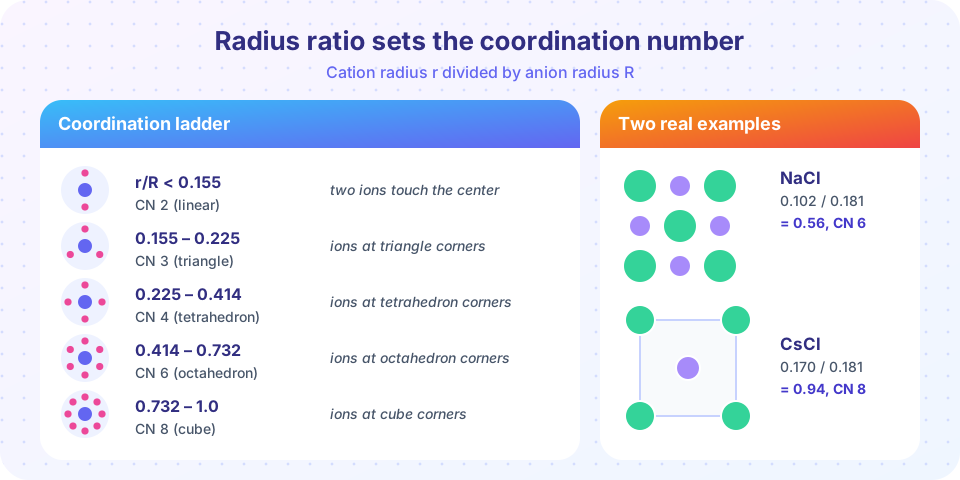
In an ionic crystal, positive and negative ions want as many opposite-charge neighbors as possible, but they cannot overlap and like charges must not touch. A small cation surrounded by big anions can have only so many anion neighbors before the anions touch each other. The geometric limits give the radius-ratio rule: below 0.155 the coordination number is 2, up to 0.225 it is 3, up to 0.414 it is 4, up to 0.732 it is 6 and up to 1.0 it is 8.
- NaCl (rock salt): Na⁺ (about 0.102 nm) and Cl⁻ (0.181 nm) give a ratio of 0.56, so CN = 6. MgO and many oxides use this structure.
- CsCl: Cs⁺ is much larger (about 0.170 nm), giving 0.94 and CN = 8.
- SiO₂: Si⁴⁺ (about 0.040 nm) with O²⁻ (0.140 nm) gives about 0.29, so CN = 4: every silicon sits at the center of an oxygen tetrahedron. These SiO₄ tetrahedra link at the corners into networks. Linked in an ordered array they form quartz; linked randomly they form silica glass, a non-crystalline solid.
The radius-ratio rule is a first guide, not a law: real ions are not hard spheres, and covalent character changes the picture. Charge balance also matters. In Al₂O₃ (alumina) aluminum ions fill two-thirds of the octahedral sites so the charges cancel.
Strong bonds, weak parts
The bonds in a ceramic are strong, so you might expect enormous strength. The theoretical strength is roughly E/10, around 40 GPa for alumina. Real alumina breaks at a few hundred megapascals, about a hundred times lower. The culprit is flaws: pores, scratches, grain-boundary cracks and inclusions left from processing or handling.
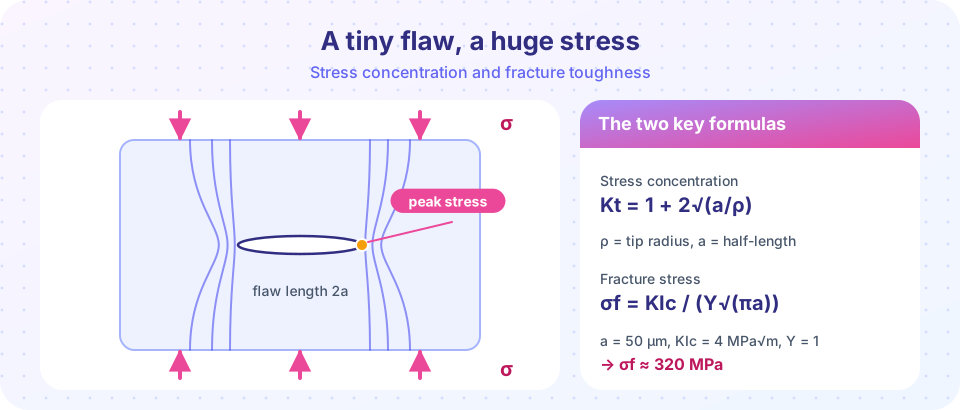
A flaw concentrates stress. For an elliptical crack of half-length a and tip radius ρ, the stress at the tip is raised by Kt ≈ 1 + 2√(a/ρ). A sharp crack has a tiny ρ, so even a small, hidden crack multiplies the applied stress many times. Metals blunt such crack tips by yielding. Ceramics barely deform plastically, so the stress at the tip reaches the bond strength and the crack runs.
Griffith and fracture toughness
A. A. Griffith (1921) balanced the elastic energy released when a crack grows against the energy needed to create new surface. The result, in modern form, says a crack of length a grows when the stress reaches
σf = K_Ic / (Y √(π a))
where Y is a geometry factor near 1 and K_Ic is the fracture toughness. Typical values: soda-lime glass about 0.7 MPa·√m, alumina 3 to 5 MPa·√m, structural steels tens of MPa·√m. For alumina with K_Ic = 4 MPa·√m and a 50 µm flaw (a = 50 × 10⁻⁶ m) and Y = 1: σf = 4 / √(π × 50×10⁻⁶) ≈ 319 MPa. Halve the flaw and the strength rises by about 40%. This is why careful polishing, clean processing and fine, uniform powders matter so much.
Strength is a distribution
Because the largest flaw decides failure, identical ceramic bars break at different stresses, and larger specimens (more chance of a big flaw) are weaker. Designers use Weibull statistics: the probability that a specimen survives stress σ is
P_s(σ) = exp[−(σ / σ₀)^m]
with σ₀ a scale parameter and m the Weibull modulus. For ceramics m is typically 5 to 20; a high m means consistent strength. To get a design stress with 95% survival, solve σ = σ₀ (−ln 0.95)^(1/m). A ceramic with m = 10 can be loaded to a much larger fraction of σ₀ than one with m = 5.
Making ceramics tougher
- Transformation toughening: zirconia particles change crystal structure near a crack tip, expanding and squeezing the crack shut.
- Fiber or whisker reinforcement: crack-bridging fibers (ceramic matrix composites) add toughness, as in jet-engine parts.
- Compressive surface stress: tempered glass has a compressed skin, so surface flaws stay closed until the load overcomes the compression.
- Fine grains and clean processing: smaller, fewer flaws.
Common misconceptions
"Strong bonds mean a strong ceramic." Flaws, not bond strength, usually set the strength of real ceramics.
"Brittle means weak." Many ceramics are very strong in compression (concrete, bearings); brittleness is about lack of plastic deformation in tension.
"All specimens of one ceramic have the same strength." They scatter; design with probability, not a single number.
Try it
Press Run (or Ctrl + Enter) to see the result here.
Program input · what you'd type while the program runs
Type the answers before you press Run, one per line. Each time the program reads a line (with input()), it gets the next line from this box.
Press Run (or Ctrl + Enter) to see the result here.
Program input · what you'd type while the program runs
Type the answers before you press Run, one per line. Each time the program reads a line (with input()), it gets the next line from this box.
Check your understanding
Quick check · 5 questions
of 5 answered You scored / 5 · perfect!
-
1. Na+ is 0.102 nm and Cl- is 0.181 nm. What coordination number does the radius ratio predict?
0.102 / 0.181 = 0.56, which lies in the 0.414–0.732 range, so CN = 6. -
2. Why are ceramics much weaker than their bond strength predicts?
Flaws raise local stress, and ceramics have almost no plastic deformation to blunt the crack. -
3. A ceramic has K_Ic = 4 MPa·√m. How does fracture stress change if the flaw size is quartered?
σf is proportional to 1/√a, so quartering a doubles σf. -
4. A higher Weibull modulus m means:
m measures consistency; a high m means narrow strength distribution. -
5. Which method toughens zirconia?
A stress-induced phase change near the crack tip expands the particles and closes the crack.
Summary
- The cation/anion radius ratio guides coordination: 0.414–0.732 gives CN 6 (NaCl), 0.732–1.0 gives CN 8 (CsCl), SiO₂ has CN 4 tetrahedra.
- Real ceramic strength is set by flaws;
σf = K_Ic / (Y√(πa)). - Strength scatters; Weibull statistics (survival
exp[−(σ/σ₀)^m]) support design. - Toughening: transformation toughening, fibers, compressive surfaces, fine clean microstructures.
Track your progress
Create a free account to tick off lessons and pick up where you left off on any device.
of Materials Science lessons completed