


















Lesson 11 of 46 · Crystal Structures and Defects
Chapter 3 Overview: Crystal Structures and Defects
Learn what makes a solid crystalline, how lattices and unit cells describe order, and how the seven crystal systems and 14 Bravais lattices organize all crystals.
Bonding tells you how two atoms stick together. To understand a whole solid you need to know how billions of atoms arrange themselves. In most metals, ceramics and many polymers, atoms fall into a regular pattern that repeats in three dimensions: a crystal. In glass and rubber they do not: those are amorphous. The pattern, and the places where it breaks, control strength, ductility, conductivity and almost everything else you care about. This chapter describes the patterns, the notation that scientists use for them, how X-rays measure them, and how imperfections change the story.
What you will learn
- The difference between crystalline and amorphous solids.
- What a lattice, a basis and a unit cell are.
- The seven crystal systems and 14 Bravais lattices.
- How single crystals differ from polycrystals, and why that matters.
- How the lessons in this chapter fit together.
Key terms
Lattice: an infinite set of points in space with identical surroundings.
Basis: the atom or group of atoms attached to each lattice point.
Unit cell: the smallest repeating box that builds the crystal when stacked in three directions.
Lattice parameters: the edge lengths a, b, c and the angles α, β, γ of the unit cell.
Order and disorder
Describing a crystal
Crystal systems
Defects
Crystalline and amorphous solids
In a crystalline solid every atom has the same surroundings as every other equivalent atom, and this order extends over thousands or millions of atoms: long-range order. Table salt, diamond, quartz, iron and aluminum are crystalline. In an amorphous solid, such as window glass or most plastics, atoms have a fairly regular local environment (each silicon in glass still has four oxygen neighbors) but no pattern repeats beyond a few atomic spacings. Amorphous materials are formed when a liquid is cooled too quickly for atoms to find their crystalline positions, or when the molecules are too tangled to crystallize.
Order has consequences. Crystals have sharp melting points and cleave along flat planes, and X-rays diffract from them in sharp peaks. Amorphous solids soften gradually over a range of temperature, fracture with curved surfaces and give broad diffraction humps. Many polymers are semi-crystalline, with ordered regions embedded in an amorphous matrix.
Lattice plus basis
The simplest description of a crystal is "a lattice plus a basis". The lattice is a mathematical pattern of points: repeat a vector a₁ in one direction and a vector a₂ in another and you get a grid in a plane; add a third vector for three dimensions. The basis is whatever you hang on each point. For copper the basis is one atom. For salt it is one sodium and one chlorine ion. For a protein crystal it can be thousands of atoms. A unit cell is a box whose edges are lattice vectors and which, repeated along all three directions, fills space without gaps. The cell is not unique; we choose the one that reflects the symmetry.
The cell is described by six numbers, the edge lengths a, b, c and the angles α (between b and c), β (between a and c) and γ (between a and b). These are the lattice parameters. For copper, a = b = c = 0.3615 nm and all angles are 90°.
Seven systems, fourteen lattices
Crystal symmetry limits the shapes a unit cell can take. All possible cells belong to one of seven crystal systems, defined by the relations among a, b, c and α, β, γ:
| System | Edge lengths | Angles | Example |
|---|---|---|---|
| Cubic | a = b = c |
all 90° | Cu, Fe, NaCl |
| Tetragonal | a = b ≠ c |
all 90° | white tin |
| Orthorhombic | a ≠ b ≠ c |
all 90° | sulfur, some ceramics |
| Hexagonal | a = b ≠ c |
α = β = 90°, γ = 120° |
Mg, Zn, Ti |
| Rhombohedral | a = b = c |
α = β = γ ≠ 90° |
calcite, bismuth |
| Monoclinic | a ≠ b ≠ c |
α = γ = 90° ≠ β |
gypsum |
| Triclinic | a ≠ b ≠ c |
all different | some feldspars |
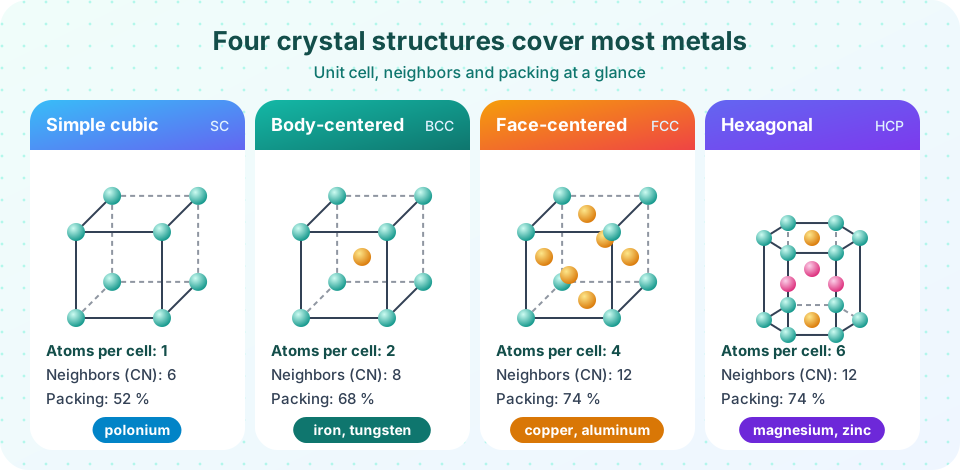
Adding centering (a point in the middle of the cell, in the middle of each face, or on certain faces) gives 14 distinct lattices, the Bravais lattices: three cubic (simple, body-centered, face-centered), two tetragonal, four orthorhombic, two monoclinic and one each of triclinic, hexagonal and rhombohedral. Most metals fall in three of them, which is why we study the cubic and hexagonal cases in detail in the next lesson.
Press Run (or Ctrl + Enter) to see the console output here.
No output.
Single crystals, polycrystals and anisotropy
A single crystal has one continuous lattice throughout, like a silicon wafer or a gemstone. Most engineering metals and ceramics are polycrystalline: they consist of many small crystals, called grains, each with its own orientation, joined at grain boundaries. A steel bar contains billions of grains, each 10 to 100 µm across. Because properties differ with direction in a crystal (anisotropy: the stiffness of a single iron crystal along the cube edge is about 130 GPa and along the body diagonal about 280 GPa), a randomly oriented polycrystal averages out and is nearly isotropic. If grains share a preferred orientation (a texture, produced by rolling, for instance), properties depend on direction again. Turbine blades in jet engines are cast as single crystals to remove grain boundaries, which weaken the nickel alloy at high temperature.
The next picture contrasts a crystal, a hexagonal crystal and a disordered pattern. The disordered pattern is generated by random placement of non-overlapping disks, a schematic of amorphous structure.
Press Run (or Ctrl + Enter) to see the result here.
Program input · what you'd type while the program runs
Type the answers before you press Run, one per line. Each time the program reads a line (with input()), it gets the next line from this box.
What each lesson covers
| Lesson | What it covers |
|---|---|
| Unit cells and packing | SC, BCC, FCC and HCP: atoms per cell, coordination, packing fraction, interstitial sites, polymorphism |
| Miller indices | Naming planes and directions; planar density; angles between directions |
| Density and X-ray diffraction | Theoretical density and Bragg's law; reading powder patterns |
| Crystal defects | Vacancies, dislocations, grain boundaries and grain size |
| Chapter 3 review | Recap and ten questions |
Common misconceptions
"Glass is a very slow liquid that flows over centuries." Glass is an amorphous solid; old windows are thicker at the bottom because of how the glass was made, not because it flows.
"A unit cell contains the atoms drawn at its corners and faces whole." Corner and face atoms are shared with neighboring cells, so only a fraction of each belongs to the cell (next lesson).
"Polycrystals are random, so grain boundaries do not matter." Grain boundaries block dislocations and strengthen metals, but they also let atoms diffuse and cracks creep at high temperatures.
Check your understanding
Quick check · 5 questions
of 5 answered You scored / 5 · perfect!
-
1. Which description fits an amorphous solid?
Amorphous solids such as glass have local order but no repeating pattern over long distances. -
2. How many Bravais lattices exist in three dimensions?
There are 14 Bravais lattices in seven crystal systems. -
3. A unit cell with a = b = c and all angles 90° belongs to which system?
Equal edges and right angles define the cubic system. -
4. A polycrystalline metal consists of
Grains are separated by grain boundaries. -
5. Why are some jet-engine turbine blades cast as single crystals?
At high temperature grain boundaries promote creep, so single crystals last longer.
Summary
- Crystals have long-range order; amorphous solids have only short-range order.
- A crystal is a lattice plus a basis, described by a unit cell with parameters
a, b, c, α, β, γ. - Seven crystal systems and 14 Bravais lattices cover all crystals; most metals are cubic or hexagonal.
- Engineering metals are polycrystals of many grains; properties may depend on direction (anisotropy and texture).
- Imperfections (defects) are central to real behavior and are the topic of the last part of this chapter.
Next: Unit Cells and Packing
Track your progress
Create a free account to tick off lessons and pick up where you left off on any device.
of Materials Science lessons completed