


















Lesson 40 of 46 · Electrical, Thermal and Optical Properties
Chapter review: electrical, thermal and optical properties
Review Chapter 8: resistivity and bands, doping, thermal expansion and conductivity, thermal shock, optical absorption and magnetic hysteresis, with a ten-question quiz.
This chapter showed how one picture, electrons in energy bands and atoms vibrating in potential wells, explains how materials conduct, expand, transmit light and respond to magnets. Use this page to review before the final projects.
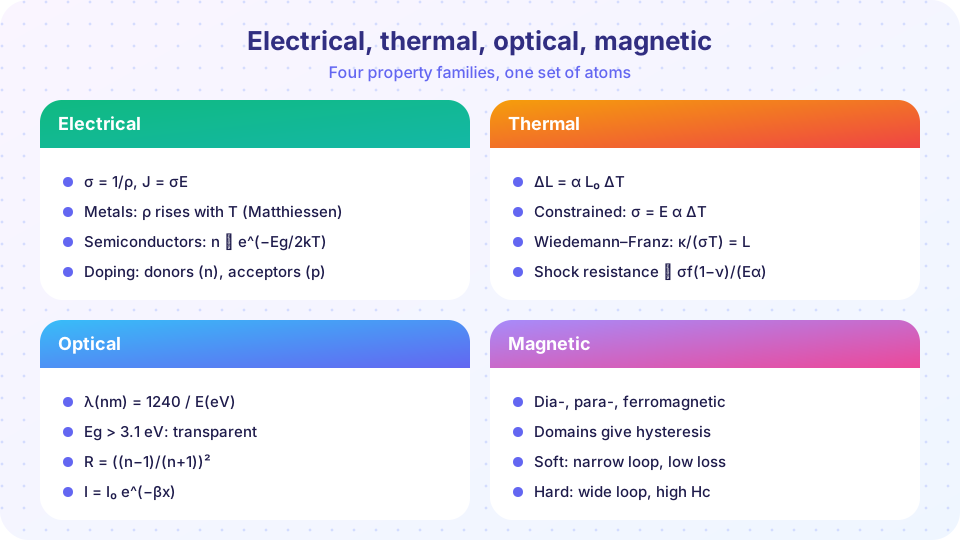
Chapter in one table
| Property | Key equation or fact |
|---|---|
| Resistance | R = ρL/A, σ = n q μ |
| Metals | ρ rises with T (Matthiessen); alloying raises ρ |
| Semiconductors | n_i ∝ T^(3/2) e^(−Eg/2kT); doping gives n- or p-type |
| Expansion | ΔL = α L₀ ΔT; constrained σ = E α ΔT |
| Heat conduction | Electrons in metals, phonons in insulators; k/(σT) = 2.44×10⁻⁸ |
| Thermal shock | R = σ_f(1−ν)/(Eα) |
| Optics | R + A + T = 1, E(eV) = 1240/λ(nm), R = ((n−1)/(n+1))² |
| Magnetism | Dia-, para-, ferromagnetic; Curie temperature; hysteresis loop |
Try it
Press Run (or Ctrl + Enter) to see the result here.
Program input · what you'd type while the program runs
Type the answers before you press Run, one per line. Each time the program reads a line (with input()), it gets the next line from this box.
Press Run (or Ctrl + Enter) to see the console output here.
No output.
Check your understanding
Quick check · 10 questions
of 10 answered You scored / 10 · perfect!
-
1. A wire of resistivity 2×10⁻⁸ Ω·m, length 5 m and cross-section 1×10⁻⁶ m² has resistance:
R = ρL/A = 2e-8 × 5 / 1e-6 = 0.1 Ω. -
2. Which of these increases with temperature in a metal?
More phonon scattering raises resistivity. -
3. Why does an intrinsic semiconductor conduct better when warm?
n_i rises exponentially with T. -
4. A 10 m aluminum bar (α = 23×10⁻⁶ K⁻¹) is heated 50 K. ΔL?
ΔL = 23e-6 × 10 × 50 = 0.0115 m. -
5. What dominates heat conduction in glass?
Glass has no free electrons; lattice vibrations carry the heat. -
6. A photon with wavelength 400 nm has energy about:
E = 1240 / 400 = 3.1 eV, the blue end of the visible range. -
7. Which material would look transparent in visible light (pure and defect-free)?
A gap above 3.1 eV means no visible photon is absorbed. -
8. A narrow hysteresis loop is typical of a:
Soft magnets magnetize and demagnetize easily with little loss. -
9. Why is borosilicate glass used for lab ovenware?
α ≈ 3.3×10⁻⁶ K⁻¹ keeps thermal stress low. -
10. What is the Curie temperature of iron?
Iron loses ferromagnetism near 770 °C (nickel is 358 °C, cobalt 1115 °C).
Summary
- Bands and gaps explain electrical and optical behavior; atomic vibrations explain thermal behavior.
- Know the key equations in the table and when each applies.
Track your progress
Create a free account to tick off lessons and pick up where you left off on any device.
of Materials Science lessons completed