


















Lesson 31 of 46 · Ceramics, Polymers and Composites
Chapter overview: ceramics, polymers and composites
Meet the three non-metal material classes: how bonding makes ceramics hard and brittle, polymers light and tough, and composites tailored, using a stiffness-density map.
Metals are not the only materials that matter. Your phone screen is a glass, its case is a polymer, the circuit board is a fiber composite, and the chips are crystalline silicon. Engineers choose among metals, ceramics, polymers and composites, and the differences between these classes come down to how the atoms are bonded.
This chapter looks at the three classes beyond metals. You will see how bonding explains their typical properties, how to compare classes on one chart, and what the following three lessons teach in detail.
What you will learn
- Relate bonding type to the typical properties of each material class.
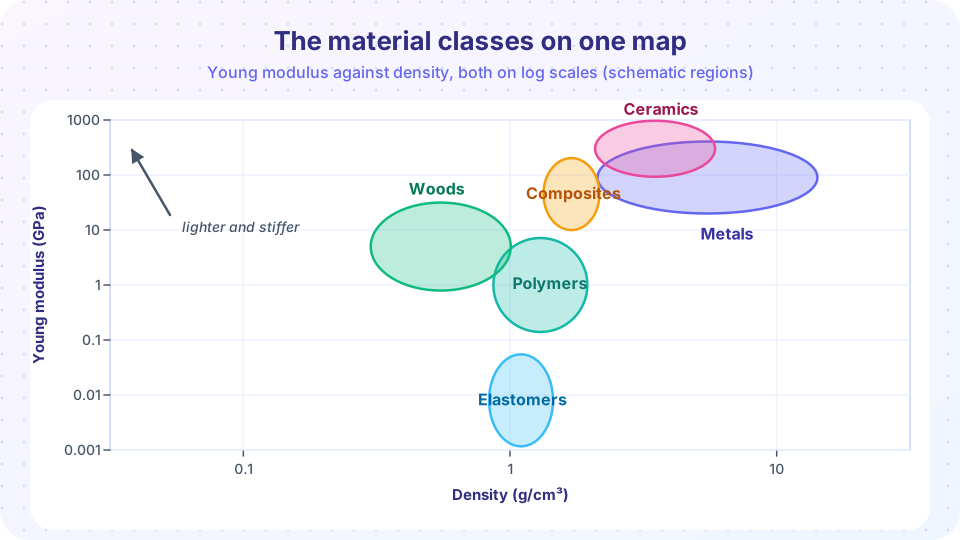
- Read a stiffness-density chart.
- Know what each lesson in the chapter covers.
Key terms
Ceramic: an inorganic, non-metallic solid, usually ionic or covalent, such as alumina, glass or porcelain.
Polymer: a material made of long chain molecules built from repeating units.
Composite: a material of two or more distinct phases combined to get properties neither has alone.
Specific stiffness: Young modulus divided by density.
Bonding explains the classes
- Metals have a shared sea of electrons, so atoms can slip past each other: ductile, conductive.
- Ceramics have strong ionic and covalent bonds that resist both slip and heat: hard, stiff, high melting, brittle, usually insulating.
- Polymers have strong covalent bonds along chains but weak secondary bonds between chains: light, low stiffness, easy to process, soft at moderate temperatures.
- Composites join phases so that, say, stiff strong fibers carry load while a tough matrix holds them and spreads stress.
Look at the chart. Ceramics and metals sit at the high-modulus end, polymers and elastomers far below, and woods in between with low density. Composites bridge the gap: carbon-fiber laminates match aluminum in stiffness at about half the density. That is why aircraft are increasingly made of them.
Three classes beyond metals
What bonding gives
What is in the chapter
- Ceramic structure and strength: ionic crystals, radius ratio, flaws, Griffith fracture and Weibull statistics.
- Polymer structure and behavior: chains, crystallinity, the glass transition and viscoelasticity.
- Composites and the rule of mixtures: fibers, matrices and the bounds on stiffness.
- Chapter review.
Try it
Press Run (or Ctrl + Enter) to see the result here.
Program input · what you'd type while the program runs
Type the answers before you press Run, one per line. Each time the program reads a line (with input()), it gets the next line from this box.
Press Run (or Ctrl + Enter) to see the console output here.
No output.
Check your understanding
Quick check · 4 questions
of 4 answered You scored / 4 · perfect!
-
1. Which bonding type is typical of ceramics?
Ceramics have strong ionic and/or covalent bonds, which make them hard, stiff and brittle. -
2. Why are polymers generally soft compared with ceramics?
Strong covalent bonds run along the chains, but the bonds between chains are weak. -
3. What is a composite?
Composites combine phases, such as stiff fibers in a tough matrix. -
4. On the stiffness-density map, which regions overlap the most low density with high stiffness?
Carbon-fiber composites reach high modulus at about 1.6 g/cm³.
Summary
- Bonding type explains the personality of each class.
- Ceramics: hard, stiff, brittle. Polymers: light, soft, processable. Composites: tailored.
- A stiffness-density map compares classes at a glance.
Track your progress
Create a free account to tick off lessons and pick up where you left off on any device.
of Materials Science lessons completed