


















Lesson 38 of 46 · Electrical, Thermal and Optical Properties
Thermal properties: expansion, conductivity and thermal stress
Learn heat capacity, thermal expansion from the atomic potential, thermal conductivity by electrons and phonons, the Wiedemann–Franz law, and thermal stress and shock.
Rail tracks buckle in summer, a hot glass dish can crack when it meets cold water, a processor needs a copper heat sink, and a pot handle is plastic so you can pick it up. All four are thermal properties at work: how much heat a material stores, how much it expands, and how fast it conducts heat.
In this lesson you will explain each property from what the atoms do, compute thermal strain and stress, and learn why some ceramics survive a sudden temperature change while others shatter.
What you will learn
- State heat capacity and the Dulong–Petit value.
- Explain thermal expansion and compute ΔL and constrained thermal stress.
- Compare thermal conductivity of metals, ceramics and polymers.
- Use the Wiedemann–Franz law.
- Estimate thermal shock resistance.
Key terms
Heat capacity (C): heat needed to raise a mole (or kilogram) by 1 K.
Coefficient of thermal expansion (α): fractional length change per kelvin: ΔL/L₀ = α ΔT.
Thermal conductivity (k or κ): heat flow per unit area per unit temperature gradient, in W/(m·K).
Thermal stress: stress from restrained expansion or from temperature gradients.
Heat capacity
Heat added to a solid makes its atoms vibrate harder. Classically, each atom has three vibrational directions, each storing kT of energy, so the molar heat capacity should be 3R ≈ 24.9 J/(mol·K). This is the Dulong–Petit law, and it works at and above room temperature for many solids: copper measures about 24.4 and aluminum about 24.2 J/(mol·K). At low temperature quantum effects freeze out the vibrations and C falls toward zero (roughly as T³). Per kilogram, light elements store more heat, which is one reason aluminum and water-bearing materials heat slowly.
Thermal expansion
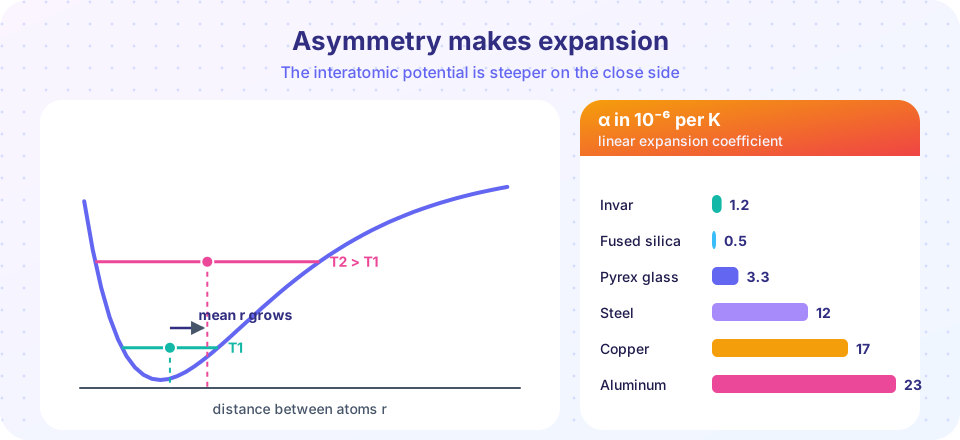
Why do solids expand? Not because the vibrations get larger in a symmetric spring, but because the potential energy curve between two atoms is asymmetric: it rises steeply at short distance (electron clouds repel strongly) and gently at long distance. When heated, an atom vibrates with larger amplitude, and the midpoint of its motion moves to a longer distance. The sum over all atoms is the expansion ΔL = α L₀ ΔT.
Typical α values (×10⁻⁶ per K): aluminum 23, copper 17, steel 12, alumina 8, borosilicate glass 3.3, Invar (Fe–36% Ni) about 1.2, fused silica 0.5. Strongly bonded materials, with deep and narrow wells, expand least. A 10 m steel rail heated by 40 K lengthens by 12×10⁻⁶ × 10 × 40 = 4.8 mm.
If expansion is prevented, stress appears: σ = E α ΔT. For steel (E = 200 GPa, α = 12×10⁻⁶ K⁻¹) held rigidly and heated by 100 K: σ = 200×10⁹ × 12×10⁻⁶ × 100 = 240 MPa, a large fraction of the yield stress. That is why bridges have expansion joints and why rails are pre-stressed or free to slide.
Thermal conductivity
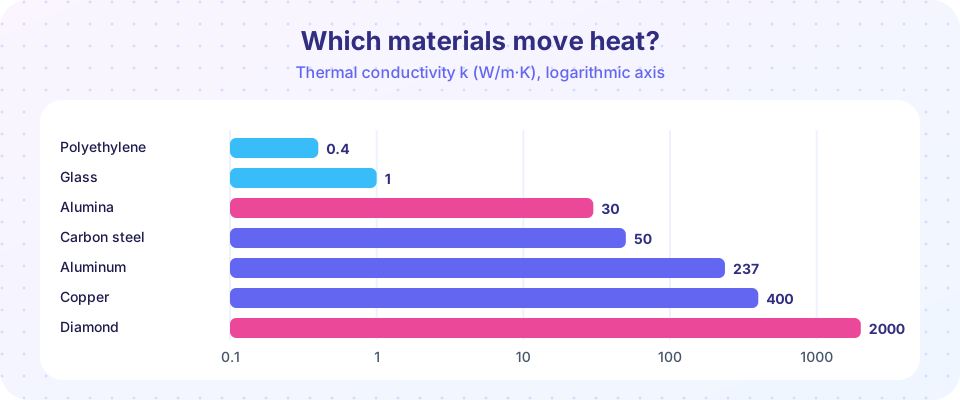
Heat flows by two carriers: free electrons and lattice vibrations (phonons). In metals electrons dominate, so good electrical conductors are good thermal conductors, linked by the Wiedemann–Franz law: k / (σ T) = L, with the Lorenz number L ≈ 2.44×10⁻⁸ W·Ω/K². For copper (σ = 5.95×10⁷ S/m) at 300 K it predicts k ≈ 2.44×10⁻⁸ × 5.95×10⁷ × 300 ≈ 435 W/(m·K), close to the measured 400.
In ceramics and polymers electrons are scarce and phonons carry heat. Perfect, light, strongly bonded crystals conduct extremely well: diamond is about 2,000 W/(m·K), higher than any metal, and is also an electrical insulator. Defects, grain boundaries and complicated structures scatter phonons, so glass is only about 1 W/(m·K), and polymers 0.1 to 0.5. Foams and porous ceramics, mostly trapped air, make good insulators.
Thermal stress and shock
Even without constraint, a temperature gradient creates stress: the cooler surface wants to contract while the warm interior resists. Quench a hot glass plate in cold water and the surface is put into tension, where flaws (previous lesson) let cracks start. A common figure of merit for resistance to the maximum sudden temperature change is
R = σ_f (1 − ν) / (E α)
where σ_f is the fracture strength and ν Poisson's ratio. High strength, low stiffness and low expansion all help. With typical values, alumina (σ_f 300 MPa, ν 0.22, E 380 GPa, α 8×10⁻⁶ K⁻¹) gives about 77 K; borosilicate glass (σ_f 70 MPa, ν 0.2, E 63 GPa, α 3.3×10⁻⁶) gives about 270 K; fused silica gives over 2,000 K. That is why laboratory glassware is borosilicate, and why high conductivity helps too, since it reduces the gradients.
Common misconceptions
"Materials that feel cold are at a lower temperature." Metals at room temperature feel colder than wood because their higher conductivity pulls heat from your hand faster, not because they are colder.
"A hole in a metal plate shrinks when heated." It expands, as if it were made of the same metal.
"Thermal shock needs a very high temperature." It depends on the change and its speed; ice in a hot glass is enough.
Try it
Press Run (or Ctrl + Enter) to see the result here.
Program input · what you'd type while the program runs
Type the answers before you press Run, one per line. Each time the program reads a line (with input()), it gets the next line from this box.
Press Run (or Ctrl + Enter) to see the result here.
Program input · what you'd type while the program runs
Type the answers before you press Run, one per line. Each time the program reads a line (with input()), it gets the next line from this box.
Check your understanding
Quick check · 5 questions
of 5 answered You scored / 5 · perfect!
-
1. What is the Dulong–Petit molar heat capacity of a simple solid?
Three vibrational directions each storing kT per atom gives 3R. -
2. A 10 m steel rail (α = 12×10⁻⁶ K⁻¹) is heated by 40 K. How much does it lengthen?
ΔL = 12e-6 × 10 × 40 = 4.8e-3 m. -
3. Why does a solid expand when heated?
The curve is steeper on the compressed side, so mean separation increases. -
4. Why is diamond an excellent thermal conductor but an electrical insulator?
Strong light bonds and a perfect lattice give long phonon mean free paths. -
5. Which change raises thermal shock resistance R = σ_f(1−ν)/(Eα)?
A smaller α reduces the thermal strain for a given ΔT.
Summary
- Heat capacity of solids approaches 3R at room temperature and above.
ΔL = α L₀ ΔT; constrained,σ = E α ΔT; asymmetry of the potential causes expansion.- Metals conduct heat with electrons (
k/(σT) = L); ceramics and polymers use phonons. - Thermal shock resistance rises with strength and falls with stiffness and expansion.
Track your progress
Create a free account to tick off lessons and pick up where you left off on any device.
of Materials Science lessons completed