


















Lesson 23 of 46 · Phase Diagrams
Solid solutions, tie lines and the lever rule
Learn how metals dissolve in each other, how the Gibbs phase rule works, and how to find the amount and composition of each phase with a tie line and the lever rule.
When you dissolve sugar in tea you get one liquid with the sugar spread evenly through it. Metals do something similar in the solid state: copper and nickel atoms can share one crystal lattice, forming a single solid solution. Whether two elements can do this, and over what range of composition, is the first thing a phase diagram records.
In this lesson you will see why some pairs mix freely and others hardly at all, then learn the two most useful tools in the chapter. The tie line gives you the composition of each phase in a two-phase region, and the lever rule gives you how much of each phase there is. You will practice on the copper–nickel system, whose lens-shaped diagram is the simplest of all.
What you will learn
- Distinguish substitutional and interstitial solid solutions.
- Apply the Hume-Rothery rules to predict solubility.
- Use the Gibbs phase rule to count degrees of freedom.
- Read a tie line and compute phase fractions with the lever rule.
- Explain why fast cooling produces cored microstructures.
Key terms
Solid solution: a crystal in which solute atoms are spread through the solvent lattice, with the same crystal structure as the solvent.
Liquidus: the line above which the alloy is entirely liquid.
Solidus: the line below which the alloy is entirely solid.
Tie line: a horizontal line at the chosen temperature across a two-phase region; its ends give the phase compositions.
Lever rule: the mass balance that turns tie-line lengths into phase fractions.
Two ways to dissolve an atom
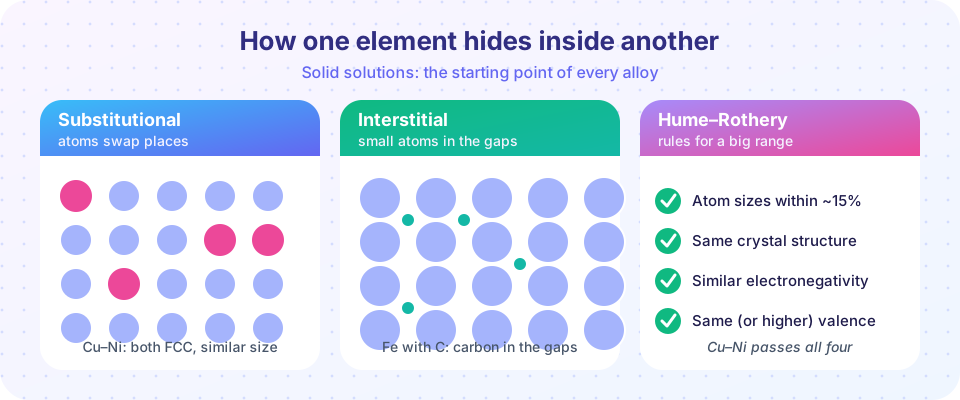
In a substitutional solid solution the solute atom takes the place of a solvent atom on a lattice site. Copper and nickel are the textbook case: their atomic radii are about 0.128 nm and 0.125 nm, both crystallize FCC, and both have similar chemistry. In an interstitial solution the solute is much smaller than the host and sits in the gaps between host atoms. Carbon in iron is the example that makes steel possible: a carbon atom (radius around 0.07 nm) fits into the gaps of iron (about 0.124 nm), but only a little of it fits, because the gaps are small.
William Hume-Rothery summarized when substitution is extensive. Four conditions favor a wide range of solubility:
- The atomic radii differ by no more than about 15%.
- The two elements have the same crystal structure.
- Their electronegativities are similar, otherwise they prefer to form compounds.
- They have the same valence, or the solute has the higher one (a metal dissolves a higher-valence metal more readily than the reverse).
Treat these as strong hints, not laws. Copper and silver meet the size rule yet dissolve in each other only a little, because the energy balance still favors separate phases.
How many things can you change? The Gibbs phase rule
Josiah Willard Gibbs showed that for a system in equilibrium the number of degrees of freedom F (independent variables you can change without changing the set of phases) is
F = C − P + N
where C is the number of components, P the number of phases and N the number of external variables. For alloys at fixed (atmospheric) pressure N = 1 (temperature only), so F = C − P + 1. In a Cu–Ni alloy (C = 2) a single-phase region has F = 2: you may change temperature and composition freely. In the two-phase lens F = 1. Choose a temperature and the compositions of both phases are fixed, which is exactly why a horizontal tie line works.
Reading the Cu–Ni diagram
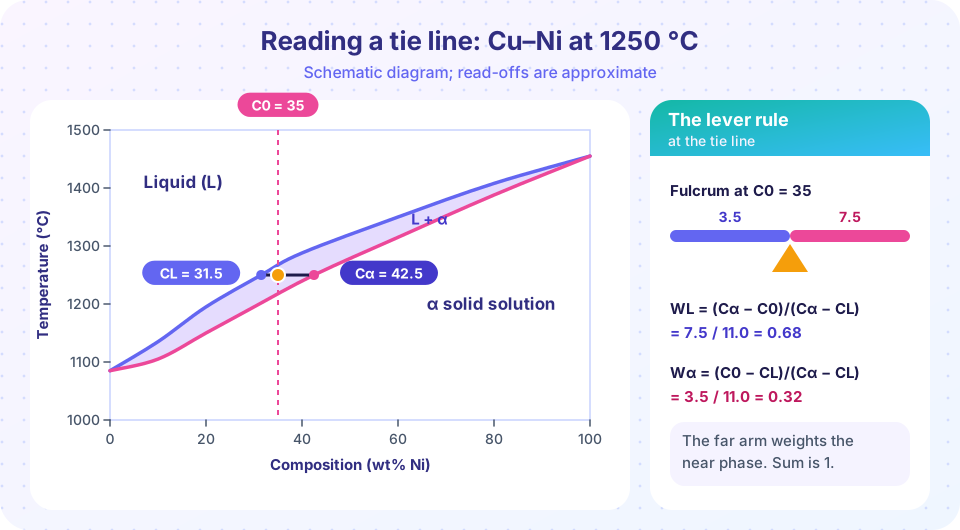
Copper melts near 1085 °C and nickel near 1455 °C. Because the metals mix completely in both the liquid and the solid state, the diagram has just two lines, the liquidus above and the solidus below, meeting at the melting point of each pure metal. Above the liquidus the alloy is liquid (L). Below the solidus it is a single solid solution (α). In between lies a mixed region, L + α, where crystals and melt coexist.
Take an alloy with 35 wt% Ni and hold it at 1250 °C. The point lies in the lens, so two phases are present. Draw the horizontal tie line through it. Where it meets the liquidus (about 31.5 wt% Ni) gives the composition of the liquid; where it meets the solidus (about 42.5 wt% Ni) gives the composition of the solid. The solid is richer in the higher-melting metal, which is why the lens slopes upward.
The lever rule
You know what each phase is made of. How much of each is there? Count the nickel. Let C0 be the overall composition, CL and Cα the phase compositions, and WL and Wα the mass fractions. Then
WL + Wα = 1 and WL·CL + Wα·Cα = C0
Solving gives the lever rule:
WL = (Cα − C0) / (Cα − CL) and Wα = (C0 − CL) / (Cα − CL)
Think of the tie line as a seesaw with the fulcrum at the overall composition C0. Each phase hangs at its own end. To balance, the amount of a phase is proportional to the length of the opposite arm, divided by the whole length. For our alloy: WL = (42.5 − 35) / (42.5 − 31.5) = 7.5 / 11.0 ≈ 0.68, and Wα ≈ 0.32. The alloy at 1250 °C is about two-thirds liquid. Check the balance: 0.68 × 31.5 + 0.32 × 42.5 ≈ 35.0 wt% Ni.
Use the same recipe at any temperature in the lens. As you cool from the liquidus the liquid fraction falls from 1 to 0 at the solidus.
Cooling that is too fast: coring
The diagram assumes atoms have time to diffuse so that the first crystals, rich in nickel, re-equilibrate with the melt. Solid-state diffusion is slow. In a casting the first crystals keep their nickel-rich centers while later layers are poorer, so each grain has a composition gradient: coring. Cored castings melt at lower temperature along the grain boundaries, where the last, nickel-poor liquid froze, and they can be weaker. A homogenizing anneal just below the solidus lets diffusion even things out.
Common misconceptions
"The tie line tells you how much of each phase." It tells you the compositions; the lever rule on its lengths gives the amounts.
"The phase diagram tells you how fast the structure forms." It describes equilibrium only. Cooling rate, nucleation and diffusion decide what you really get.
"The fulcrum is at the phase you want." The fulcrum is at the overall composition; the fraction of a phase is the opposite arm over the whole line.
Try it
Press Run (or Ctrl + Enter) to see the result here.
Program input · what you'd type while the program runs
Type the answers before you press Run, one per line. Each time the program reads a line (with input()), it gets the next line from this box.
Press Run (or Ctrl + Enter) to see the result here.
Program input · what you'd type while the program runs
Type the answers before you press Run, one per line. Each time the program reads a line (with input()), it gets the next line from this box.
Check your understanding
Quick check · 5 questions
of 5 answered You scored / 5 · perfect!
-
1. Carbon dissolves in iron as which type of solid solution?
A carbon atom is much smaller than an iron atom, so it sits in the gaps between iron atoms. -
2. Which is NOT one of the Hume-Rothery conditions for extensive substitutional solubility?
The conditions are size, crystal structure, electronegativity and valence. The state of an element at room temperature is not one of them. -
3. In a binary alloy at fixed pressure, how many degrees of freedom does a single-phase region have?
F = C - P + 1 = 2 - 1 + 1 = 2. Temperature and composition can both be changed freely. -
4. A 35 wt% Ni alloy at 1250 °C has liquid at 31.5 wt% Ni and alpha at 42.5 wt% Ni. What is the liquid fraction?
WL = (42.5 - 35) / (42.5 - 31.5) = 7.5 / 11.0, about 0.68. -
5. What causes coring in a Cu–Ni casting?
The first crystals are nickel-rich and do not re-equilibrate quickly, so each grain keeps a composition gradient.
Summary
- Solutes dissolve substitutionally (similar size) or interstitially (much smaller than the host).
- Hume-Rothery rules (size, structure, electronegativity, valence) predict wide solubility but are not guarantees.
F = C − P + 1counts degrees of freedom at fixed pressure; in a two-phase region of a binary the compositions are fixed by temperature.- A tie line gives phase compositions; the lever rule gives phase fractions from the opposite arm over the whole line.
- Fast cooling prevents equilibrium and causes coring, which a homogenizing anneal reduces.
Next: Eutectic systems
Track your progress
Create a free account to tick off lessons and pick up where you left off on any device.
of Materials Science lessons completed