


















Lesson 28 of 46 · Metals and Alloys
Heat treatment, TTT diagrams and martensite
How cooling rate decides the structure of steel: read a TTT diagram, understand pearlite, bainite and martensite, and see why tempering trades hardness for toughness.
The iron–carbon diagram tells you where a steel is heading if you wait forever. A blacksmith quenching a glowing blade in water does not wait. What forms depends on how fast you cool, and that is where the time–temperature–transformation (TTT) diagram comes in. It adds the missing axis: time.
This lesson explains the three products of cooling austenite, why martensite is so hard and so brittle, and how tempering rescues it. It is the foundation of nearly every strengthening heat treatment applied to steel.
What you will learn
- Read a TTT diagram, including the nose, Ms line and cooling paths.
- Describe pearlite, bainite and martensite and how each forms.
- Explain tempering and the common anneal, normalize and quench-and-temper treatments.
- Use the Hollomon–Jaffe tempering parameter for a simple comparison.
Key terms
TTT diagram: a plot of transformation start and finish times against temperature for a constant (isothermal) hold.
Martensite: a supersaturated, body-centered tetragonal phase formed by a diffusionless shear transformation on rapid cooling.
Bainite: a fine mixture of ferrite and carbides formed at intermediate temperatures.
Tempering: reheating martensite below A₁ to gain toughness.
Hardenability: how deep into a section martensite can form on quenching.
Reading a TTT diagram
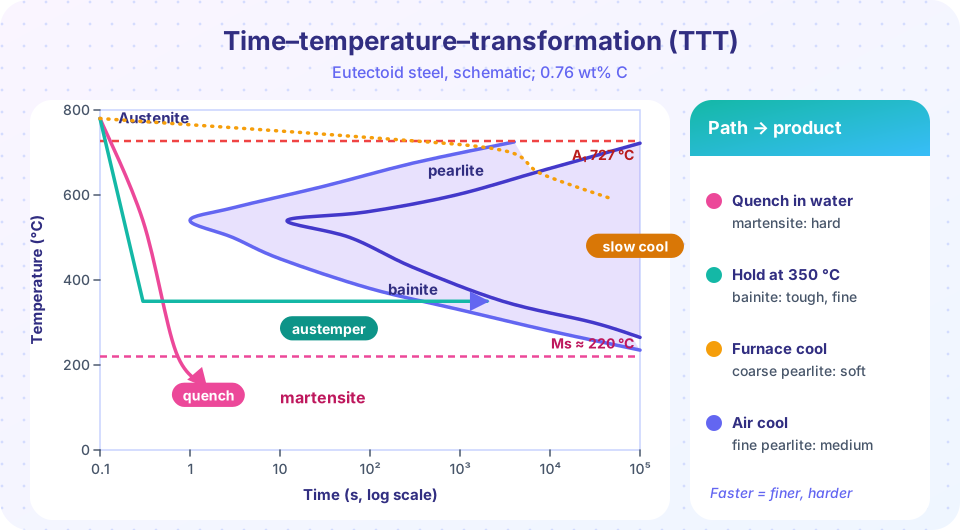
Heat a eutectoid steel above 727 °C so it is all austenite, then cool it quickly to a chosen temperature and hold. The diagram marks when the austenite starts to transform and when it finishes. The curves form a C, with the "nose" near 540 °C where transformation is fastest. Just below A₁ the driving force is small (the austenite is barely unstable) so nuclei form slowly. At low temperatures the driving force is large but carbon diffusion is sluggish. The competition between the two puts the fastest transformation in between.
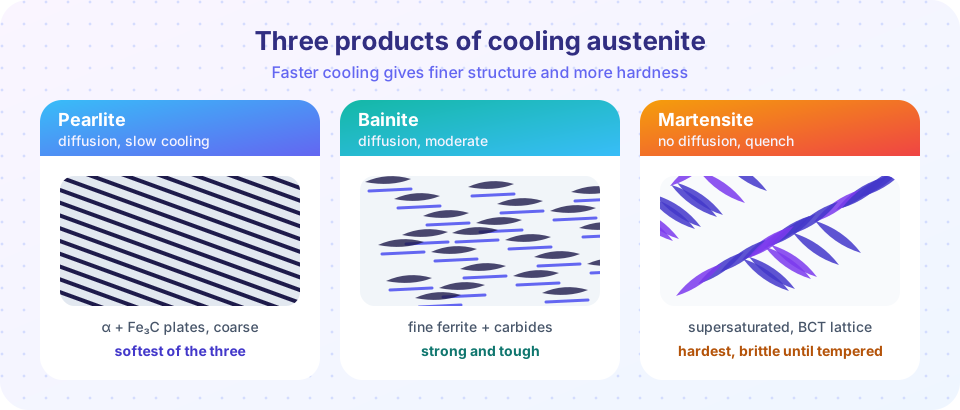
- Above the nose: austenite becomes pearlite. The higher the temperature, the coarser the plates and the softer the steel.
- Below the nose, down to about 250 °C: bainite, a fine ferrite with tiny carbides, stronger than pearlite yet tough.
- Below Ms (about 220 °C for 0.76 wt% C): martensite, forming almost instantly, independent of time.
Cooling curves drawn on the diagram show what a real part experiences. A water quench that passes to the left of the nose misses pearlite and bainite completely. Slow furnace cooling crosses both curves near A₁ and yields coarse pearlite.
Martensite
When cooling is fast enough, carbon atoms have no time to leave. The FCC lattice shears into a body-centered tetragonal (BCT) one, with carbon trapped in a stretched cell. The transformation involves no diffusion; it spreads at roughly the speed of sound in the crystal, as thin lens-shaped plates. The result is extremely hard: the strained lattice, the many plate boundaries and the high dislocation density all block slip. It is also brittle and internally stressed.
The amount of martensite depends only on how far below Ms you cool. The Koistinen–Marburger relationship, a good empirical approximation for many steels, says the fraction transformed is f = 1 − exp[−0.011 (Ms − T)]. With a low Mf, some retained austenite often survives at room temperature, especially in high-carbon steels.
Tempering
Untempered martensite is too brittle for most uses, so it is reheated, typically at 150 to 650 °C. Carbon leaves the lattice and forms fine carbide particles, and internal stresses relax. Hardness and strength fall, toughness and ductility rise; the higher the temperature, the greater the effect. Heat treaters call the combination "quench and temper" and it is the standard route for shafts, springs, tools and gears. Some steels lose toughness if tempered in a band roughly from 260 to 370 °C (tempered martensite embrittlement), so that range is avoided.
A common way to compare tempering treatments is the Hollomon–Jaffe parameter P = T (20 + log₁₀ t), with T in kelvin and t in hours. Two treatments with the same P give about the same hardness. For 1 hour at 400 °C: P = 673 × 20 = 13,460. The same P is reached at 450 °C in about 2.5 minutes. Use it only for rough planning within one steel grade.
Other common treatments
- Annealing: heat into austenite and cool very slowly (furnace cooling); soft, coarse pearlite for machining.
- Normalizing: heat into austenite and air-cool; finer pearlite, more uniform and stronger.
- Spheroidizing: hold just below A₁ for many hours; cementite balls up in soft ferrite for easy forming.
- Austempering: quench to a bainite temperature and hold; tough and less likely to crack.
- Case hardening: diffuse carbon (carburizing) or nitrogen into the surface only, then quench; a hard skin over a tough core, as in gears.
Hardenability is a separate idea from hardness. A plain carbon steel quenches to martensite only near the surface of a thick part, because the core cools too slowly. Alloying elements such as chromium, molybdenum and nickel push the C-curves to the right, so martensite forms to greater depth. The Jominy end-quench test measures it.
Common misconceptions
"Quenching makes steel stronger and better." Un-tempered martensite is very hard but brittle; tempering is what makes it usable.
"Martensite forms when you hold the steel at a low temperature for a long time." It forms on cooling below Ms regardless of time, by shear, not diffusion.
"The TTT diagram applies to any cooling." It is for constant-temperature holds. Continuous cooling has its own (CCT) diagram, shifted to longer times.
Try it
Press Run (or Ctrl + Enter) to see the result here.
Program input · what you'd type while the program runs
Type the answers before you press Run, one per line. Each time the program reads a line (with input()), it gets the next line from this box.
Press Run (or Ctrl + Enter) to see the result here.
Program input · what you'd type while the program runs
Type the answers before you press Run, one per line. Each time the program reads a line (with input()), it gets the next line from this box.
Press Run (or Ctrl + Enter) to see the console output here.
No output.
Check your understanding
Quick check · 5 questions
of 5 answered You scored / 5 · perfect!
-
1. Why is transformation fastest near the 'nose' of the TTT diagram?
Just below A₁ there is little driving force; at low temperature diffusion is slow. The fastest rate lies between. -
2. How does martensite form?
Martensite forms by a shear of the lattice without diffusion, trapping carbon in a BCT structure. -
3. What does tempering do to martensite?
Reheating lets carbon precipitate as carbides and relieves stress: softer but tougher. -
4. Which treatment gives soft coarse pearlite for easy machining?
Very slow cooling gives coarse pearlite, the softest structure of the common treatments. -
5. What happens to the fraction of martensite as you cool further below Ms?
Per Koistinen–Marburger, the fraction depends on Ms minus T, not on time.
Summary
- A TTT diagram adds time to the phase diagram; the C-curve nose is where transformation is fastest.
- Slow cooling → pearlite; intermediate → bainite; fast quench below Ms → martensite.
- Martensite is hard and brittle; tempering trades some hardness for toughness.
- Anneal, normalize, spheroidize, austemper and case-harden are the standard variations.
- Alloying shifts the curves right and increases hardenability.
Track your progress
Create a free account to tick off lessons and pick up where you left off on any device.
of Materials Science lessons completed