


















Lesson 25 of 46 · Phase Diagrams
Chapter review: phase diagrams
Review Chapter 5: Gibbs phase rule, tie lines, the lever rule, Cu–Ni and Pb–Sn diagrams and invariant reactions, with a recap table and a ten-question quiz.
You have now covered the toolkit that metallurgists, ceramists and solder engineers use every day. This review puts the chapter on one page, gives you a table to scan, and then tests you with ten mixed questions.
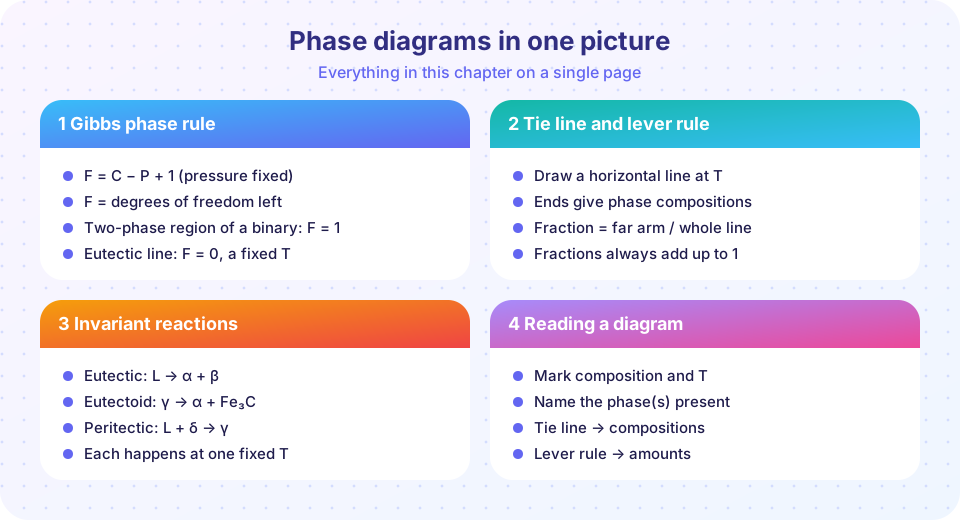
Chapter in one table
| Idea | Key statement | Example |
|---|---|---|
| Phase | Uniform in structure and composition | α, β, liquid |
| Hume-Rothery rules | Size within ~15%, same structure, similar electronegativity and valence | Cu–Ni mix completely |
| Gibbs rule (fixed p) | F = C − P + 1 |
Binary two-phase region: F = 1 |
| Tie line | Horizontal line gives phase compositions | CL = 31.5, Cα = 42.5 wt% Ni |
| Lever rule | Phase fraction = opposite arm / whole line | WL = 7.5 / 11.0 ≈ 0.68 |
| Eutectic | L → α + β at one temperature |
Pb–Sn: 61.9 wt% Sn, 183 °C |
| Eutectoid | γ → α + β in the solid |
Fe–C (next chapter) |
| Peritectic | L + α → β |
Appears in Fe–C near 1495 °C |
| Coring | Fast cooling leaves composition gradients | Cu–Ni castings |
A method for any diagram question
- Mark the point (composition, temperature) and read the region label.
- If it is a single-phase region, the phase has the overall composition.
- If it is two-phase, draw the horizontal tie line and read the end compositions.
- Apply the lever rule using the arm opposite each phase.
- Check that the fractions add to 1 and reproduce the overall composition.
Try it
Press Run (or Ctrl + Enter) to see the result here.
Program input · what you'd type while the program runs
Type the answers before you press Run, one per line. Each time the program reads a line (with input()), it gets the next line from this box.
Press Run (or Ctrl + Enter) to see the console output here.
No output.
Check your understanding
Quick check · 10 questions
of 10 answered You scored / 10 · perfect!
-
1. Which pair of metals is most likely to show complete solid solubility?
Cu and Ni meet the size, structure and chemistry conditions, so they form a lens-shaped diagram. -
2. At fixed pressure, how many degrees of freedom does a pure metal have while melting (liquid + solid)?
F = 1 - 2 + 1 = 0: the melting temperature is a fixed value at that pressure. -
3. A tie line gives you which information?
The ends give the compositions. The lever rule then converts the lengths into amounts. -
4. In the lever rule, the fraction of the liquid phase is proportional to which arm?
The fulcrum is at the overall composition, so each phase is weighted by the arm on the other side. -
5. A Cu–Ni alloy with 35 wt% Ni at 1250 °C has CL = 31.5 and Cα = 42.5 wt% Ni. What is the alpha fraction?
Wα = (35 - 31.5) / (42.5 - 31.5) = 3.5 / 11.0, about 0.32. -
6. What is the eutectic reaction?
A liquid transforms on cooling into two solid phases at a fixed temperature. -
7. How many degrees of freedom are there on the eutectic line of a binary system at fixed pressure?
C = 2, P = 3 gives F = 0, so the reaction occurs at one temperature. -
8. Solder with a near-eutectic composition has what practical advantage?
A eutectic goes from liquid to solid at one temperature, avoiding a pasty range. -
9. Which statement about a phase diagram is correct?
Phase diagrams describe equilibrium. Real cooling can be faster and give different structures. -
10. A 40 wt% Sn alloy just below 183 °C has 0.51 proeutectic alpha. What fraction is the eutectic microconstituent?
The microconstituents add to 1, so 1 - 0.51 = 0.49.
Summary
- Phase diagrams show equilibrium phases against composition and temperature.
F = C − P + 1counts freedoms; invariant reactions have F = 0.- Tie lines give compositions; the lever rule gives amounts.
- Lens, eutectic and eutectoid shapes cover most cases.
Track your progress
Create a free account to tick off lessons and pick up where you left off on any device.
of Materials Science lessons completed