


















Lesson 26 of 46 · Metals and Alloys
Chapter overview: metals and alloys
A tour of engineering metals: why iron-based alloys dominate, how carbon changes steel, and where aluminum, copper, titanium and magnesium fit in.
Metals are the workhorses of engineering: bridges, engines, wires, tools, aircraft skins and surgical implants. Their usefulness comes from one shared feature, a sea of mobile electrons holding positive ions together, which makes them strong yet able to deform without shattering, and good conductors of heat and electricity.
Pure metals are rarely used as they come. Adding other elements and controlling how the material is cooled and worked turns a soft metal into one that is ten times stronger. This chapter shows how, starting from the phase-diagram tools you just learned.
What you will learn
- Why alloys are stronger than pure metals.
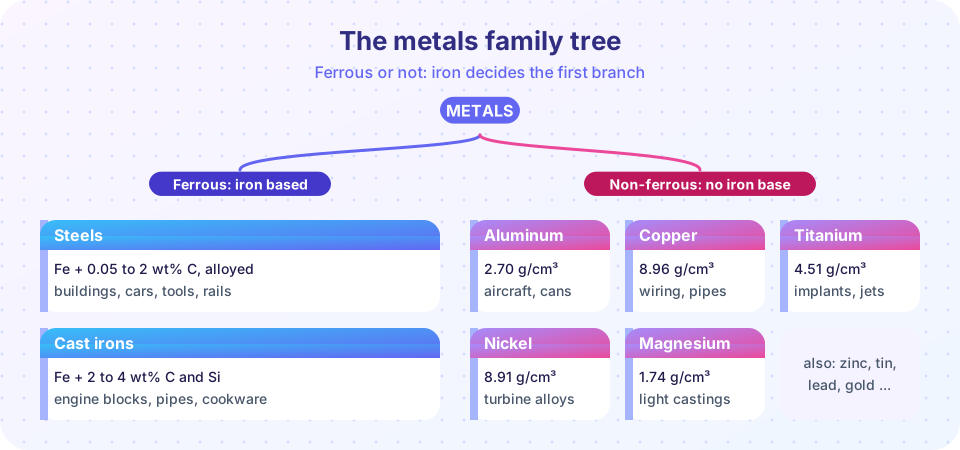
- How the family of engineering metals is organized.
- What the next three lessons teach and how they link.
Key terms
Alloy: a metal combined with one or more other elements, usually to improve its properties.
Ferrous: iron-based (steels and cast irons).
Non-ferrous: not iron-based (aluminum, copper, titanium, nickel, magnesium and others).
Heat treatment: controlled heating and cooling that changes microstructure and properties.
Why alloys beat pure metals
A pure metal crystal is soft because planes of atoms slide easily, carried by line defects called dislocations. Anything that makes dislocation motion harder makes the metal stronger. Foreign atoms in solid solution distort the lattice, fine particles block dislocations, and smaller grains put more boundaries in their path. Alloying and heat treatment are largely the art of placing those obstacles on purpose. You will see this at work in steel: tiny amounts of carbon, trapped in different arrangements, give materials from soft sheet metal to razor-hard blades from the same element, iron.
The family tree
Ferrous metals
Non-ferrous metals
Tools of the trade
What is in the chapter
- The iron–carbon diagram reads the steel corner of the Fe–C map: ferrite, austenite, cementite and pearlite.
- Heat treatment and TTT diagrams adds time: quenching, martensite, tempering and bainite.
- Steels, cast irons and non-ferrous alloys sorts the real-world alloy families and what each is used for.
- Chapter review closes with a ten-question quiz.
Try it
Press Run (or Ctrl + Enter) to see the result here.
Program input · what you'd type while the program runs
Type the answers before you press Run, one per line. Each time the program reads a line (with input()), it gets the next line from this box.
Press Run (or Ctrl + Enter) to see the console output here.
No output.
Check your understanding
Quick check · 4 questions
of 4 answered You scored / 4 · perfect!
-
1. What does 'ferrous' mean?
Ferrous metals have iron as the base element: steels and cast irons. -
2. Why are alloys usually stronger than pure metals?
Dislocations carry plastic deformation; anything that obstructs them raises strength. -
3. Which is the lightest structural metal in the list?
Magnesium has a density of about 1.74 g/cm³, lower than aluminum (2.70). -
4. Which lesson adds the time axis to the phase-diagram picture?
TTT diagrams show how long a transformation takes at each temperature.
Summary
- Alloying and heat treatment raise strength by obstructing dislocation motion.
- Ferrous (steels, cast irons) and non-ferrous metals form the family tree.
- This chapter goes from the Fe–C diagram to TTT diagrams to real alloy families.
Next: The iron–carbon diagram
Track your progress
Create a free account to tick off lessons and pick up where you left off on any device.
of Materials Science lessons completed