


















Lesson 37 of 46 · Electrical, Thermal and Optical Properties
Electrical conduction and semiconductors
Understand Ohm's law and resistivity from the electron's point of view, Matthiessen's rule for metals, and how band gaps, thermal excitation and doping control semiconductors.
You already know Ohm's law from physics: V = IR. Materials science asks a deeper question: why does one wire have a smaller R than another of the same size? The answer involves how many electrons are free to move, and how often they are knocked off course.
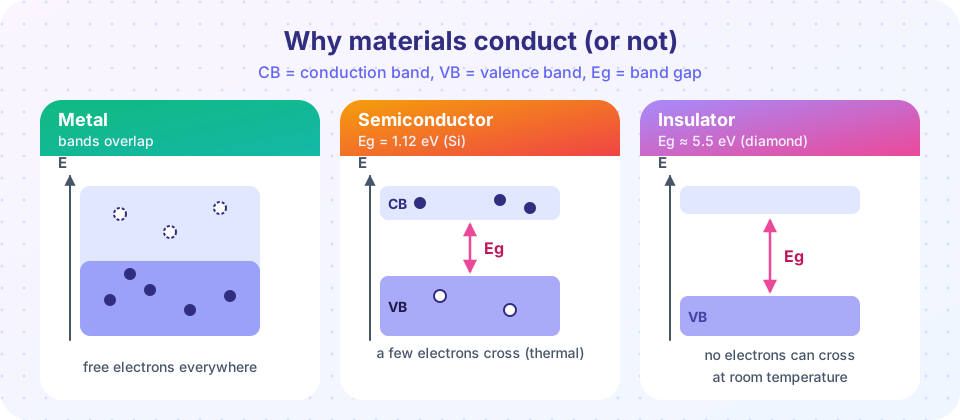
In this lesson you will connect resistivity to carrier density and mobility, see why metals get worse conductors when hot while semiconductors get better, and learn how adding a part per million of an impurity can change silicon's conductivity by a factor of a million.
What you will learn
- Relate resistivity to carrier concentration and mobility.
- Apply Matthiessen's rule and the temperature coefficient of resistivity.
- Explain intrinsic conduction and how it depends on temperature.
- Describe n-type and p-type doping and estimate the resistivity of doped silicon.
Key terms
Mobility (μ): the drift velocity per unit electric field, in m²/(V·s) or cm²/(V·s).
Carrier concentration (n): the number of mobile charge carriers per unit volume.
Intrinsic semiconductor: a pure semiconductor in which carriers come only from thermal excitation across the gap.
Dopant: an impurity atom added deliberately to supply carriers.
Hole: a missing electron in the valence band that behaves like a positive carrier.
From Ohm's law to carriers
For a uniform wire of length L and cross-section A, the resistance is R = ρ L / A. Inside the material the local form of Ohm's law is J = σ E: current density equals conductivity times electric field. Microscopically, conductivity is
σ = n q μ
with n the number of mobile carriers per m³, q the charge of each (1.602 × 10⁻¹⁹ C) and μ the mobility. In a semiconductor with both electrons and holes, add the two contributions: σ = q (n μn + p μp).
Copper has about 8.5 × 10²⁸ free electrons per m³, an enormous n, which is why it conducts so well. Mobility is limited by scattering: electrons bounce off lattice vibrations (phonons), impurity atoms, dislocations and grain boundaries.
Resistivity of metals: Matthiessen's rule
Because different scattering mechanisms act independently, their contributions to resistivity add:
ρ = ρ_thermal + ρ_impurity + ρ_deformation
The thermal part grows roughly linearly with temperature near room temperature: ρ_T = ρ₀ [1 + α (T − T₀)]. For copper α ≈ 0.0039 per kelvin, so heating copper from 20 °C to 120 °C raises its resistivity by about 39%. Impurities and cold work raise the other two terms and are nearly independent of temperature. That is why alloying lowers conductivity: about 1 wt% nickel in copper roughly doubles its resistivity, while it raises strength. Designers use pure copper for wires and alloys for springs and contacts.
Semiconductors: carriers made by heat and impurities
At absolute zero a pure semiconductor is an insulator. At finite temperature some electrons gain enough thermal energy to jump the gap Eg, leaving holes behind. The number of electron-hole pairs follows an exponential law:
n_i ∝ T^(3/2) exp(−Eg / 2kT)
where k = 8.617 × 10⁻⁵ eV/K. For silicon (Eg = 1.12 eV) the intrinsic concentration is about 10¹⁰ cm⁻³ at 300 K: tiny compared with the 5 × 10²² atoms/cm³, and about twelve orders of magnitude below a metal. With mobilities near 1,350 cm²/(V·s) for electrons and 480 for holes, the intrinsic resistivity is of order 10³ Ω·m, between a conductor and an insulator.
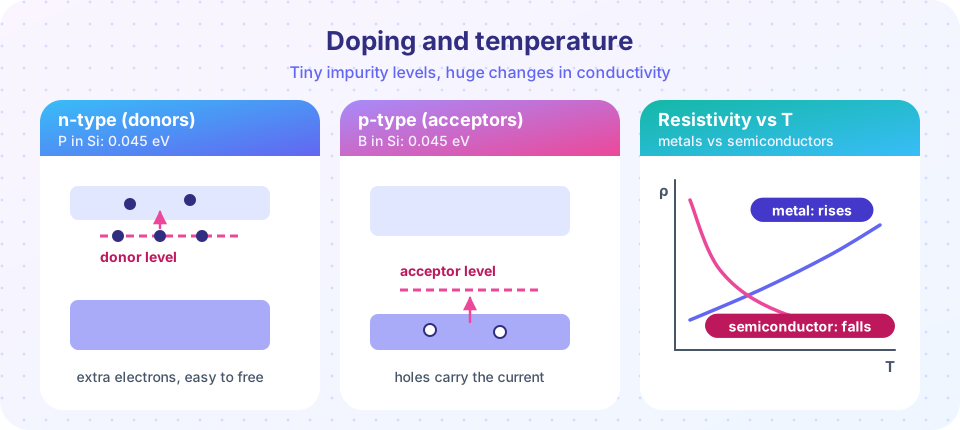
The exponential makes the conductivity rise rapidly with temperature, the opposite of a metal. That is the electrical signature that separates the two: metals' resistivity rises as they warm, semiconductors' falls.
Doping
Add a few phosphorus atoms (five valence electrons) to silicon and each replaces a silicon atom, leaving one extra electron loosely bound; its energy sits just below the conduction band, about 0.045 eV, so room temperature frees nearly all of them. The result is an n-type semiconductor. Add boron (three valence electrons) and each atom accepts an electron from the valence band, leaving a mobile hole: p-type. Dopant levels are tiny, from 10¹⁴ to 10¹⁹ per cm³, yet can raise conductivity by many orders of magnitude.
Worked example: n-type silicon with N_d = 10¹⁶ cm⁻³ (almost fully ionized, so n ≈ 10¹⁶ cm⁻³) and μn ≈ 1,350 cm²/(V·s). Then σ = q n μn = 1.602×10⁻¹⁹ × 10¹⁶ × 1,350 ≈ 2.2 S/cm, so ρ ≈ 0.46 Ω·cm, which is 0.0046 Ω·m. That is several hundred thousand times smaller than the intrinsic value from a doping level of only two parts in 10⁷. Joining p-type and n-type regions makes diodes and transistors, which you can study in the semiconductor devices track.
Superconductors
Some materials, when cooled below a critical temperature, lose all measurable DC resistance: niobium at 9.2 K, the ceramic YBa₂Cu₃O₇ near 92 K. Explaining them needs quantum theory beyond this course, but you should know they exist and that they are used for MRI magnets.
Common misconceptions
"Heating improves conduction in all materials." It worsens it in metals (more scattering) and improves it in semiconductors (more carriers).
"Doped silicon has many more carriers than a metal." A heavily doped semiconductor has 10¹⁹ cm⁻³ at most, far below a metal's 10²² cm⁻³.
"Holes are particles." A hole is the absence of an electron; it behaves like a positive carrier in the equations.
Try it
Press Run (or Ctrl + Enter) to see the result here.
Program input · what you'd type while the program runs
Type the answers before you press Run, one per line. Each time the program reads a line (with input()), it gets the next line from this box.
Press Run (or Ctrl + Enter) to see the console output here.
No output.
Check your understanding
Quick check · 5 questions
of 5 answered You scored / 5 · perfect!
-
1. Which equation gives conductivity in terms of carriers?
Conductivity is carrier concentration times charge times mobility. -
2. What happens to metal resistivity as temperature rises?
More lattice vibration means more scattering and lower mobility. -
3. Why does a semiconductor's conductivity rise with temperature?
n_i grows exponentially with temperature, which outweighs the mobility drop. -
4. Which dopant makes silicon n-type?
Phosphorus has five valence electrons, giving one extra electron per atom. -
5. Why does alloying lower the conductivity of copper?
By Matthiessen's rule the impurity term adds to the thermal term.
Summary
σ = n q μ; resistivity of a wire isR = ρL/A.- Matthiessen:
ρ = ρ_thermal + ρ_impurity + ρ_deformation; metals' ρ rises with T. - Semiconductors:
n_i ∝ T^(3/2) exp(−Eg/2kT); conductivity rises with T. - Doping supplies carriers: donors give n-type, acceptors give p-type; a few ppm change σ by orders of magnitude.
Next: Thermal properties
Track your progress
Create a free account to tick off lessons and pick up where you left off on any device.
of Materials Science lessons completed