


















Lesson 9 of 46 · Atomic Structure and Bonding
Bond Energy, Stiffness and Thermal Expansion
Use the energy well between two atoms to explain elastic modulus, melting point and thermal expansion, with Lennard-Jones calculations for argon and metals.
Two atoms near each other have a potential energy that depends on their separation r. That single curve, drawn once, explains three things you can measure on a bar of metal: how hard it is to stretch (elastic modulus), how hot it can get before it melts, and how much it grows when it warms. This is the bridge between the atom and the part, and it is worth getting familiar with, because later chapters on strength, creep and phase changes all lean on it.
What you will learn
- What shape the energy curve has and why: attraction plus repulsion.
- How force follows from energy, and how stiffness follows from the curvature of the well.
- How well depth relates to melting point and well asymmetry to thermal expansion.
- How to estimate the elastic modulus from bond stiffness and atom spacing.
Key terms
Equilibrium spacing r₀: the separation at which the net force is zero and the energy is lowest.
Bond energy E₀: the depth of the well, the energy needed to pull the atoms apart.
Bond stiffness k: the curvature of the energy at r₀, k = d²U/dr², in N/m.
Lennard-Jones potential: a simple model, U = 4ε[(σ/r)¹² − (σ/r)⁶].
The shape of the well
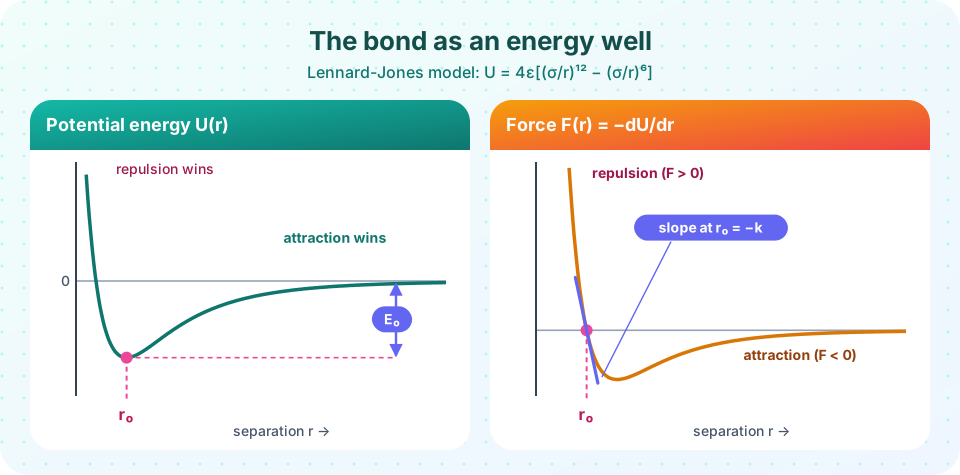
At large separations the atoms attract, and the attraction falls off with distance. At short distances the filled electron shells overlap and repel very strongly. Add the two and you get a curve that dips to a minimum at r₀ and rises steeply on the compressed side. A convenient model is the Lennard-Jones potential,
U(r) = 4ε [ (σ/r)¹² − (σ/r)⁶ ].
The r⁻⁶ term is the attraction (the van der Waals form) and the r⁻¹² term is the repulsion. Setting the slope to zero gives r₀ = 2^(1/6) σ ≈ 1.122 σ, where U(r₀) = −ε. So ε is the bond energy. Real metals and ceramics have different attractive terms, but the shape is similar, so the model is good enough to understand trends.
From energy to force to stiffness
The force between the atoms is minus the slope of the energy: F = −dU/dr. At the bottom of the well the slope is zero, so the force vanishes: the atoms sit at their equilibrium distance. Push them closer and the force is repulsive (positive); pull them apart and it is attractive (negative), reaching a maximum pull at a separation a little beyond r₀ (at about 1.24σ in this model). That maximum is the ideal strength of the bond.
Near r₀ the force is almost linear in the displacement, F ≈ −k (r − r₀), like a spring. The stiffness is the curvature of the well. For the Lennard-Jones model k = 72 ε / r₀² ≈ 57.1 ε/σ². A narrow, deep well has a large k and a stiff material.
To go from a bond to a bar, consider a cube of material where each atom occupies a cell of side r₀. A force F on one atom corresponds to a stress σ = F/r₀², and a displacement x corresponds to a strain ε = x/r₀. Therefore
E = σ/ε = (F/r₀²)/(x/r₀) = k / r₀.
This is only an estimate, because real crystals are not simple cubic and the atoms interact with more than their nearest neighbors, but it explains why stiff materials have large k and why E is nearly independent of the details of the sample.
Press Run (or Ctrl + Enter) to see the result here.
Program input · what you'd type while the program runs
Type the answers before you press Run, one per line. Each time the program reads a line (with input()), it gets the next line from this box.
Melting and stiffness across materials
A deeper well needs more thermal energy to loosen the bonds. A crude but useful rule says melting begins when the vibration amplitude reaches about a tenth of the atom spacing (the Lindemann criterion). Since vibration energy grows with temperature, deeper and stiffer wells mean higher melting points. The table below uses measured moduli and nearest-neighbor distances to estimate the bond stiffness k ≈ E r₀, then compares it with the melting point. The ordering matches the order of melting points, as the model predicts.
Press Run (or Ctrl + Enter) to see the result here.
Program input · what you'd type while the program runs
Type the answers before you press Run, one per line. Each time the program reads a line (with input()), it gets the next line from this box.
The last column printed above is the product of the expansion coefficient and the melting temperature, which comes out near 0.02 for these metals. This reflects the same well: where atoms are strongly bonded, a given temperature rise produces less extra vibration and less expansion.
Why materials expand when heated
The Lennard-Jones well is asymmetric: it is steep on the compressed side and shallow on the stretched side. When an atom has thermal energy, it vibrates back and forth between two turning points where the potential equals its total energy. The right turning point is farther from r₀ than the left one, because the well is shallower there. So the average position moves outward as the energy rises. A symmetric (parabolic) well would give no expansion at all. This is the origin of thermal expansion, quantified by the coefficient α = (1/L)(dL/dT). Typical values in 10⁻⁶ per kelvin are about 23 for aluminum, 12 for steel, 4.5 for tungsten, 8 for alumina, and 100 or more for many polymers (weak secondary bonds make a very shallow well).
Drag the slider in the next demonstration to give the atom more energy and watch the average separation move to the right.
Common misconceptions
"Atoms in a solid are at rest." They vibrate constantly, with amplitude growing with temperature. At absolute zero they still have zero-point motion.
"Thermal expansion means the atoms get bigger." The atoms keep their size; their average separation grows because of the asymmetric well.
"The ideal strength of the bond is the strength of the metal." The maximum pull of the bond is far higher than the measured strength of real crystals, which yield at a small fraction of it because dislocations move (chapters 3 and 4).
Check your understanding
Quick check · 5 questions
of 5 answered You scored / 5 · perfect!
-
1. What is the force between two atoms at the equilibrium spacing r₀?
At the minimum of the energy the slope is zero, so the force F = −dU/dr is zero. -
2. Which quantity of the energy curve corresponds to the elastic modulus?
E is approximately k/r₀, and k is the curvature of the well at r₀. -
3. Why does a solid expand when heated?
A symmetric well would produce no expansion. -
4. Which of these is expected to have the lowest thermal expansion?
Deep, narrow wells give low expansion; weak bonds give large expansion. -
5. In the Lennard-Jones model the value of U at r₀ is
At r₀ = 2^(1/6)σ, U = −ε, so ε is the bond energy.
Summary
- Energy
U(r)has a well of depthE₀at the equilibrium spacingr₀; force isF = −dU/dr. - Bond stiffness
kis the curvature atr₀, and the modulus is approximatelyE ≈ k/r₀. - Deep wells give high melting points; narrow wells give stiff materials.
- The well is asymmetric, so the mean spacing grows as the energy rises, which is thermal expansion.
- The ideal bond strength is much larger than the strength of real crystals.
Next: Chapter 2 Review
Track your progress
Create a free account to tick off lessons and pick up where you left off on any device.
of Materials Science lessons completed