


















Lesson 4 of 46 · Getting Started
Units and Length Scales
Master the SI units and constants used in materials science, from stress in MPa to energy in eV, and see which tools reveal structure from atoms to parts.
Materials science crosses more scales than almost any other subject. A single steel bridge involves atoms 0.25 nm apart, grains 20 µm across, cracks a millimeter long and girders ten meters long. Properties at the largest scale depend on features at the smallest. To move between them you need a clear set of units, a few constants, and a sense of which instrument can see what. This lesson collects them in one place and practices the conversions you will use throughout the course.
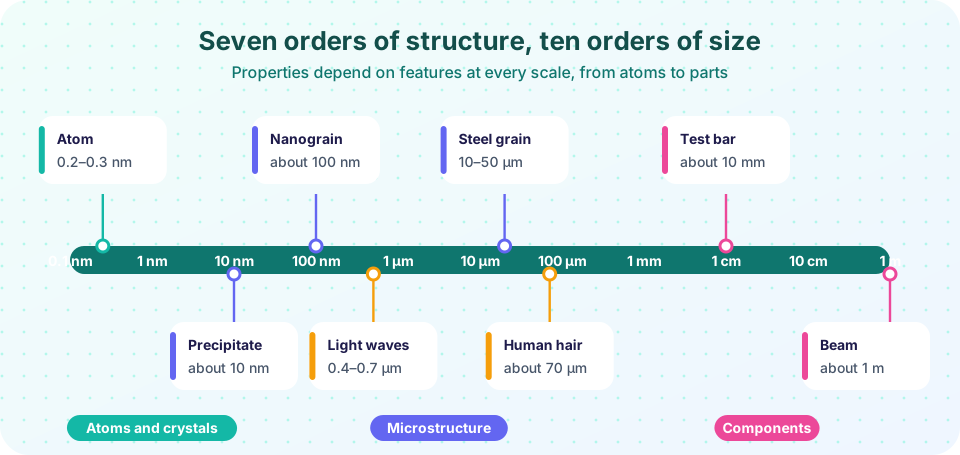
What you will learn
- The SI units for stress, strain, energy, density and temperature, with common prefixes.
- How to convert between MPa, psi, GPa and ksi, and between eV per atom and kJ per mole.
- How to compute atoms per unit volume from density and atomic mass.
- Which microscope or technique matches each length scale.
Key terms
Pascal (Pa): the SI unit of stress and pressure, one newton per square meter.
Mole: the amount of substance containing N_A = 6.022 × 10²³ entities (Avogadro's number).
Electronvolt (eV): energy gained by an electron crossing one volt, 1 eV = 1.602 × 10⁻¹⁹ J.
Atomic mass unit (u): one twelfth of the mass of a carbon-12 atom, about 1.661 × 10⁻²⁷ kg.
The units you will use
Stress and pressure are force per area. The pascal is tiny (a newton on a square meter), so we use the megapascal: 1 MPa = 10⁶ Pa = 1 N/mm², which is also handy because dimensions are usually in millimeters. Moduli use gigapascals: 1 GPa = 10⁹ Pa = 1000 MPa. In United States practice you will meet psi and ksi: 1 MPa ≈ 145.04 psi, so 1 ksi ≈ 6.895 MPa. Steel's modulus of about 205 GPa is about 29.7 million psi, often written 30 Msi.
Strain is a ratio of lengths and has no unit. It is quoted as a decimal (0.002), a percentage (0.2 %) or "microstrain" (2000 µε).
Energy appears in two systems. Bulk thermodynamics uses joules per mole (usually kJ/mol). Atomic-scale physics uses electronvolts per atom. The bridge is 1 eV/atom = 96.485 kJ/mol. Thermal energy at temperature T is k_B T, where k_B = 8.617 × 10⁻⁵ eV/K, so at room temperature (300 K) it is about 0.026 eV. That tiny number, compared with bond energies of several eV, is why solids hold together at room temperature.
Density is quoted in g/cm³ (numerically equal to Mg/m³) or kg/m³. Water is 1.00 g/cm³ and steel is 7.85, which is 7850 kg/m³.
Temperature in materials equations is in kelvin (K), T(K) = T(°C) + 273.15. Melting points are often given in °C, but ratios such as T/T_m must use kelvin.
Length: 1 nm = 10⁻⁹ m = 10 Å (angstrom). Crystallographers often use angstroms; this course uses nanometers.
Atoms per volume
Many calculations start from the number of atoms in a given volume. For an element with density ρ (g/cm³) and atomic mass A (g/mol),
n = ρ N_A / A atoms per cm³.
Copper has ρ = 8.96 g/cm³ and A = 63.55 g/mol, so n = 8.96 × 6.022 × 10²³ / 63.55 ≈ 8.49 × 10²² atoms/cm³. The volume per atom is 1/n, and the cube root of that is a rough "spacing" between atoms, about 0.228 nm for copper. The real nearest-neighbor distance (0.256 nm in the face-centered cubic structure) is a little larger because the average spacing mixes in the empty space between atoms.
Press Run (or Ctrl + Enter) to see the result here.
Program input · what you'd type while the program runs
Type the answers before you press Run, one per line. Each time the program reads a line (with input()), it gets the next line from this box.
Which tool sees which scale?
| Scale | Question | Tool |
|---|---|---|
| 0.1 to 1 nm | Where are the atoms? | X-ray and neutron diffraction, transmission electron microscopy (TEM) with atomic resolution |
| 1 to 100 nm | Precipitates, dislocations, thin films | TEM, atomic force microscopy (AFM) |
| 0.1 to 100 µm | Grains, phases, inclusions | Optical microscopy (limited to about 0.2 µm by the wavelength of light), scanning electron microscopy (SEM, down to about 1 nm) |
| 0.1 mm to 1 m | Cracks, defects, whole parts | Eye, X-ray radiography, ultrasonic testing |
Optical microscopes cannot resolve features smaller than roughly half the wavelength of visible light (about 0.2 µm), so electrons, whose wavelength is far shorter, are used for finer detail. X-rays do not make pictures; they produce diffraction patterns from which atom spacings are calculated (lesson on diffraction in chapter 3).
Conversions you will do again and again
Press Run (or Ctrl + Enter) to see the console output here.
No output.
Common misconceptions
"1 MPa and 1 N/m² are the same." A megapascal is a million newtons per square meter, which equals one newton per square millimeter. Mixing millimeters and meters is the most common source of factor-of-a-million errors.
"Use degrees Celsius in every formula." Formulas with exponentials such as exp(−Q / RT), and ratios such as T/T_m, need kelvin.
"A bond energy in eV and in kJ/mol are different quantities." They are the same energy in different units, per atom versus per mole.
Check your understanding
Quick check · 5 questions
of 5 answered You scored / 5 · perfect!
-
1. A steel has a yield strength of 350 MPa. In N/mm² this is
1 MPa = 1 N/mm², so the numbers are equal. -
2. How many kJ/mol is an energy of 1 eV per atom?
1 eV/atom = 96.485 kJ/mol. -
3. Which formula gives atoms per cm³ from density ρ (g/cm³) and atomic mass A (g/mol)?
Mass per cm³ divided by mass per mole gives moles per cm³; multiply by N_A for atoms. -
4. Which tool can resolve individual atoms?
Visible light is limited to about 0.2 µm, but electrons allow sub-0.1 nm resolution. -
5. At 300 K, thermal energy k_B T is about
8.617 × 10⁻⁵ eV/K × 300 K ≈ 0.026 eV.
Summary
- Stress is in MPa (1 N/mm²) or GPa; strain is dimensionless; energy is in J, kJ/mol or eV/atom.
1 eV/atom = 96.485 kJ/mol, andk_B T ≈ 0.026 eVat room temperature.- Atoms per cm³ is
ρ N_A / A; take care with the volume units. - Use kelvin in exponentials and ratios of temperature.
- Different tools see different scales: diffraction and TEM for atoms, SEM and optical for grains, ultrasonics for parts.
Next: Chapter 1 Review
Track your progress
Create a free account to tick off lessons and pick up where you left off on any device.
of Materials Science lessons completed