


















Lesson 10 of 46 · Atomic Structure and Bonding
Chapter 2 Review: Atomic Structure and Bonding
Recap electron configurations, periodic trends, ionic, covalent and metallic bonds, and the bond energy curve, then test yourself with ten review questions.
This chapter traced a chain from the electron to the property. Valence electrons set how atoms bond; the bond sets an energy well; the well sets melting point, stiffness and thermal expansion; and the type of bond sets the character of the material: ductile metals, hard brittle ceramics, soft polymers. Use this page to check that every link holds before moving on to crystal structures.
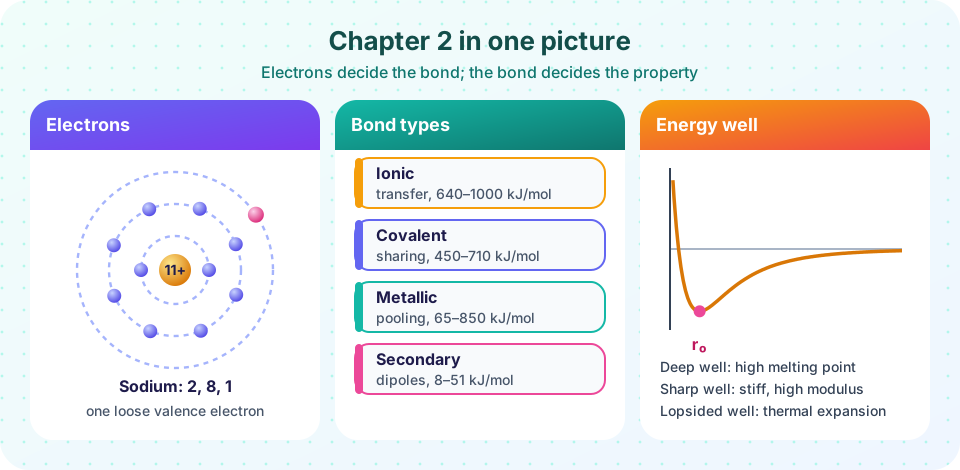
Recap table
| Topic | Key ideas | Numbers and formulas |
|---|---|---|
| Atoms and periodic trends | Shells fill 1s, 2s, 2p, 3s, 3p, 4s, 3d…; valence electrons; trends in size, ionization energy and electronegativity | s, p, d, f hold 2, 6, 10, 14 electrons; F = 3.98, Cs = 0.79 (Pauling) |
| Primary bonds | Ionic transfer, covalent sharing, metallic pooling; mixed bonds; secondary bonds | %IC = [1 − exp(−0.25 ΔX²)] × 100; NaCl lattice energy about 787 kJ/mol |
| Bond energy and properties | Energy well, F = −dU/dr, stiffness k, thermal expansion from asymmetry |
E ≈ k / r₀; Lennard-Jones r₀ = 2^(1/6) σ, U(r₀) = −ε |
Compare the bond types by property:
| Bond | Directional? | Strength | Typical behavior |
|---|---|---|---|
| Ionic | No | High (640 to 1000 kJ/mol) | Hard, brittle, insulating solid, high melting point |
| Covalent | Yes | High (450 to 710 kJ/mol) | Hard, rigid, brittle; insulator or semiconductor |
| Metallic | No | Low to high (65 to 850 kJ/mol) | Ductile, conducting |
| Van der Waals / hydrogen | Weak | 8 to 50 kJ/mol | Soft, low melting point, thermally expanding |
Try it
First, classify bonds from an electronegativity difference. Change the pair and watch the verdict.
Press Run (or Ctrl + Enter) to see the console output here.
No output.
Second, compare two energy wells that have the same width but different depth, to see why a deeper well means a stiffer bond and a higher melting point.
Press Run (or Ctrl + Enter) to see the result here.
Program input · what you'd type while the program runs
Type the answers before you press Run, one per line. Each time the program reads a line (with input()), it gets the next line from this box.
Check your understanding
Quick check · 10 questions
of 10 answered You scored / 10 · perfect!
-
1. Which electron configuration belongs to chlorine (Z = 17)?
Chlorine has seven valence electrons: 3s² 3p⁵ after the neon core. -
2. Moving down a group, ionization energy
The outer electron is farther from the nucleus and better shielded, so it is easier to remove. -
3. Which bond type is both non-directional and gives ductility?
The electron sea holds planes of ion cores together while they slide. -
4. The percent ionic character of a bond with ΔX = 0 is
With ΔX = 0,1 − exp(0) = 0. -
5. Why are solid ionic compounds brittle?
A half-spacing shift puts like ions together and causes repulsion, so the crystal cleaves. -
6. The force between two atoms is
F = −dU/dr; the curvature gives stiffness. -
7. A deeper energy well with the same spacing leads to
A deeper well is generally also a steeper one, giving a higher k and a higher melting point. -
8. Which explains thermal expansion?
Vibrations about an asymmetric well push the mean spacing outward. -
9. Which interaction keeps water molecules in ice together?
Hydrogen bonds link neighboring water molecules. -
10. For Lennard-Jones atoms, r₀ is approximately
r₀ = 2^(1/6) σ ≈ 1.122 σ.
Summary
- Electron configuration and valence electrons decide how an atom bonds; electronegativity differences predict the bond type.
- Ionic, covalent and metallic bonds are strong; van der Waals and hydrogen bonds are weak.
- The bond is an energy well: its depth gives melting point, its curvature stiffness, its asymmetry thermal expansion.
- Metals conduct and deform because of the electron sea; ionic and covalent solids tend to be hard and brittle.
Track your progress
Create a free account to tick off lessons and pick up where you left off on any device.
of Materials Science lessons completed