


















Lesson 35 of 46 · Ceramics, Polymers and Composites
Chapter review: ceramics, polymers and composites
Review Chapter 7: radius ratio, Griffith fracture, Weibull statistics, polymer Tg and viscoelasticity, rubber elasticity and composite bounds, with a ten-question quiz.
You have seen how three very different material classes follow from bonding and structure. This page gathers the key ideas and equations, then tests them.
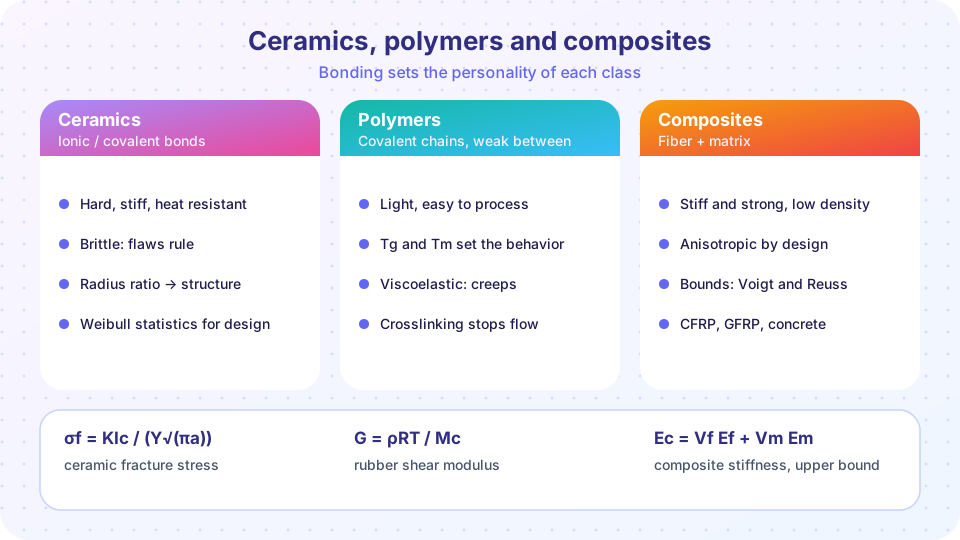
Chapter in one table
| Topic | Key statement |
|---|---|
| Radius ratio | r/R sets CN: 0.414–0.732 → 6, 0.732–1.0 → 8 |
| Ceramic strength | σf = K_Ic / (Y√(πa)), flaws rule |
| Weibull | P_s = exp[−(σ/σ₀)^m]; larger m is more consistent |
| Polymer families | Thermoplastic, thermoset, elastomer |
| Tg | Modulus falls ~1000× in amorphous polymers |
| Maxwell relaxation | σ = σ₀ exp(−t/τ) |
| Rubber elasticity | G = ρRT / Mc |
| Composite bounds | Upper Vf Ef + Vm Em; lower 1/(Vf/Ef + Vm/Em) |
| Critical fiber length | l_c = σ_f d / (2 τ_c) |
Try it
Press Run (or Ctrl + Enter) to see the result here.
Program input · what you'd type while the program runs
Type the answers before you press Run, one per line. Each time the program reads a line (with input()), it gets the next line from this box.
Press Run (or Ctrl + Enter) to see the console output here.
No output.
Check your understanding
Quick check · 10 questions
of 10 answered You scored / 10 · perfect!
-
1. Cs+ (0.170 nm) and Cl- (0.181 nm) have a radius ratio of about 0.94. Coordination number?
0.732–1.0 gives CN = 8, the CsCl structure. -
2. Why does a ceramic fail far below its theoretical strength?
Griffith: fracture stress ∝ 1/√(flaw size). -
3. A ceramic's flaw size is doubled. Fracture stress becomes:
σf ∝ 1/√a, so doubling a gives 1/√2 ≈ 0.71. -
4. A high Weibull modulus indicates:
m measures the consistency of the strength distribution. -
5. Which polymer type does not melt on heating?
A covalent crosslinked network cannot flow. -
6. What happens at the glass transition of an amorphous polymer?
From glassy (≈ 3 GPa) to rubbery (≈ 1 MPa). -
7. In a Maxwell model with τ = 100 s, how much stress remains after 100 s under constant strain?
exp(−1) ≈ 0.37. -
8. A glass/epoxy composite has Vf = 0.6, Ef = 72 GPa, Em = 3 GPa. Stiffness along fibers?
0.6 × 72 + 0.4 × 3 = 44.4 GPa. -
9. Which describes the critical fiber length?
Load transfer through interface shear sets the length at which the fiber reaches full stress. -
10. Why are composites called anisotropic?
Fiber alignment makes stiffness and strength direction dependent.
Summary
- Bonding explains each class; radius ratio, flaws, Tg, crosslinks and fiber alignment are the key concepts.
- Use Griffith and Weibull for ceramics, relaxation models for polymers, and the rule of mixtures for composites.
Next: Chapter overview: electrical, thermal and optical properties
Track your progress
Create a free account to tick off lessons and pick up where you left off on any device.
of Materials Science lessons completed