


















Lesson 27 of 46 · Metals and Alloys
The iron–carbon phase diagram
Read the steel corner of the Fe–C diagram: ferrite, austenite, cementite and pearlite, the eutectoid reaction, and lever-rule calculations for hypo- and hypereutectoid steels.
Iron is an unusually interesting element. At room temperature its atoms stack in a body-centered cubic (BCC) pattern, but heat it above 912 °C and it rearranges into face-centered cubic (FCC), then back to BCC near 1394 °C before melting at 1538 °C. Add a little carbon and the transformations shift in ways that give us the whole family of steels.
The iron–carbon diagram is the most important phase diagram in engineering. This lesson reads its steel corner, introduces the four key phases, and uses the lever rule to predict how much ferrite, pearlite and cementite a slowly cooled steel contains.
What you will learn
- Name and describe ferrite, austenite, cementite and pearlite.
- Locate the eutectoid point and the A₁, A₃ and Acm lines.
- Distinguish hypoeutectoid, eutectoid and hypereutectoid steels.
- Compute proeutectoid, pearlite and total phase fractions with the lever rule.
Key terms
Ferrite (α): BCC iron with at most about 0.022 wt% carbon in solution; soft and ductile.
Austenite (γ): FCC iron dissolving up to 2.14 wt% carbon; stable only at high temperature in plain carbon steel.
Cementite (Fe₃C): the iron carbide with 6.70 wt% carbon; very hard and brittle.
Pearlite: a lamellar mixture of ferrite and cementite formed from austenite at the eutectoid.
Eutectoid: an invariant reaction in the solid state: γ → α + Fe₃C.
The four phases
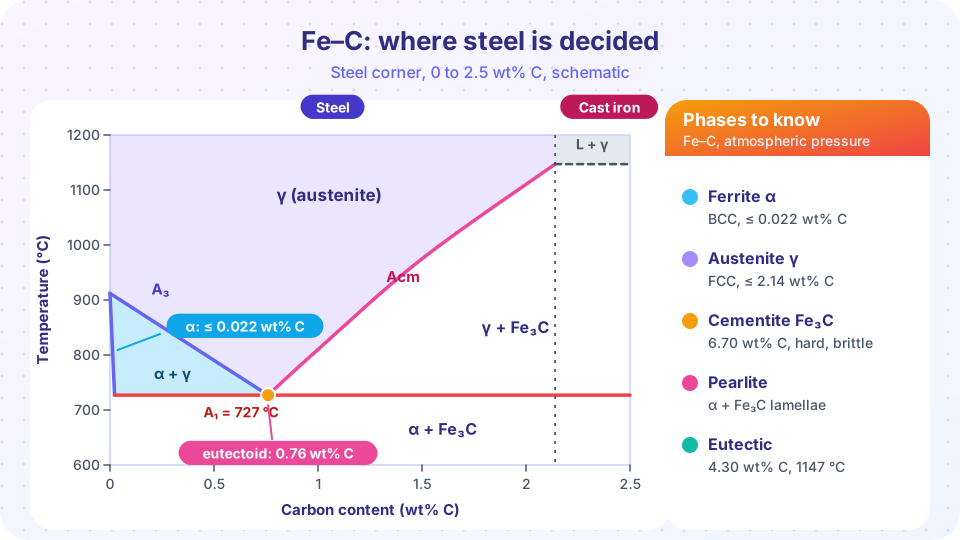
Ferrite holds very little carbon because carbon sits in the small gaps of a BCC lattice, which are even tighter than in FCC. Austenite has larger interstitial sites and dissolves up to 2.14 wt% carbon at 1147 °C. That large difference in solubility is the secret of heat treatment: dissolve carbon in austenite, then see what happens when you take it away. Cementite is a compound, not a solution; it has a fixed composition of 6.70 wt% carbon. The diagram in full runs from pure iron to cementite on the right.
The eutectoid reaction
At 0.76 wt% C and 727 °C the diagram has a notch, the eutectoid. On cooling through 727 °C, austenite transforms entirely into two solid phases:
γ (0.76 wt% C) → α (0.022 wt% C) + Fe₃C (6.70 wt% C)
As in the Pb–Sn eutectic, the products have very different compositions from the parent, so carbon must diffuse a short distance, and the result is a fine alternating structure: pearlite, named for its mother-of-pearl sheen under the microscope. Its plates are about 0.1 to 1 µm apart. Because ferrite is soft and cementite is hard, pearlite is much stronger than ferrite, but still tough.
The key lines are labeled A₁ (727 °C, the eutectoid temperature), A₃ (the ferrite-to-austenite boundary falling from 912 °C) and Acm (the cementite solvus on the high-carbon side). Plain steels have less than 2.14 wt% C; above this the alloy is a cast iron, which also undergoes a eutectic reaction at 4.30 wt% C and 1147 °C.
Hypo- and hypereutectoid steels
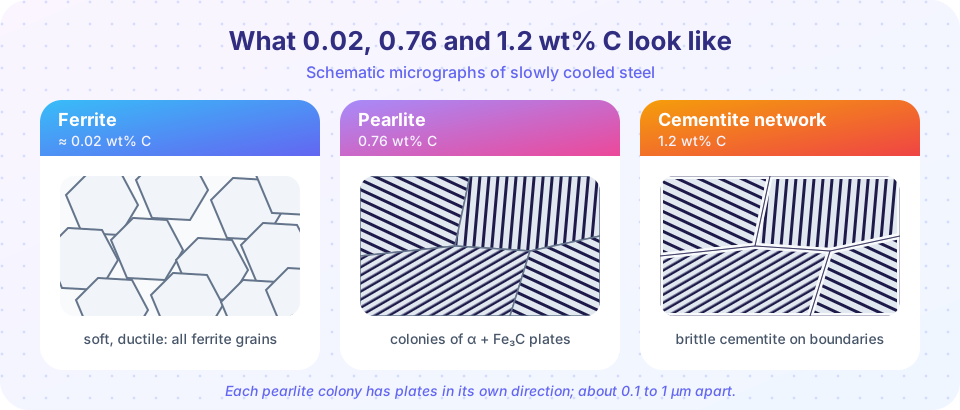
- Hypoeutectoid (< 0.76 wt% C): cooling from austenite, proeutectoid ferrite forms first at the grain boundaries below the A₃ line; the rest transforms to pearlite at 727 °C.
- Eutectoid (0.76 wt% C): 100% pearlite.
- Hypereutectoid (0.76 to 2.14 wt% C): proeutectoid cementite forms first along grain boundaries below Acm, then pearlite fills the rest. A continuous cementite network makes the steel brittle, one reason high-carbon steels are carefully processed.
Worked example: 0.40 wt% C steel
Just above 727 °C the steel is austenite plus proeutectoid ferrite. The tie line runs from 0.022 wt% C (α) to 0.76 wt% C (γ):
- Proeutectoid α:
(0.76 − 0.40) / (0.76 − 0.022) = 0.36 / 0.738 ≈ 0.49 - Austenite, which becomes pearlite:
1 − 0.49 ≈ 0.51
Just below 727 °C all the austenite is pearlite, so the microconstituents are 49% proeutectoid ferrite and 51% pearlite. For the phases, use the tie line from 0.022 to 6.70 wt% C:
- Total ferrite:
(6.70 − 0.40) / (6.70 − 0.022) = 6.30 / 6.678 ≈ 0.94 - Cementite:
≈ 0.057
Cementite is under 6% of the mass, yet it carries the extra strength, because it sits as thin plates inside the pearlite. A 1.0 wt% C steel follows the same method: proeutectoid cementite (1.0 − 0.76) / (6.70 − 0.76) ≈ 0.040 and pearlite about 0.96.
Common misconceptions
"Steel is a compound of iron and carbon." Steel is a mixture of phases, mostly ferrite with Fe₃C; only cementite is a compound.
"More carbon always means a better steel." Strength and hardness rise, but ductility, toughness and weldability fall; the right amount depends on the job.
"Austenite exists in every steel at room temperature." In plain carbon steel it is stable only above 727 °C. Some stainless steels keep it because of added nickel.
Try it
Press Run (or Ctrl + Enter) to see the result here.
Program input · what you'd type while the program runs
Type the answers before you press Run, one per line. Each time the program reads a line (with input()), it gets the next line from this box.
Press Run (or Ctrl + Enter) to see the console output here.
No output.
Check your understanding
Quick check · 6 questions
of 6 answered You scored / 6 · perfect!
-
1. What are the eutectoid composition and temperature of the Fe–C system?
The eutectoid notch is at 0.76 wt% C and 727 °C; 4.30 wt% C at 1147 °C is the eutectic. -
2. Which phase is a compound with 6.70 wt% carbon?
Cementite, Fe₃C, has a fixed composition of 6.70 wt% C. Pearlite is a mixture of ferrite and cementite. -
3. A 0.40 wt% C steel cooled slowly consists of which microconstituents at room temperature?
It is hypoeutectoid: proeutectoid ferrite forms first, then the remaining austenite becomes pearlite. -
4. Why does austenite dissolve far more carbon than ferrite?
The interstitial gaps in FCC iron are larger, so more carbon fits. -
5. What fraction of a 0.40 wt% C steel is proeutectoid ferrite?
(0.76 - 0.40) / (0.76 - 0.022) ≈ 0.49. -
6. Which is a drawback of a continuous cementite network in a hypereutectoid steel?
Cementite is hard and brittle; a network along grain boundaries gives easy crack paths.
Summary
- Fe–C phases: ferrite (BCC, ≤ 0.022 wt% C), austenite (FCC, ≤ 2.14 wt% C), cementite (Fe₃C, 6.70 wt% C).
- Eutectoid: γ → α + Fe₃C at 0.76 wt% C and 727 °C, giving pearlite.
- Hypoeutectoid steels have proeutectoid ferrite plus pearlite; hypereutectoid steels have proeutectoid cementite plus pearlite.
- The lever rule gives microconstituent and phase fractions, as for any binary diagram.
Track your progress
Create a free account to tick off lessons and pick up where you left off on any device.
of Materials Science lessons completed