


















Lesson 43 of 46 · Projects and Practice
Practice problem set: phase diagrams to properties
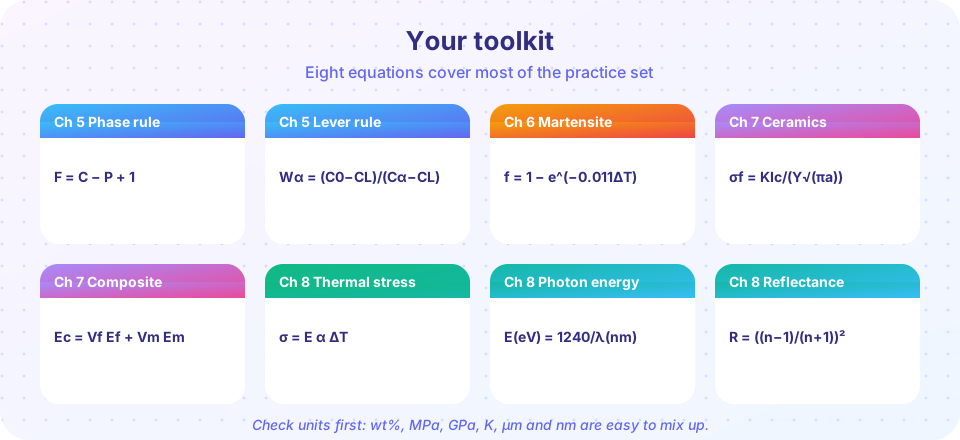
Ten worked-style practice problems covering lever rule, steel microstructure, martensite, Griffith fracture, Weibull, composites, thermal stress, optics, resistance and tempering.
Reading is not the same as being able to do it. This set gives you ten problems that use the equations from chapters 5 to 8. Try each one on paper first; then run the checker in Python to see if your number matches. Each problem gives the data you need, so no diagram reading is required.
What you will learn
- Apply the chapter's equations to numerical problems.
- Check your answers with a small program.
- Develop a habit of checking units and sanity limits.
Key terms
Sanity check: a quick test that a result is plausible (fractions between 0 and 1, stresses below the fracture stress, and so on).
Units: wt%, GPa, MPa, µm, nm, K and °C are easy to mix; write units on every line.
The problems
- Lever rule (isomorphous). A Cu–Ni alloy with 40 wt% Ni is held at a temperature where the liquid contains 33 wt% Ni and the solid contains 44 wt% Ni. What fraction is solid?
- Eutectic alloy. Pb–Sn with 30 wt% Sn is cooled to just below 183 °C. Use eutectic compositions 19.2, 61.9 and 97.5 wt% Sn. Find (a) the proeutectic α fraction, (b) the total α fraction and (c) the total β fraction.
- Steel. A slowly cooled 0.60 wt% C steel: find the proeutectoid ferrite fraction, the pearlite fraction and the total cementite fraction (α 0.022, eutectoid 0.76, Fe₃C 6.70 wt% C).
- Martensite. A steel with Ms = 250 °C is quenched to 20 °C. Using
f = 1 − exp[−0.011 (Ms − T)], what is the martensite fraction? - Griffith. Silicon nitride with K_Ic = 6 MPa·√m and Y = 1 contains a flaw of length a = 30 µm. Estimate the fracture stress.
- Weibull. A ceramic has σ₀ = 400 MPa and m = 8. What is the survival probability at 300 MPa?
- Composite. A carbon/epoxy laminate has Vf = 0.55, Ef = 230 GPa and Em = 3.5 GPa. Find the stiffness along and across the fibers.
- Thermal stress. An aluminum plate (E = 70 GPa, α = 23×10⁻⁶ K⁻¹) is fully constrained and heated by 60 K. What stress develops?
- Optical. Light of wavelength 520 nm strikes CdS (Eg = 2.4 eV). What is the photon energy and is it absorbed?
- Tempering. Tempering for 1 h at 350 °C gives a target hardness. Using
P = T(20 + log₁₀ t)(T in K, t in hours), how long at 400 °C gives the same P?
Check your answers
Press Run (or Ctrl + Enter) to see the result here.
Program input · what you'd type while the program runs
Type the answers before you press Run, one per line. Each time the program reads a line (with input()), it gets the next line from this box.
Press Run (or Ctrl + Enter) to see the console output here.
No output.
Worked answers and notes
Compare your results to the checker output:
- Problem 1: solid ≈ 0.64 (liquid 0.36); the alloy is closer to the solid end, so the solid dominates.
- Problem 2: proeutectic α ≈ 0.75; total α ≈ 0.86; total β ≈ 0.14.
- Problem 3: proeutectoid ferrite ≈ 0.22, pearlite ≈ 0.78, total cementite ≈ 0.087.
- Problem 4: about 92% martensite; the remaining 8% is retained austenite (in this simple model).
- Problem 5: about 620 MPa.
- Problem 6: survival ≈ 0.90, so about 10% of specimens fail by 300 MPa.
- Problem 7: along ≈ 128 GPa; across ≈ 7.6 GPa.
- Problem 8: about 97 MPa.
- Problem 9: 2.385 eV, just below the 2.4 eV gap, so the photon is barely not absorbed by CdS (real absorption edges are broadened by temperature and defects).
- Problem 10: about 0.033 h, roughly 2 minutes.
Common misconceptions
"If the numbers work out, the answer is right." A fraction above 1 or a stress above the strength of the material means a setup error; always sanity-check.
"Microconstituents and phases are the same." Problem 2 shows they give different numbers.
Check your understanding
Quick check · 4 questions
of 4 answered You scored / 4 · perfect!
-
1. In problem 2, why is the total alpha fraction larger than the proeutectic alpha fraction?
The eutectic microconstituent also contains alpha plates, so total alpha exceeds proeutectic alpha. -
2. Which check would catch a mistake in a lever-rule result?
Fractions are non-negative and add to one. -
3. A photon of 2.385 eV and a gap of 2.4 eV: absorbed?
A photon needs at least Eg to lift an electron across. -
4. Constraining aluminum while heating by 60 K produces about:
σ = E α ΔT = 70e9 × 23e-6 × 60 ≈ 9.7e7 Pa.
Summary
- Practice with real numbers builds fluency in the chapter's equations.
- Always check units and plausibility.
Next: Glossary
Track your progress
Create a free account to tick off lessons and pick up where you left off on any device.
of Materials Science lessons completed