


















Lesson 44 of 46 · Projects and Practice
Glossary: phases, metals, non-metals and properties
A glossary of materials science terms from phase diagrams, metals and alloys, ceramics, polymers, composites and electrical, thermal, optical and magnetic properties.
Materials science has its own vocabulary, and much of it is shared with chemistry, physics and engineering. This glossary collects the terms from chapters 5 to 8 with short definitions, grouped by chapter. Use it to look things up and to quiz yourself.
What you will learn
- Find the definition of any term from chapters 5 to 8.
- See how each term connects to processing, structure, properties or performance.
- Test your recall with a quick self-quiz.
Key terms
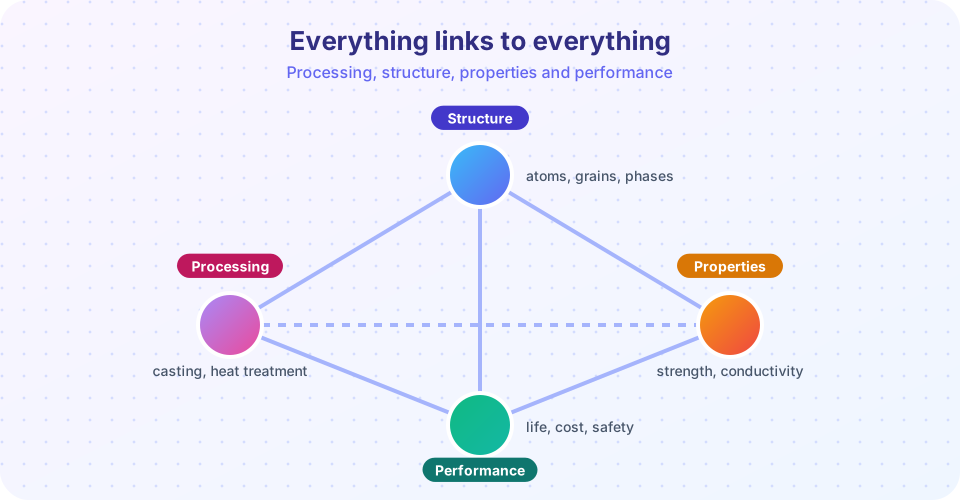
Processing: how a material is made and shaped (casting, forging, heat treatment, sintering).
Structure: its arrangement from atoms to grains to phases.
Properties: its measured response (strength, conductivity, color).
Performance: how it does in service (life, cost, safety).
Chapter 5: phase diagrams
| Term | Meaning |
|---|---|
| Phase | A region of uniform structure and composition |
| Component | An independent chemical species of the system |
| Equilibrium | The state of lowest free energy, reached with time |
| Solid solution | Solute atoms dissolved in a solvent crystal lattice |
| Substitutional / interstitial | Solute replaces a host atom / sits in a gap |
| Hume-Rothery rules | Size, structure, electronegativity and valence conditions for wide solubility |
| Gibbs phase rule | F = C − P + 1 at fixed pressure |
| Liquidus / solidus | Boundaries above which all is liquid / below which all is solid |
| Tie line | Horizontal line giving phase compositions |
| Lever rule | Phase fractions from tie-line arm lengths |
| Coring | Composition gradients in a rapidly cooled solid solution |
| Eutectic | L → α + β at one temperature |
| Eutectoid | γ → α + Fe₃C, a eutectic in the solid |
| Peritectic | L + α → β |
| Solvus | Solubility limit line in a solid |
| Proeutectic | Phase that forms before the eutectic reaction |
| Invariant reaction | A reaction with zero degrees of freedom |
Chapter 6: metals and alloys
| Term | Meaning |
|---|---|
| Ferrite (α) | BCC iron, at most ~0.022 wt% C, soft |
| Austenite (γ) | FCC iron, up to 2.14 wt% C |
| Cementite (Fe₃C) | Iron carbide, 6.70 wt% C, hard and brittle |
| Pearlite | Lamellar mixture of ferrite and cementite |
| Bainite | Fine ferrite and carbides formed at intermediate temperatures |
| Martensite | Supersaturated BCT phase from a diffusionless shear |
| TTT diagram | Transformation start and finish against time and temperature |
| Ms | Temperature at which martensite starts to form |
| Tempering | Reheating martensite to gain toughness |
| Hardenability | Depth to which a steel hardens on quenching |
| Annealing / normalizing | Slow / air cooling from austenite |
| Stainless steel | Steel with at least ~10.5 wt% Cr |
| Cast iron | Fe–C alloy with about 2 to 4 wt% C (gray, ductile, white, malleable) |
| Precipitation hardening | Strengthening by fine particles from aging |
| Brass / bronze | Cu–Zn / mainly Cu–Sn alloys |
Chapter 7: ceramics, polymers and composites
| Term | Meaning |
|---|---|
| Coordination number | Number of nearest neighbors around an ion |
| Radius ratio | r(cation)/R(anion), which guides coordination |
| Sintering | Densifying powder by heating below melting |
| Fracture toughness (K_Ic) | Resistance to crack growth, MPa·√m |
| Griffith criterion | σf = K_Ic/(Y√(πa)) |
| Weibull modulus (m) | Measure of strength scatter; larger is more consistent |
| Monomer / mer | Repeating unit of a polymer |
| Degree of polymerization | Mean number of mers per chain |
| Thermoplastic / thermoset / elastomer | Meltable / crosslinked rigid / stretchy network |
| Glass transition (Tg) | Glassy-to-rubbery change in an amorphous polymer |
| Crystallinity | Fraction of ordered chain-folded regions |
| Viscoelasticity | Combined elastic and viscous response |
| Matrix / reinforcement | Continuous phase / stiff strong phase of a composite |
| Rule of mixtures | Average of properties by volume fraction (with bounds) |
| Critical fiber length | l_c = σ_f d/(2τ_c) |
Chapter 8: electrical, thermal, optical and magnetic properties
| Term | Meaning |
|---|---|
| Resistivity (ρ) / conductivity (σ) | R = ρL/A; σ = 1/ρ = nqμ |
| Mobility | Drift velocity per unit field |
| Matthiessen's rule | Resistivities from different scattering add |
| Band gap (Eg) | Energy gap between valence and conduction bands |
| Intrinsic / extrinsic | Pure / doped semiconductor |
| Donor / acceptor | Dopant giving electrons (n-type) / holes (p-type) |
| Phonon | Quantum of lattice vibration |
| Thermal expansion coefficient (α) | ΔL/L₀ = αΔT |
| Thermal conductivity (k) | Heat flow per area per temperature gradient |
| Wiedemann–Franz law | k/(σT) = L, Lorenz number 2.44×10⁻⁸ W·Ω/K² |
| Thermal shock | Cracking from sudden temperature change |
| Refractive index (n) | c/v in the material |
| Beer–Lambert law | I = I₀ e^(−βx) |
| Ferromagnetism | Strong spontaneous alignment of moments in domains |
| Hysteresis | Lag of B behind H on field reversal |
| Coercivity / remanence | Reverse field to demagnetize / flux left at zero field |
| Curie temperature | Temperature above which ferromagnetism disappears |
Try it
Press Run (or Ctrl + Enter) to see the console output here.
No output.
Press Run (or Ctrl + Enter) to see the result here.
Program input · what you'd type while the program runs
Type the answers before you press Run, one per line. Each time the program reads a line (with input()), it gets the next line from this box.
Check your understanding
Quick check · 5 questions
of 5 answered You scored / 5 · perfect!
-
1. Which term names a phase transformation 'liquid → two solids'?
L → α + β is the eutectic reaction. -
2. What does Tg mean for an amorphous polymer?
At Tg the modulus falls roughly a thousandfold on heating. -
3. Which term describes a pure semiconductor whose carriers come from thermal excitation only?
Intrinsic semiconductors are undoped. -
4. Hardenability describes:
It is a measure of depth of hardening. -
5. In the tetrahedron, 'service life and cost' belong to:
Performance is how the material does in use.
Summary
- Terms from phase diagrams, metals, non-metals and functional properties are all linked through processing, structure, properties and performance.
- Use the tables to look up terms and the flashcard TryIt to self-test.
Next: Cheat sheet
Track your progress
Create a free account to tick off lessons and pick up where you left off on any device.
of Materials Science lessons completed