


















Lesson 45 of 46 · Projects and Practice
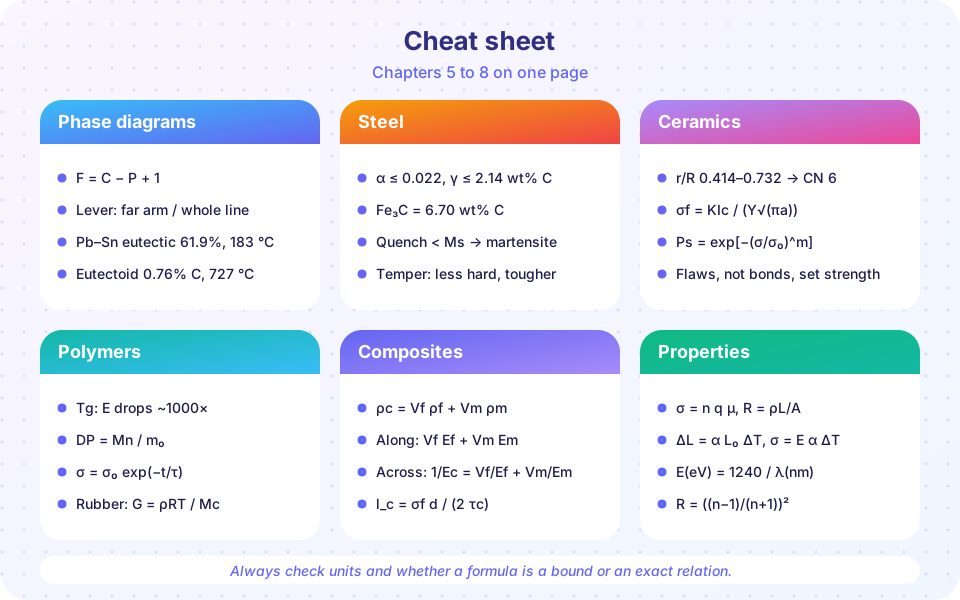
Cheat sheet: chapters 5 to 8 on one page
A one-page recap of phase diagrams, steel, ceramics, polymers, composites and functional properties: the key numbers, equations and decision rules in one place.
When you are solving a problem or revising before a test, you want the essentials on one page. This cheat sheet collects the numbers and equations from chapters 5 to 8. It is a memory aid, not a replacement for understanding: each line points back to a lesson.
What you will learn
- Recall the key numbers for Fe–C, Pb–Sn and Cu–Ni problems.
- Choose the right equation for a given problem.
- Convert between common units quickly.
Key terms
Bound: a limit on a property; for example, Voigt and Reuss give upper and lower bounds on composite stiffness.
Invariant: a reaction with F = 0, at fixed temperature and composition.
Numbers worth remembering
| Quantity | Value |
|---|---|
| Pb–Sn eutectic | 61.9 wt% Sn at 183 °C (α 19.2, β 97.5 wt% Sn) |
| Fe–C eutectoid | 0.76 wt% C at 727 °C |
| Fe–C eutectic | 4.30 wt% C at 1147 °C |
| Ferrite / austenite max carbon | 0.022 / 2.14 wt% C |
| Cementite | 6.70 wt% C |
| Silicon gap / density | 1.12 eV; 2.33 g/cm³ |
| Visible light | 400 to 750 nm, 3.1 to 1.65 eV |
| Curie temperatures | Ni 358 °C, Fe 770 °C, Co 1115 °C |
| Dulong–Petit | 3R ≈ 24.9 J/(mol·K) |
| Lorenz number | 2.44×10⁻⁸ W·Ω/K² |
Which equation do I use?
- "How much of each phase?" Draw a tie line, use the lever rule. Sum the fractions to 1.
- "What does this steel look like?" Compare carbon to 0.76 wt%: hypo (ferrite + pearlite), eutectoid (pearlite), hyper (cementite + pearlite).
- "How hard after quenching?" Compare cooling rate with the TTT nose; below Ms you get martensite; then temper.
- "Why did this ceramic break?" Griffith:
σf = K_Ic/(Y√(πa)); use Weibull for the scatter. - "Is this polymer stiff or rubbery?" Compare use temperature with Tg (and Tm).
- "What is the composite's stiffness?" Along fibers:
Vf Ef + Vm Em; across:1/Ec = Vf/Ef + Vm/Em. - "Will it conduct or absorb?" Compare gap Eg with the photon energy; metals have no gap.
- "How much does it expand, and what stress if held?"
ΔL = α L₀ ΔT;σ = E α ΔT.
Try it
Press Run (or Ctrl + Enter) to see the result here.
Program input · what you'd type while the program runs
Type the answers before you press Run, one per line. Each time the program reads a line (with input()), it gets the next line from this box.
Press Run (or Ctrl + Enter) to see the console output here.
No output.
Common misconceptions
"A cheat sheet replaces understanding." Equations apply only under their assumptions (equilibrium, fixed pressure, aligned fibers, normal incidence); know the limits.
"All numbers are exact." Properties vary with temper, temperature and source. Treat them as typical values.
Check your understanding
Quick check · 4 questions
of 4 answered You scored / 4 · perfect!
-
1. A 1.0 wt% C steel cooled slowly contains which proeutectoid phase?
Above the eutectoid composition, cementite forms along grain boundaries before pearlite. -
2. Which equation gives the stiffness of a composite along its fibers?
Isostrain rule of mixtures. -
3. A photon of wavelength 550 nm has energy about:
1240 / 550 ≈ 2.25 eV. -
4. What stress develops in a rigidly held steel bar (E = 200 GPa, α = 12×10⁻⁶ K⁻¹) heated by 50 K?
σ = 200e9 × 12e-6 × 50 = 1.2e8 Pa.
Summary
- Keep the numbers table and the "which equation" list at hand.
- Always state assumptions and check units.
Next: Further study
Track your progress
Create a free account to tick off lessons and pick up where you left off on any device.
of Materials Science lessons completed