


















Lesson 24 of 46 · Phase Diagrams
Eutectic systems and their microstructures
Read the Pb–Sn eutectic diagram, follow the eutectic reaction on cooling, and predict microstructures and phase fractions for hypoeutectic and hypereutectic alloys.
Why does solder melt at a lower temperature than either of the metals it is made from? Why do road crews spread salt on ice? Both answers live in the same kind of phase diagram: the eutectic system, where mixing two components lowers the melting temperature, and one particular mixture melts sharply at a single minimum temperature.
In this lesson you will walk through lead–tin (Pb–Sn), the classic eutectic system, follow alloys of different compositions as they cool, and calculate how much of each microstructural ingredient they contain. The skills carry straight into the iron–carbon diagram in the next chapter.
What you will learn
- Identify the regions, solvus lines and eutectic point of a eutectic diagram.
- Write and apply the eutectic reaction.
- Distinguish hypoeutectic, eutectic and hypereutectic alloys.
- Calculate primary (proeutectic) and eutectic microconstituent fractions.
- Explain why a eutectic composition is used for solder.
Key terms
Eutectic point: the composition and temperature where a liquid transforms directly into two solid phases.
Solvus: the boundary that marks the solubility limit of a solute in a solid phase.
Proeutectic phase: the solid that forms before the eutectic temperature is reached.
Microconstituent: a distinct structural ingredient, such as primary alpha or the eutectic mixture.
Invariant reaction: a reaction with F = 0; it happens at one fixed temperature and composition.
Anatomy of the diagram
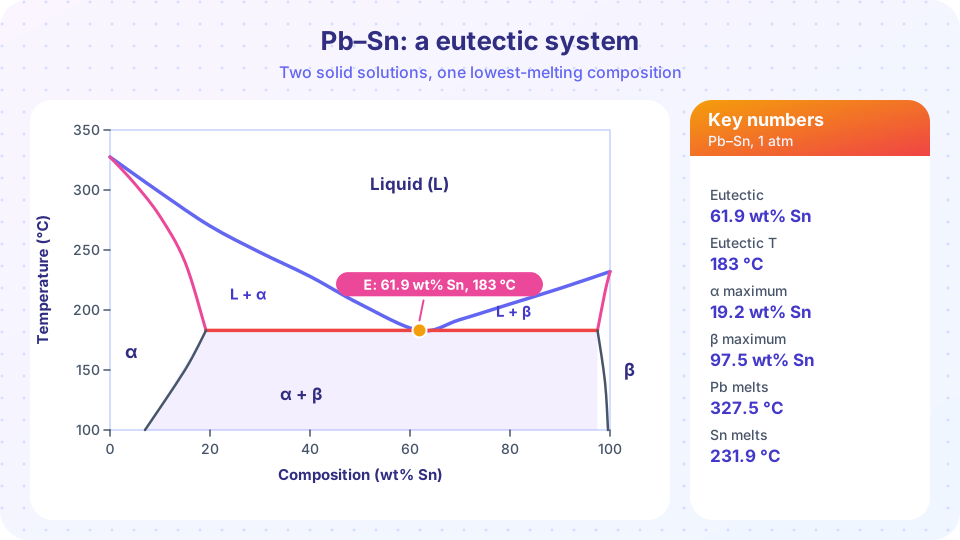
Lead melts at 327.5 °C and tin at about 232 °C. The two liquidus lines slope down from the pure-metal ends and meet at the eutectic point: 61.9 wt% Sn at 183 °C. Neither element dissolves much in the other, so there are two solid solutions: α, rich in lead, which can hold up to 19.2 wt% Sn at 183 °C; and β, rich in tin, which can hold up to 97.5 wt% Sn at the same temperature. The horizontal line at 183 °C connects the three compositions 19.2, 61.9 and 97.5. The curved lines that bend down from its ends are the solvus lines: they show the solubility shrinking as the alloy cools. In the broad region below the line the alloy is a mixture of two phases, α + β.
Apply the Gibbs rule at the eutectic line: C = 2 components, P = 3 phases (L, α, β), so F = 2 − 3 + 1 = 0. Nothing can change while all three phases coexist. The temperature stays pinned at 183 °C until the liquid is gone, which is why a cooling curve of a eutectic alloy shows a flat plateau, like a pure metal.
The eutectic reaction
On cooling through 183 °C the liquid of composition 61.9 wt% Sn transforms into two solids at once:
L (61.9 wt% Sn) → α (19.2 wt% Sn) + β (97.5 wt% Sn)
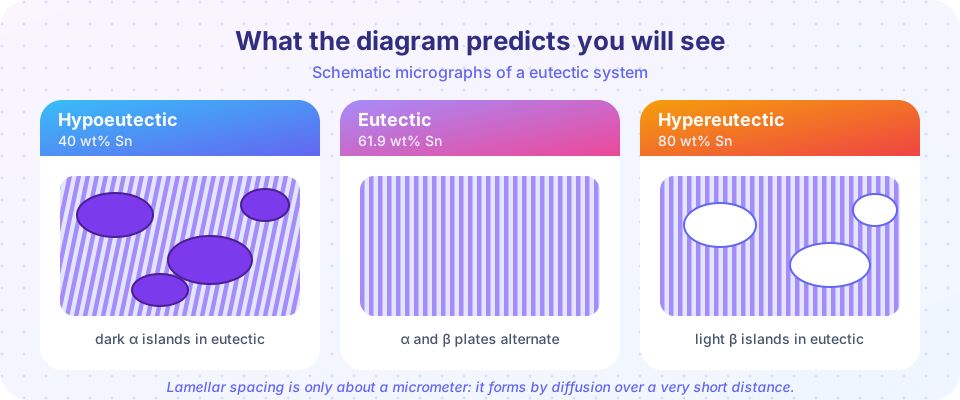
Both products have very different compositions from the liquid, so atoms must move. They only need to move a short distance: α and β grow side by side as thin plates, passing lead to one and tin to the other. This produces the fine, alternating structure called a lamellar eutectic, with a plate spacing around a micrometer. A fine structure like this is why eutectic alloys are strong and why they solidify with little shrinkage porosity, a big advantage for casting.
Hypoeutectic and hypereutectic alloys
An alloy with the eutectic composition (61.9 wt% Sn) melts and freezes at one temperature, which is exactly what you want in solder: no pasty, half-molten stage during which a joint might be disturbed. The traditional 63Sn–37Pb solder is very close to this composition.
Other alloys freeze over a range. Take 40 wt% Sn, which is hypoeutectic (less solute than the eutectic). Cooling from the liquid, the alloy crosses the liquidus at about 228 °C. Crystals of α start to form. They are the proeutectic α. As the temperature falls toward 183 °C the remaining liquid becomes richer in tin, following the liquidus, until it reaches 61.9 wt% Sn at 183 °C. The remaining liquid now transforms by the eutectic reaction. The final structure: large proeutectic α grains surrounded by the lamellar eutectic.
Fractions just below 183 °C, using the lever rule with the tie line from 19.2 to 61.9 wt% Sn (just above the line):
- Proeutectic α:
(61.9 − 40) / (61.9 − 19.2) = 21.9 / 42.7 ≈ 0.51 - Eutectic microconstituent:
1 − 0.51 ≈ 0.49
The eutectic itself contains α and β. Counting the total amount of each phase using the tie line 19.2 to 97.5 just below the line:
- Total α:
(97.5 − 40) / (97.5 − 19.2) = 57.5 / 78.3 ≈ 0.73 - Total β:
1 − 0.73 ≈ 0.27
The two ways of counting answer different questions. Microconstituents are what you see in the microscope; phases are what an X-ray diffraction pattern reports. A hypereutectic alloy (more than 61.9 wt% Sn) works the same way with proeutectic β in place of α.
Eutectics beyond solder
- Aluminum–silicon casting alloys: the eutectic is at about 12.6 wt% Si and 577 °C, giving excellent castability for engine blocks and wheels.
- Salt and water: the NaCl–H₂O eutectic is near −21 °C at about 23 wt% NaCl, the reason road salt melts ice well below 0 °C but not on the coldest days.
- Cast iron: iron and carbon form a eutectic near 4.3 wt% C at 1147 °C. You will meet it in the next chapter.
Two other invariant reactions are worth naming now. A eutectoid reaction is a eutectic that happens inside the solid, γ → α + β; the Fe–C diagram has one. A peritectic reaction is L + α → β, a liquid and a solid combining into a new solid.
Common misconceptions
"Eutectic means the strongest alloy." It means the lowest melting composition. Strength depends on the microstructure.
"Below 183 °C the alloy is α + β only at the eutectic composition." Every composition between the two solvus lines is α + β below the line; they differ in the amounts and the microstructure.
"Phase fractions equal microconstituent fractions." They answer different questions; compute the one you need.
Try it
Press Run (or Ctrl + Enter) to see the result here.
Program input · what you'd type while the program runs
Type the answers before you press Run, one per line. Each time the program reads a line (with input()), it gets the next line from this box.
Check your understanding
Quick check · 5 questions
of 5 answered You scored / 5 · perfect!
-
1. What is the eutectic composition and temperature in the Pb–Sn system?
The eutectic point is at 61.9 wt% Sn and 183 °C, where the liquidus lines meet. -
2. How many degrees of freedom exist along the eutectic line of a binary system at fixed pressure?
F = C - P + 1 = 2 - 3 + 1 = 0: the temperature is pinned until the liquid is gone. -
3. Which reaction describes the eutectic transformation?
On cooling, one liquid transforms into two solids. The last option is a eutectoid, which happens in the solid state. -
4. A 40 wt% Sn alloy cooled to just below 183 °C is about 51% proeutectic alpha. What is the rest?
The remaining 49% froze as the eutectic mixture of alpha and beta plates. -
5. Why is a near-eutectic Sn-Pb alloy popular for electronics solder?
A eutectic freezes at one temperature, so the joint goes from liquid to solid quickly and is less likely to be disturbed.
Summary
- A eutectic system has a minimum melting point where liquid → α + β at fixed temperature and composition.
- Pb–Sn: eutectic at 61.9 wt% Sn and 183 °C; solubility limits 19.2 wt% (α) and 97.5 wt% (β).
- The eutectic line is an invariant (F = 0) and forms a fine lamellar mixture.
- Hypo- and hypereutectic alloys contain proeutectic grains plus eutectic; the lever rule gives both microconstituent and phase fractions.
- Eutectic behavior explains solder, Al–Si castings and salt on ice.
Track your progress
Create a free account to tick off lessons and pick up where you left off on any device.
of Materials Science lessons completed