


















Lesson 8 of 46 · Atomic Structure and Bonding
Primary Bonds: Ionic, Covalent and Metallic
Compare ionic, covalent and metallic bonding, calculate the Coulomb energy of NaCl, estimate percent ionic character, and meet the weaker secondary bonds.
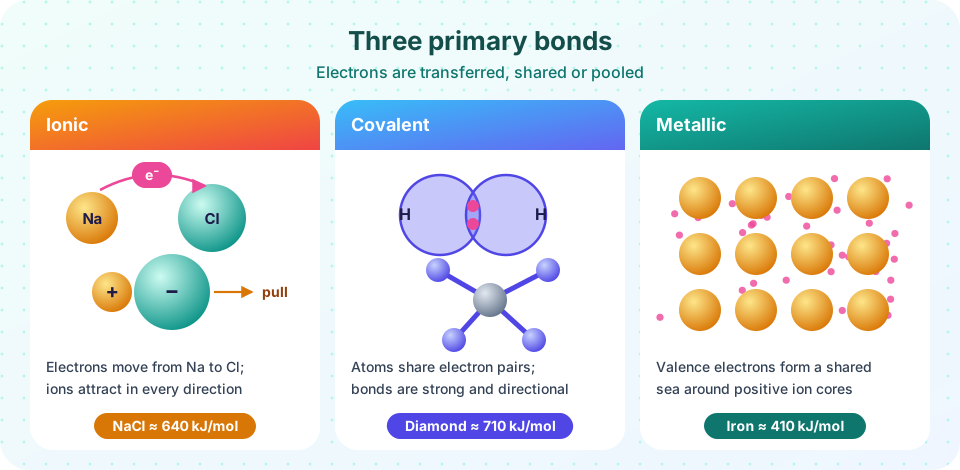
Atoms bond by rearranging their valence electrons. There are three ways to do it. Atoms can hand electrons over completely (ionic bonding), share them in pairs (covalent bonding), or release them into a communal pool (metallic bonding). These three primary bonds, plus the weaker secondary bonds that act between molecules, give the five material classes their personalities. In this lesson you will compare them, calculate the energy of a real ionic crystal, and learn to estimate how ionic a bond is from electronegativity alone.
What you will learn
- How ionic, covalent and metallic bonds form and what each does to properties.
- How to estimate Coulomb attraction and lattice energy for an ionic crystal.
- How to compute percent ionic character from electronegativity.
- What secondary bonds are and where they matter (polymers, water, solid argon).
Key terms
Ion: an atom that has gained or lost electrons and carries a net charge.
Coulomb's law: the force between charges, F = k q₁q₂ / r² with k = 8.988 × 10⁹ N·m²/C².
Lattice energy: the energy released when separated gaseous ions come together to form a crystal.
Directional bond: a bond that prefers a particular angle, as in diamond (109.5° between bonds).
Ionic bonding
Sodium has one loose valence electron (ionization energy 5.14 eV) and chlorine badly wants one more. If sodium gives its electron to chlorine, both get filled outer shells and become ions, Na⁺ and Cl⁻. The ions attract each other by the Coulomb force, which acts in all directions. In a crystal each Na⁺ is surrounded by six Cl⁻ and vice versa, so the bonding is non-directional and each ion pulls on all of its neighbors.
For an isolated pair at distance r the energy is U = −k e² / r. With r = 0.282 nm (the Na–Cl spacing in the crystal), k e² = 2.307 × 10⁻²⁸ J·m gives U = −8.18 × 10⁻¹⁹ J = −5.1 eV. In a crystal each ion feels all the other ions, some attractive and some repulsive. Summing over the lattice gives a geometry constant, the Madelung constant M (1.7476 for the rock-salt structure of NaCl). The lattice energy per mole is approximately
U = −(M N_A k e² / r₀)(1 − 1/n)
where n (near 8 for NaCl) describes the short-range repulsion. The program below evaluates it and finds about 750 kJ/mol, close to the experimental value of 787 kJ/mol.
Properties follow from the bonding. Ionic solids are hard and have high melting points (801 °C for NaCl, 2852 °C for MgO, whose ions carry double charges). They are electrical insulators when solid, because the ions are locked in place, but conduct when melted or dissolved. And they are brittle: if one plane of ions slides by half a spacing, like charges come face to face and repel, so the crystal cleaves instead of deforming.
Press Run (or Ctrl + Enter) to see the result here.
Program input · what you'd type while the program runs
Type the answers before you press Run, one per line. Each time the program reads a line (with input()), it gets the next line from this box.
Covalent bonding
When both atoms want electrons, neither can win them outright, so they share them. Two hydrogen atoms form H₂ by overlapping their 1s orbitals so that the pair of electrons spends time between the nuclei. Carbon, with four valence electrons, can share with four neighbors. The sharing is along particular directions, giving directional bonds with fixed angles: 109.5° in diamond and in silicon, where each atom sits at the center of a tetrahedron.
Covalent bonds are strong (450 kJ/mol in silicon, about 710 in diamond) and rigid, so covalent solids are hard and have high melting points. They tend to be brittle as well, because moving atoms past each other requires breaking directional bonds. Electrical behavior ranges from insulating (diamond) to semiconducting (silicon). The long carbon chains of polymers use covalent bonds along the chain, but the chains are held to each other by weak secondary bonds, which is why polymers are soft and melt at low temperatures.
Metallic bonding
Metal atoms have few, loosely held valence electrons. In a metal crystal these electrons detach and move freely through the whole lattice, forming an electron sea around positive ion cores. The bonding is non-directional, since the sea attracts the ion cores however they are arranged. Two things follow. Metals conduct electricity and heat well, because the electrons can move. And metals are ductile: planes of ions can slide over each other while the electron sea keeps holding them together, so metals deform without fracturing. Bond strength ranges widely, from mercury (about 65 kJ/mol, liquid at room temperature) to tungsten (about 850 kJ/mol), which depends on how many d electrons contribute.
Mixed bonds and percent ionic character
Most real bonds are partly ionic and partly covalent. Pauling suggested that the fraction of ionic character depends on the electronegativity difference:
%IC = [1 − exp(−0.25 (X_A − X_B)²)] × 100
Hydrogen fluoride, with ΔX = 1.78, is 55 % ionic; gallium arsenide, with ΔX = 0.37, is only about 3 %. As a rough rule, bonds with ΔX above about 1.7 behave ionically and those below 0.5 behave covalently. The Van Arkel–Ketelaar triangle puts ionic, covalent and metallic bonding at the corners of a triangle and places real compounds inside it.
Press Run (or Ctrl + Enter) to see the result here.
Program input · what you'd type while the program runs
Type the answers before you press Run, one per line. Each time the program reads a line (with input()), it gets the next line from this box.
Secondary bonds
Even atoms that cannot bond in the primary ways attract each other weakly. Van der Waals bonds arise from momentary shifts of electron clouds, which create tiny fluctuating dipoles that attract each other. They hold solid argon together (about 8 kJ/mol) and the chains of polyethylene to one another. Hydrogen bonds are stronger (about 20 to 50 kJ/mol). They act when a hydrogen atom attached to oxygen, nitrogen or fluorine is attracted to a lone pair on a neighboring molecule. Hydrogen bonds explain why ice is less dense than liquid water, and they give nylon and cellulose their strength. Secondary bonds are weak compared with k_B T at high temperature, so materials that rely on them soften and melt easily.
Common misconceptions
"Ionic compounds consist of molecules." A crystal of NaCl is one giant lattice. There is no separate "NaCl molecule" in the solid.
"Covalent solids are always insulators." Silicon is a semiconductor, and graphite conducts along its sheets.
"Metals are ductile because their bonds are weak." They are ductile because metallic bonding is non-directional, so planes can slide without breaking the bond. Tungsten has strong metallic bonds and is still ductile at high temperature.
Check your understanding
Quick check · 5 questions
of 5 answered You scored / 5 · perfect!
-
1. Which bond is formed by complete transfer of electrons?
Ionic bonds arise when one atom gives electrons to another, producing attracting ions. -
2. Why are ionic crystals brittle?
A shift of half a spacing puts like ions face to face; the crystal cleaves instead of flowing. -
3. Which feature makes metals good electrical conductors?
The electron sea carries charge. -
4. A bond between two atoms with an electronegativity difference of 2.2 is most likely
Differences above about 1.7 give mostly ionic bonds. -
5. Which interaction holds polyethylene chains together?
Along the chain the bonds are covalent, but the chains are bound to each other only weakly.
Summary
- Ionic bonds transfer electrons and give hard, brittle, insulating crystals with non-directional attraction.
- Covalent bonds share electrons in fixed directions and give hard, rigid, often brittle solids.
- Metallic bonds pool electrons, giving conduction and ductility.
- Real bonds are mixed; percent ionic character is
[1 − exp(−0.25 ΔX²)] × 100. - Secondary bonds (van der Waals, hydrogen) are weak but decisive in polymers, water and noble-gas solids.
Track your progress
Create a free account to tick off lessons and pick up where you left off on any device.
of Materials Science lessons completed