


















Lesson 30 of 46 · Metals and Alloys
Chapter review: metals and alloys
Review Chapter 6: the iron–carbon diagram, TTT and martensite, tempering, steel and cast iron families, precipitation hardening, with a recap table and ten-question quiz.
This chapter took you from the iron–carbon diagram to the alloys in everyday objects. Use this page to recap and test yourself before moving on to ceramics, polymers and composites.
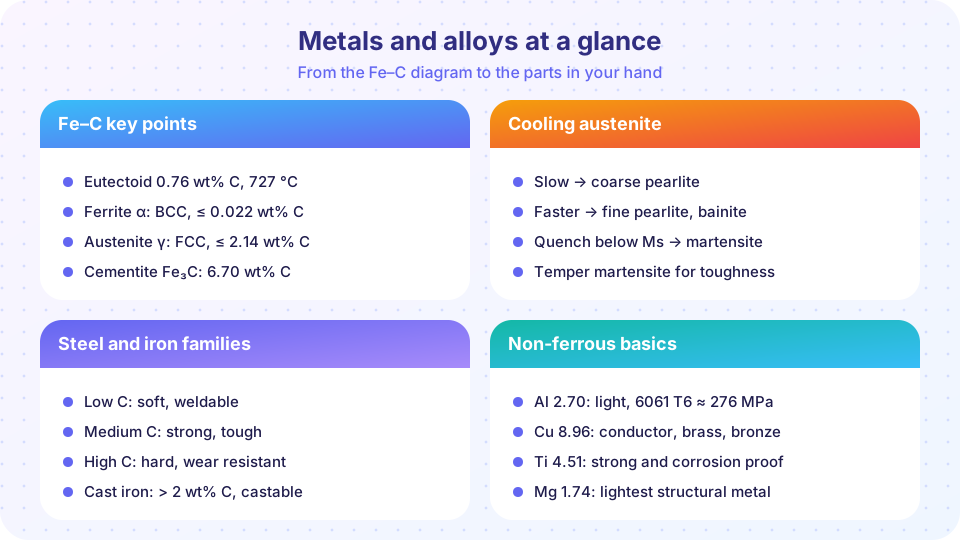
Chapter in one table
| Topic | Key facts |
|---|---|
| Ferrite α | BCC, ≤ 0.022 wt% C, soft |
| Austenite γ | FCC, ≤ 2.14 wt% C, above 727 °C in plain steel |
| Cementite Fe₃C | 6.70 wt% C, hard, brittle |
| Eutectoid | 0.76 wt% C, 727 °C, γ → α + Fe₃C = pearlite |
| Eutectic (cast iron) | 4.30 wt% C, 1147 °C |
| Pearlite / bainite / martensite | Slow / intermediate / fast cooling; martensite is diffusionless |
| Tempering | Reheat martensite for toughness |
| Hardenability | Alloying moves C-curves right |
| Cast irons | Gray (flakes), ductile (nodules), white, malleable |
| Precipitation hardening | Solution treat, quench, age |
Try it
Press Run (or Ctrl + Enter) to see the result here.
Program input · what you'd type while the program runs
Type the answers before you press Run, one per line. Each time the program reads a line (with input()), it gets the next line from this box.
Press Run (or Ctrl + Enter) to see the console output here.
No output.
Check your understanding
Quick check · 10 questions
of 10 answered You scored / 10 · perfect!
-
1. Which phase has BCC structure and holds at most about 0.022 wt% C?
Ferrite (α) is BCC iron with very low carbon solubility. -
2. What forms when austenite of 0.76 wt% C cools slowly through 727 °C?
The eutectoid reaction gives pearlite, alternating ferrite and cementite plates. -
3. What fraction of a slowly cooled 0.40 wt% C steel is pearlite?
Pearlite = 1 - 0.49 = 0.51, since proeutectoid ferrite is 0.49. -
4. Martensite forms when:
Fast quenching avoids diffusion-controlled products and shears austenite into martensite. -
5. What is the purpose of tempering?
Reheating martensite lets carbon form carbides and relieves stress. -
6. Which cast iron owes its ductility to nodular graphite?
Magnesium treatment makes graphite round, blunting cracks. -
7. Why is stainless steel 'stainless'?
The chromium oxide layer is thin, adherent and self-healing. -
8. Order the steps of precipitation hardening.
The supersaturated solid solution made by quenching decomposes into fine precipitates on aging. -
9. Which has the lower density?
Magnesium is the lightest common structural metal. -
10. What does hardenability describe?
Hardenability is about depth of hardening, which alloying elements increase by delaying pearlite and bainite.
Summary
- Fe–C phases and the eutectoid explain pearlite and the steel families.
- Cooling rate decides pearlite, bainite or martensite; tempering restores toughness.
- Alloys are chosen for strength, weight, corrosion resistance and cost.
Track your progress
Create a free account to tick off lessons and pick up where you left off on any device.
of Materials Science lessons completed