


















Lesson 17 of 46 · Mechanical Properties
Chapter 4 Overview: Mechanical Properties
Meet stress, strain and the tensile test, the main mechanical properties (stiffness, strength, ductility, toughness), and a map of the mechanical properties chapter.
Every structure carries loads. A bridge deck bends under traffic, an aircraft wing flexes in turbulence, a hip implant is loaded about a million times a year, and a turbine blade is pulled by centrifugal force at red heat. Whether these parts work depends on a handful of mechanical properties: how much the material stretches (stiffness), how much load it can take before it deforms permanently (yield strength) or breaks (tensile strength), how much it can deform before failing (ductility) and how much energy it absorbs (toughness). This chapter defines them, shows how they are measured, and ties them back to the dislocations and bonds of the previous two chapters.
What you will learn
- The definitions of stress and strain, and the types of loading.
- How a tensile test works and what it reveals.
- The five main mechanical properties and the chapter's lessons.
- How ceramics, metals, polymers and elastomers differ in their stress-strain curves.
Key terms
Stress σ: force divided by the area it acts on, σ = F/A, in Pa or MPa.
Strain ε: the fractional change in length, ε = ΔL/L₀, dimensionless.
Elastic deformation: deformation that disappears when the load is removed.
Plastic deformation: permanent deformation that remains after unloading.
How materials are loaded
What we measure
How parts fail
Stress and strain
If you pull a rod with a force F and the rod has cross-section area A, the average stress is σ = F/A. One MPa equals one newton per square millimeter, so a 10 mm diameter rod (area 78.5 mm²) pulled with 20 kN carries 255 MPa. Dividing by area removes the size of the specimen: a thick rod and a thin one of the same material fail at the same stress, though at different forces. In the same way strain ε = ΔL/L₀ removes the original length: 1 mm of stretch in 100 mm and 10 mm in 1000 mm are the same strain, 0.01 or 1 %.
Stress comes in two forms. Normal stress acts perpendicular to a surface (tension or compression). Shear stress τ acts parallel to it and is responsible for plastic slip, as chapter 3's dislocations suggest. Real parts are usually in a combination: a beam under a transverse load has tension on one face and compression on the other, and a drive shaft is in torsion, which produces shear.
The tensile test
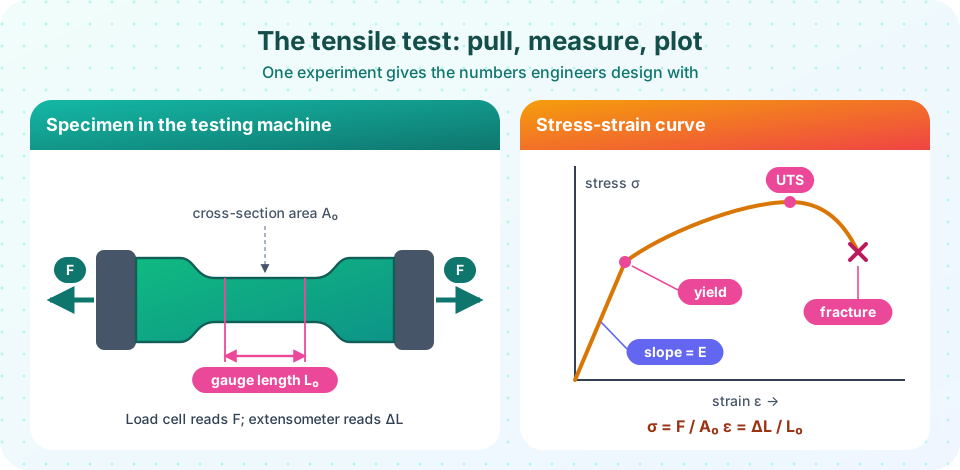
The standard way to measure stress-strain behavior is the tensile test. A specimen with a narrow, uniform "gauge" section is clamped in grips and pulled at a constant slow rate until it breaks. A load cell records the force and an extensometer records the elongation of a marked gauge length. Dividing force by the original area gives engineering stress, and elongation by the original length gives engineering strain. The plot of stress against strain is the stress-strain curve, and standardized test procedures (ASTM E8, ISO 6892) make results comparable across laboratories.
The shape of the curve depends on the material class:
- Ceramics are stiff, strong and brittle: the curve is a straight line that ends at fracture at a strain of about 0.1 %.
- Metals show a straight elastic part, then yielding and a long plastic region in which they strengthen (strain hardening), a maximum stress (the tensile strength), and necking before fracture.
- Thermoplastic polymers are about a hundred times less stiff; many yield, neck and draw into a fiber-like state at strains of tens or hundreds of percent.
- Elastomers (rubbers) stretch to several times their length elastically, with a curved response.
Press Run (or Ctrl + Enter) to see the result here.
Program input · what you'd type while the program runs
Type the answers before you press Run, one per line. Each time the program reads a line (with input()), it gets the next line from this box.
The five properties
The chapter introduces five measures taken from the stress-strain curve:
- Stiffness is
E, the slope of the elastic region (lesson on stress and strain). - Strength has two versions: yield strength
σ_y, the stress at which plastic deformation starts, and tensile strengthσ_TS(also called ultimate tensile strength, UTS), the maximum engineering stress. - Ductility is the plastic strain at fracture, quoted as percent elongation or percent reduction in area.
- Toughness is the energy absorbed up to fracture, the area under the curve.
- Hardness is resistance to local indentation, easy to measure and correlated with strength.
Each is a different number. A ceramic has high stiffness and compressive strength but low toughness; a rubber has low stiffness and high toughness for its density; a mild steel has moderate stiffness, strength and very high ductility. Which one matters depends on the application.
What each lesson covers
| Lesson | What it covers |
|---|---|
| Stress-strain behavior | Engineering and true stress, Hooke's law, elastic constants, yield, UTS, ductility, toughness |
| Plastic deformation and strengthening | Slip, Schmid's law, strengthening mechanisms, strain hardening, hardness |
| Fracture, fatigue and creep | Stress concentration, fracture toughness, S-N curves, Paris law, creep |
| Chapter 4 review | Recap and ten questions |
Try it
Choose a material and a load, and the tool shows the stress, strain and elongation of a 1 m rod of 10 mm diameter (Hooke's law, valid only while the stress stays below yield). Typical values are used.
Common misconceptions
"Strong and stiff mean the same thing." Stiffness is resistance to elastic stretch (E); strength is the stress at which yielding or fracture begins. Glass is stiff but weak in tension; spring steel is not stiffer than ordinary steel but much stronger.
"Stress is force." Stress is force per area. A pencil lead and a steel cable can carry the same force but at very different stresses.
"Elastic means flexible." In mechanics, elastic means recoverable. Steel springs are elastic and stiff; putty is flexible but not elastic.
Check your understanding
Quick check · 5 questions
of 5 answered You scored / 5 · perfect!
-
1. A 10 mm diameter rod (78.5 mm²) carries 20 kN in tension. The stress is about
20 000 N / 78.5 mm² = 255 N/mm² = 255 MPa. -
2. Strain is
ε = ΔL/L₀, a dimensionless ratio. -
3. Which property is the area under the stress-strain curve?
The area is energy absorbed per unit volume up to fracture. -
4. A brittle ceramic's stress-strain curve in tension is
Ceramics have no plastic region at room temperature. -
5. Which phrase describes elastic deformation?
Elastic strain disappears upon unloading; plastic strain remains.
Summary
- Stress is force per area (MPa = N/mm²) and strain is relative elongation; both remove the size of the specimen.
- The tensile test gives the stress-strain curve, from which stiffness, yield strength, tensile strength, ductility and toughness are read.
- Ceramics, metals, thermoplastics and elastomers have characteristic curve shapes.
- Parts fail by fracture, fatigue or creep, topics of the third lesson.
Next: Stress-Strain Behavior
Track your progress
Create a free account to tick off lessons and pick up where you left off on any device.
of Materials Science lessons completed