


















Lesson 16 of 48 · Vocabulary and Spaced Repetition
Chapter 3 review: Vocabulary and spaced repetition
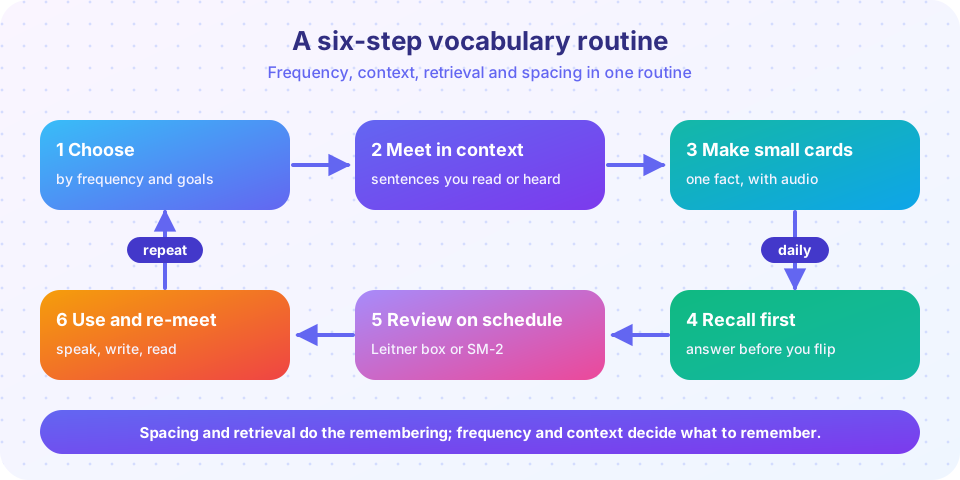
A one-picture recap of Chapter 3 on word knowledge, forgetting, spacing, retrieval practice and frequency, with an SM-2 scheduler demo and a ten-question quiz.
Chapter 3 turned vocabulary from a vague worry into a plan. A word is more than a translation. Memory fades in a predictable way. Reviews should be spaced and should force recall. And the words you choose should follow frequency and your own goals. This review puts the pieces together as one routine, then tests you.
What you will learn
- A single routine that combines the chapter's findings
- How the classic SM-2 algorithm chooses review dates
- Which claims are strong and which are provisional
Key terms
Word family: a base word and its regular related forms.
Spacing effect: spread-out study is remembered better than massed study.
Testing effect: retrieval beats restudy for lasting memory.
Zipf's law: frequency is roughly inversely proportional to rank.
SM-2: an algorithm by Piotr Woźniak (1987) that multiplies review intervals by an ease factor.
The chapter in a table
| Idea | What it says | Key names | Strength of evidence |
|---|---|---|---|
| Knowing a word | Form, meaning and use; receptive is larger than productive | Nation | Strong as a framework; sizes are estimates |
| Forgetting curve | Memory falls steeply, then slowly | Ebbinghaus; Murre and Dros | Strong shape; strength depends on material |
| Spacing | Spread reviews beat cramming; best gap grows with the target delay | Cepeda et al.; Bahrick et al. | Very strong in the laboratory; long-term language data are limited |
| Retrieval practice | Recalling beats rereading, especially after a delay | Roediger and Karpicke; Dunlosky et al. | Strong |
| Frequency | A small head of words covers much text; 95 to 98 percent coverage helps reading | Zipf; Nation; Schmitt et al. | Strong pattern, but lists depend on the corpus |
A routine that fits the evidence
- Choose a block of words from a frequency list that fits your goal, plus a few personal topic words and useful chunks.
- Meet them in context. Find each word in a sentence or two, ideally from material you read or heard.
- Make small cards. One fact per card. Add audio and a cloze or example sentence.
- Recall before you flip. Say or type the answer first.
- Review on a schedule. A tool with spaced repetition, or a Leitner box, decides the dates. Do the due reviews daily.
- Meet the words again. Reading and listening add depth: collocations, nuance and new senses.
- Use them. Write or say sentences with the words, so they move toward productive knowledge.
"The algorithm makes me learn." Software schedules reviews; it does not understand words for you. Words learned without context or use remain shallow.
"More new cards means faster progress." Reviews grow faster than new cards. Too many new cards leads to an unmanageable backlog and quitting.
"A single study proves this." Spacing and retrieval each have many replications, but the best schedule for language in the long term is still being refined.
Try it
The first demonstration implements the classic SM-2 rule. After each review you give a grade from 0 to 5. A grade below 3 resets the card. Otherwise the interval is 1 day after the first success, 6 days after the second and then multiplied by the card's ease factor. The ease factor changes with your grades. Try different grade sequences.
Press Run (or Ctrl + Enter) to see the console output here.
No output.
The second demonstration turns the chapter into flashcards. Try to answer aloud before you flip.
Check your understanding
Quick check · 10 questions
of 10 answered You scored / 10 · perfect!
-
1. Which is NOT part of knowing a word in Nation's framework?
Nation lists form, meaning and use. -
2. What does the forgetting curve show?
Ebbinghaus found that most of the loss happens soon after learning. -
3. Cepeda et al. (2008) found that, as the retention interval grows, the best gap between sessions
Longer targets need longer gaps, but the proportion shrinks. -
4. Why might a learner prefer rereading to self-testing?
Familiarity feels like knowledge, but recall practice works better. -
5. In Karpicke and Roediger (2008), dropping a pair after one correct recall led to
Continued retrieval mattered a great deal for later memory. -
6. With SM-2, a grade below 3 causes the card to
Failing resets the repetition count and brings the card back soon. -
7. Which describes Zipf's law?
A small number of words account for a large share of text. -
8. What is a weakness of a frequency list?
Choose lists that match speaking, reading or academic goals. -
9. Why spread out near-synonyms rather than learning them together?
Studies found that semantic clustering can slow learning. -
10. Which routine step makes receptive knowledge productive?
Production practice builds the ability to retrieve and use the word.
Summary
- Know words in depth: form, meaning and use.
- Space reviews and force recall; keep retrieving after the first success.
- Choose words by frequency and goals; add chunks and topic words.
- Use a scheduler (Leitner or SM-2) and keep new cards manageable.
- Chapter 4 moves from words on a screen to the sounds you hear and say.
Track your progress
Create a free account to tick off lessons and pick up where you left off on any device.
of How to Learn a Language lessons completed