


















Lesson 2 of 48 · Getting Started
Goals, fluency and what "good" means
Define your language-learning goal clearly: what fluency really means, how the CEFR scale works, why native-like is the wrong target, and how to write a goal you can test.
"I want to be fluent in French." It is the most common language goal in the world, and it is almost useless. Fluent at what? Ordering dinner, arguing about politics, reading a novel, or passing a job interview? A goal that cannot be tested cannot guide your study, and it cannot tell you when you have made progress. This lesson replaces the vague word fluent with something you can measure and aim at.
Along the way you will meet the scale that most of the world uses to describe language ability, the Common European Framework of Reference (CEFR), and a few results from research that change how you should think about "good enough."
What you will learn
- Three common meanings of "fluent" and why they differ
- How the CEFR levels A1 to C2 describe ability in terms of tasks
- Why "sounding native" is a poor target, and what to aim at instead
- How to write a language goal that is specific, testable and time-bound
Key terms
Fluency: in the narrow sense, how smoothly and quickly you speak; in the everyday sense, general command of a language.
CEFR: the Common European Framework of Reference for Languages, published by the Council of Europe in 2001 and extended in a 2020 companion volume.
Can-do statement: a sentence describing a task you can perform, such as "I can describe my job in simple terms."
Multicompetence: Vivian Cook's idea that a person who knows two languages is not two monolinguals in one head, but a different kind of language user.
Proficiency: ability to use a language to do things, measured against a scale.
Three meanings of "fluent"
Researchers separate at least three meanings. Mixing them up causes most arguments about who is fluent.
Narrow fluency is about speed and smoothness. The applied linguist Paul Lennon, writing in 1990, described it as the ability to produce speech at a normal rate with few unnatural pauses and little hesitation. You can be fluent in this sense and still be wrong: a learner can chatter smoothly with a small vocabulary and many grammar errors. Fluency is only one of the things language testers measure, alongside accuracy and complexity.
Broad fluency is the everyday meaning: "she is fluent in Italian" means she handles most situations well. This is the meaning people usually intend, and it hides a huge range.
Functional ability is what an employer or a university actually cares about: can you do the task? Write a report, run a meeting, follow a lecture. This is what the CEFR describes.
Because the broad meaning is so loose, serious learners drop the word and describe tasks instead.
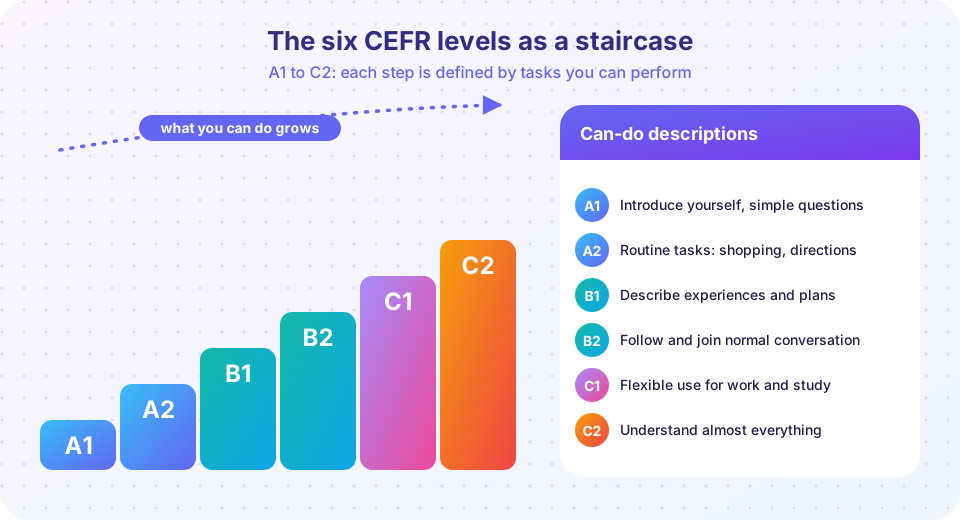
The CEFR: six steps defined by what you can do
The Council of Europe developed the CEFR so that schools, employers and exam boards in different countries could describe ability in a shared way. It has six levels in three bands.
| Band | Level | Short description |
|---|---|---|
| Basic user | A1 | Understand and use very familiar everyday phrases; introduce yourself; ask simple questions slowly answered |
| Basic user | A2 | Handle routine tasks: shopping, local geography, simple descriptions of background and immediate needs |
| Independent user | B1 | Deal with most situations while travelling; describe experiences, plans and opinions briefly |
| Independent user | B2 | Interact with a degree of fluency and spontaneity with native speakers; follow complex text on concrete and abstract topics |
| Proficient user | C1 | Use language flexibly for social, academic and professional purposes; produce clear, well-structured text |
| Proficient user | C2 | Understand virtually everything and express yourself precisely, even in complex situations |
These descriptions are paraphrases of the framework's ideas, written in our own words. The official can-do descriptors are much more detailed and cover reception, production, interaction and mediation (explaining or summarizing for someone else).
Three practical points about the CEFR.
- It is a scale of tasks, not of hours. The framework does not tell you how long each level takes. Estimates exist (you will see some in lesson 3 of this chapter), but they vary with language, learner and method.
- Skills are uneven. Most learners are not a single level. A typical self-learner might be B2 in reading, B1 in listening and A2 in speaking. A fair self-description gives one level per skill.
- Exams sample, they do not measure everything. A C1 certificate shows you performed at that level on a particular test day. It does not guarantee that you can handle every C1 task.
If your target language uses a different scale, such as ACTFL in the United States or the JLPT in Japan, the idea is the same: levels are defined by performance. Crosswalk tables exist, but they are approximate.
Native-like is the wrong target
Many learners quietly aim to be mistaken for a native speaker. Research gives three reasons to drop this target.
First, it is almost never reached. Studies of very successful late learners, for example the work of David Birdsong and others, find that a few individuals pass as native speakers on many tests, but they are exceptions, and careful testing often finds small differences even in them. A goal that almost nobody achieves is a poor way to measure progress.
Second, it is not necessary. Vivian Cook proposed the concept of multicompetence in 1992: the bilingual's knowledge is a distinct whole, and judging a second-language user only against a monolingual native speaker is like judging a swimmer by how well they run. People are understood and respected every day while speaking with an accent and with occasional errors.
Third, it misdirects effort. Munro and Derwing, who studied pronunciation for decades, found that accent, comprehensibility (how easy speech is to understand) and intelligibility (how much is actually understood) are partly separate. A speaker can have a strong accent and be perfectly easy to understand. For most goals, comprehensibility is the thing worth training; you will meet this in Chapter 4.
None of this means you should not care about quality. It means your target should be what you want to do with the language, not how much you resemble someone else.
"Fluent means never making mistakes." Native speakers make errors, pause, restart and search for words. Perfect accuracy is not a feature of fluency, and demanding it makes people stop speaking.
"Fluency is a single finish line." There is no moment at which you become fluent. You gain ability gradually, and at each stage you can do some things and not others.
Writing a goal you can test
A useful goal has four parts: a task, a context, a standard and a deadline. Compare these two.
- Vague: "Learn Spanish."
- Testable: "In nine months, hold a 15-minute conversation with a Spanish-speaking colleague about my work and weekend, understanding most of what she says, even if I need to ask for repetition twice."
The second goal tells you what to practice (talking about work and weekend plans), how to practice (conversation with a real person) and how to check (record the conversation, count the repetitions you needed). It is also honest: it accepts that you will ask for repetition.
A good method is to write three goals of different sizes.
- A 12-week goal: something you can test in three months, such as "understand a slow podcast episode for beginners with a transcript, 80% comprehension."
- A one-year goal: a CEFR level in one skill, or a real task.
- A "why" statement: one sentence about why you want this, because motivation is the thing that decides whether you are still studying in month eight. Psychologists such as Zoltán Dörnyei have argued that a vivid picture of yourself as a future user of the language, the ideal L2 self, is one of the more useful motivators. The evidence is moderate and comes mostly from questionnaires, but the idea is practical.
The next section lets you measure one narrow part of fluency yourself.
Try it
This first demonstration computes two simple numbers from a sample of speech: speech rate (words per minute including pauses) and articulation rate (words per minute while actually speaking). Researchers on fluency use measures like these. The recording times are made up for the demonstration.
Press Run (or Ctrl + Enter) to see the console output here.
No output.
The second demonstration is a can-do self-check. It is a demonstration of how scoring works, not a test: your honest answers produce a rough picture, nothing more.
Check your understanding
Quick check · 5 questions
of 5 answered You scored / 5 · perfect!
-
1. Why is 'I want to be fluent' a weak goal?
A goal should state a task, a context, a standard and a deadline so that you can tell whether you reached it. -
2. The CEFR levels are defined mainly by
The CEFR uses can-do descriptions of tasks. It does not state hours or vocabulary sizes. -
3. Which statement about accent is best supported by Munro and Derwing's work?
Strongly accented speech can be easy to understand, so training comprehensibility can matter more than reducing accent. -
4. Vivian Cook's idea of multicompetence suggests that
Multicompetence treats the bilingual's knowledge as a distinct whole, so native-likeness is not the only yardstick. -
5. A typical self-learner is most likely to
Skills develop unevenly, so describing yourself with one level per skill is more honest.
Summary
- "Fluent" has several meanings: smooth speech, general command, and functional ability. Say which you mean.
- The CEFR (A1 to C2) describes tasks you can perform; it does not specify study hours.
- Skills develop unevenly, so rate reading, listening, speaking and writing separately.
- Native-like is rarely achieved and rarely needed; comprehensibility is the more useful target.
- A good goal names a task, a context, a standard and a deadline.
Track your progress
Create a free account to tick off lessons and pick up where you left off on any device.
of How to Learn a Language lessons completed