


















Lesson 35 of 48 · Grammar Without Tears
Errors and interlanguage: reading your own mistakes
Why learner errors are evidence of a developing system, how transfer and overgeneralization show up, what fossilization is, and how to fix persistent errors.
Mistakes feel like failure, but to a researcher they look like data. When a learner says "I goed to school", the error shows something clever: the learner has noticed that English past tenses usually end in -ed and applied the pattern to a verb that does not follow it. Many children learning their first language do the same.
This lesson looks at what errors reveal, how to tell them apart, what research says about the order in which learners acquire grammar, and how to address errors that keep returning. It also takes a careful look at the idea of fossilization.
What you will learn
- What interlanguage means and why errors are informative.
- The main sources of errors: transfer, overgeneralization and slips.
- What research says about acquisition orders and readiness.
- What fossilization is, and how to work on persistent errors.
Key terms
Interlanguage: the learner's evolving language system, with rules of its own (Selinker, 1972).
Transfer: carrying patterns from your first language into the new one.
Overgeneralization: applying a rule to cases where it does not apply, such as goed.
Fossilization: the persistence of an error despite exposure and correction.
Errors as evidence
In 1967, Pit Corder published an influential paper, "The significance of learners' errors", arguing that errors are not just failures to be removed but evidence of the strategies learners are using. Larry Selinker (1972) coined the term interlanguage for the system that learners build on the way. It is influenced by their first language, by the input and by general learning strategies. Your interlanguage has rules, even when those rules differ from the target.
This view changes how you handle mistakes. Instead of "I made an error", you ask "what rule was I following?" That question suggests what to fix.
Three sources of mistakes
| Source | What it is | Example (English learner) |
|---|---|---|
| Transfer | A pattern carried from the first language | Saying "I am agree" because the learner's language says "I am in agreement" with the verb "to be" (French: je suis d'accord) |
| Overgeneralization | A rule used too widely | "She goed", "two sheeps" |
| Slip | A performance error you can correct yourself | Saying "he go" and fixing it right away |
Corder distinguished errors from mistakes: an error shows a gap in knowledge, while a mistake is a performance slip. A rough test is whether you can correct it yourself when you notice it. If yes, it may be a slip; if not, it is probably a gap. The distinction is not always sharp, and tiredness can turn gaps into slips and slips into gaps.
Earlier approaches, called contrastive analysis, tried to predict all errors by comparing the two languages. That worked for some errors but missed many that come from the learning process itself. Today researchers use both explanations.
The U-shaped path
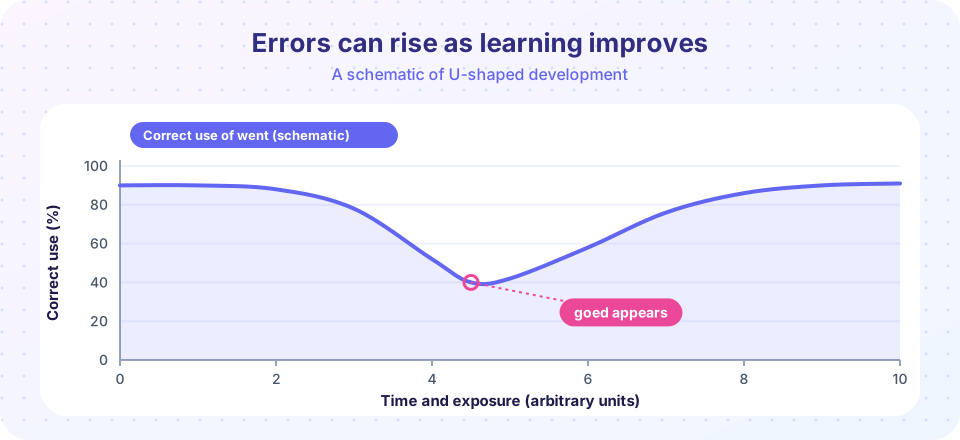
A striking pattern in language development is U-shaped behavior. In child first-language learning, researchers such as Stan Kuczaj (1977) described children who correctly say "went" early, then say "goed" for a while, then return to "went". The early correct form was memorized. The wrong form comes from learning the rule. The final form combines both.
Second language learners show similar patterns for some features. This means that an increase in errors can accompany real progress, which is useful to know when you feel you are getting worse.
Press Run (or Ctrl + Enter) to see the result here.
Program input · what you'd type while the program runs
Type the answers before you press Run, one per line. Each time the program reads a line (with input()), it gets the next line from this box.
The shape is real in the literature, though not every feature follows it, and individuals vary. The numbers here are illustrative.
Acquisition orders and readiness
In the 1970s, Heidi Dulay and Marina Burt studied the order in which children learning English as a second language produced certain grammatical morphemes (such as -ing and plural -s) correctly and found fairly consistent orders across children from different first languages. Roger Brown had earlier found a similar order for first-language learners. These findings suggested a natural order of acquisition.
Manfred Pienemann's work on German word order proposed stages learners pass through, so that instruction works only when a learner is ready for the next stage (the teachability hypothesis). Research on this is influential but contested, and results differ by feature.
The practical suggestion is moderate: expect a feature to take time, and do not be surprised when it appears and disappears. You can still practice it. You just should not read every error as failure to understand the lesson.
Fossilization: what is known and what is not
Selinker also proposed that some errors fossilize, that is, they persist in learners' speech for years despite exposure. The concept is widely used, but researchers debate it. Persistent errors do exist, especially in adult learners who have used the language mostly for communication and rarely received correction. But it is hard to show that an error cannot change, and some "fossilized" errors disappeared after the right kind of focused practice. A careful reading is that some errors are very stubborn, and that ignoring them is the surest way to keep them.
Stubborn errors often have a source: the first language supplies a pattern, communication works despite the error, and so there is no pressure to change.
Press Run (or Ctrl + Enter) to see the console output here.
No output.
The sample is invented. When you tag your own, remember that classification can be uncertain: the same error can have more than one source.
Fixing a persistent error
- Find it. Review your error log and choose one error that is both frequent and important for understanding.
- Notice it. Collect five correct examples from real texts and five of your own wrong ones. Contrast them side by side.
- Understand it. Check the rule or the difference from your first language.
- Practice it. Make ten short sentences using the correct form. Say them aloud.
- Monitor it. For a week, check that one point whenever you write.
- Ask for help. Tell a tutor or partner which error to flag.
Pick one error at a time. Trying to fix everything at once is overwhelming and is unlikely to work.
Reading an error: a short worked analysis
Take the sentence "She goed to the market yesterday." How would you analyze it?
- What is the intended meaning? She went to the market the previous day. The learner clearly knows that "yesterday" needs a past form.
- What rule is the learner following? Regular English verbs form the past with -ed, and the learner has applied it to go. The learner has the past tense idea but has not yet stored went as an exception, or retrieves it too slowly.
- Is it a slip or a gap? If the learner can correct it when asked "Is that right?", it may be a slip under time pressure. If not, it is a gap.
- What is the response? Praise what is right (tense, structure), and give the missing piece: go has an irregular past, went. Then practice the most common irregular verbs in short sentences and in reading.
Compare this with "She went to market yesterday", a different error (missing article) with a different source. A single learner has many error types, and each has its own cause and its own remedy. That is why an error log, rather than a general feeling of "my grammar is bad", is so useful.
Common misconceptions
"If I make an error, I did not learn the rule." You may know it and fail to apply it under pressure; errors in speech do not always mean a missing rule.
"Errors that persist are permanent." They are stubborn, not certainly permanent. Targeted practice and feedback can help.
"Children do not make errors." They make many and move on. Your errors are normal.
Check your understanding
Quick check · 5 questions
of 5 answered You scored / 5 · perfect!
-
1. What is interlanguage?
Selinker's term describes the system that learners build on the way to the target language. -
2. Which is an example of overgeneralization?
'Goed' applies the -ed rule where it does not apply. -
3. What is a quick test for a slip versus a gap?
A slip can usually be corrected when noticed; a gap cannot. -
4. What does U-shaped development show?
Correct memorized forms can give way to rule-based errors before recovering. -
5. What is the best-supported statement about fossilization?
The concept is used widely but debated; many stubborn errors respond to focused practice.
Summary
- Errors are evidence of an evolving system, not just failures.
- Sources include transfer, overgeneralization and slips; classification can be uncertain.
- U-shaped patterns show that more errors can accompany progress.
- Acquisition orders exist but vary; readiness and feature type matter.
- Fix one persistent error at a time with notice, understand, practice, monitor and feedback.
Track your progress
Create a free account to tick off lessons and pick up where you left off on any device.
of How to Learn a Language lessons completed