


















Lesson 34 of 48 · Grammar Without Tears
Patterns and chunks: grammar that you retrieve, not build
Why much of everyday speech is stored chunks, what Pawley and Syder, Sinclair and corpus research found, and how to collect chunks with slots.
Imagine you had to build every sentence from scratch: choose a verb, conjugate it, pick a tense, order the words, and attach the right small words. Fluent speech would be impossible. People manage because a large part of what we say is pre-assembled: phrases like "I was wondering if", "at the end of the day" and "to be honest" come out as wholes.
This has a hopeful consequence for learners. If you learn chunks along with the rules, you speak faster, sound more natural and have good examples of the grammar already built in. This lesson explains the research and gives you a practical method.
What you will learn
- What formulaic language is and how common it is.
- What evidence says about chunks and fluency.
- How the idiom principle differs from the open-choice principle.
- How to collect and practice chunks with slots.
Key terms
Formulaic sequence: a stretch of words that is stored and retrieved as a unit.
Collocation: words that appear together more often than chance, such as heavy rain.
Lexical bundle: a frequently recurring multi-word sequence, such as in the case of.
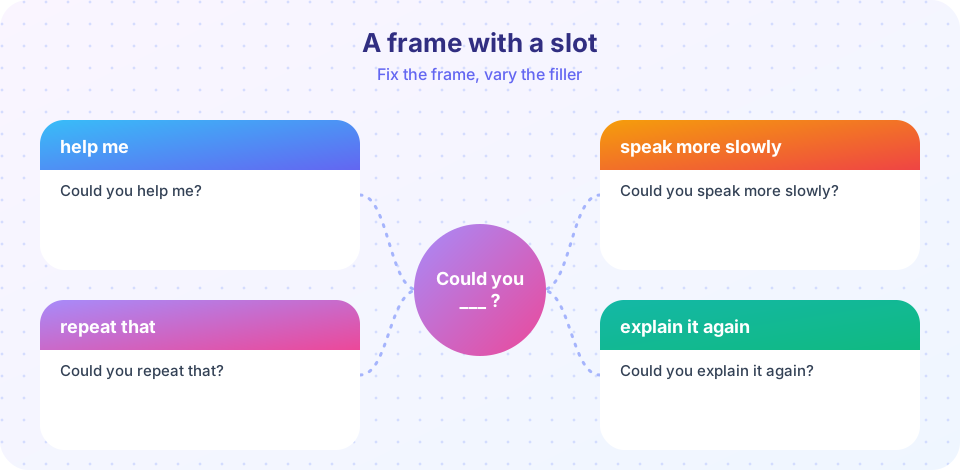
Frame with a slot: a chunk that has a gap for variable content, such as Could you ___ ?.
How much language is formulaic?
In an influential 1983 paper, Andrew Pawley and Frances Syder asked how native speakers produce fluent speech in real time given how slowly people can plan new sentences. Their answer was that speakers rely on a large store of lexicalized sentence stems, memorized units that can be adapted. They also noted that these units are partly arbitrary: you can say "I want to marry you" but not "I wish to be married to you" in the same casual context, even though both are grammatical. Knowing what sounds right takes more than rules.
The corpus linguist John Sinclair (1991) described two modes of language production:
- The open-choice principle: you can pick any word that fits the grammar.
- The idiom principle: you often choose from a set of semi-preset phrases.
Corpora, which are large collections of real text, show that the idiom principle is everywhere. Douglas Biber and colleagues found large numbers of recurring lexical bundles such as "I don't know if" in conversation and "on the basis of" in academic writing. Estimates of how much of a text is formulaic vary widely with how researchers define it, so remember that percentages quoted online depend on the definition.
Evidence for processing and fluency
Several lines of research suggest that formulaic language is processed differently from freely assembled phrases:
- Kathy Conklin and Norbert Schmitt (2008) found that native speakers read formulaic sequences faster than matched non-formulaic phrases, which fits the idea that they are retrieved as wholes. Non-native readers showed a smaller advantage, which suggests that the benefit grows with experience.
- Studies of learners who study formulaic sequences have found gains in fluency or naturalness ratings. For example, work by Frank Boers and colleagues (2006) reported that learners who had practiced chunks were rated as more fluent in speaking tasks. The effect sizes are modest and the studies small, so treat this as supportive rather than conclusive.
- Learners who use many chunks do not necessarily use more correct grammar. A chunk can be wrong, and some chunks are used without understanding their parts.
Overall, chunks seem to speed retrieval and help naturalness, while analysis of their parts helps flexibility. You want both.
Usage-based views of grammar
Researchers in the usage-based tradition, such as Nick Ellis, argue that grammar itself emerges from experience: learners store many examples, notice recurring patterns (constructions) and gradually generalize. On this view, chunks are not a side-issue. They are the raw material from which rules are built. A child who has heard "I want a ___" many times builds the frame first, and then understands the pattern.
This is consistent with the observation that learners often produce a correct chunk in one place and make a mistake with the same structure elsewhere. For example, a learner who says "I'd like a coffee" perfectly may still produce "I like go there" in another sentence. The chunk is stored; the underlying pattern is not yet general.
Finding chunks in text
You can see formulaic language by counting recurring word sequences (n-grams) in a text.
Press Run (or Ctrl + Enter) to see the result here.
Program input · what you'd type while the program runs
Type the answers before you press Run, one per line. Each time the program reads a line (with input()), it gets the next line from this box.
In a real corpus, tools called concordancers do this at scale. You do not need one; you can notice chunks while reading by underlining groups of words that sound like a unit.
Collecting chunks with slots
Instead of memorizing single words, collect small frames with gaps.
| Function | Frame | Example fillers |
|---|---|---|
| Asking politely | Could you ___ ? | help me, repeat that, speak slowly |
| Giving opinions | I think that ___ | it is a good idea, we should wait |
| Making plans | How about ___ ? | tomorrow, Friday at six |
| Checking meaning | What do you mean by ___ ? | that, "exactly" |
| Buying | I'd like ___ | a coffee, two tickets |
Notice that the grammar after each frame is built in: Could you is followed by a base verb. A learner who practices ten fillers per frame meets that rule ten times.
Press Run (or Ctrl + Enter) to see the console output here.
No output.
You can scale the idea up: ten frames and ten fillers each give a hundred sentences, built from patterns you actually own.
A practical routine
- Collect three to five chunks a day from what you read and hear, with the full sentence.
- Store them with the slot marked, in a notebook or a spaced repetition deck (see the vocabulary chapter).
- Vary them: make five new sentences per frame, saying them aloud.
- Use at least one in conversation or a message within a day.
Also learn a few collocations with each new word. Rather than learning "heavy" and "rain" separately, learn "heavy rain" and notice that a different word would sound odd.
A caution: do not translate chunks word by word
Chunks are specific to each language. The English phrase "by the way" does not translate word for word into most languages, and a literal translation of your first-language chunk often sounds odd in the target language. Learners who build sentences by translating their own chunks produce what teachers call "translationese": grammatical but unnatural phrases.
The fix is to collect chunks from the target language as they appear in real texts and speech, and to store them whole, with an example sentence. When you want to say something and cannot find a chunk, ask a tutor or search a corpus or example sentence dictionary for how speakers naturally say it, instead of translating. Over time you build a store of natural phrases that you can retrieve quickly, which is exactly what the research on formulaic language suggests fluent speakers rely on.
Common misconceptions
"Chunks are cheating." They are how fluent speakers speak. Knowing a chunk and analyzing it are complementary.
"Memorizing phrases means I do not need grammar." Chunks cover a lot, but novel messages need productive rules. Use chunks as examples and then vary them.
"A phrasebook is the same as chunk learning." A phrasebook gives phrases without practice. Chunk learning means practicing variation and using them in real talk.
Check your understanding
Quick check · 5 questions
of 5 answered You scored / 5 · perfect!
-
1. What did Pawley and Syder (1983) argue?
They proposed that native speakers use lexicalized sentence stems to speak fluently in real time. -
2. Sinclair's idiom principle says that speakers:
Language production often uses prefabricated phrases rather than free word-by-word choice. -
3. What did Conklin and Schmitt (2008) find?
This supports the idea that formulaic sequences are retrieved as units. -
4. Which is a frame with a slot?
A frame with a slot has a fixed part and a gap that can be filled in many ways. -
5. Why can a learner say 'I'd like a coffee' correctly but 'I like go there' wrongly?
Stored chunks can be correct while the general rule is not yet acquired.
Summary
- Much of fluent speech is retrieved from stored chunks, not built from rules.
- Pawley and Syder, Sinclair and corpus work describe formulaic language as widespread; quoted percentages depend on definitions.
- Evidence suggests chunks speed processing and naturalness, with modest effects for learners.
- Collect frames with slots and vary the fillers.
- Learn collocations with every new word.
Next: Errors and interlanguage
Track your progress
Create a free account to tick off lessons and pick up where you left off on any device.
of How to Learn a Language lessons completed