


















Lesson 1 of 48 · Getting Started
Course map: how this course works
Who this evidence-based language-learning course is for, how its nine chapters fit together, and how to study it so you actually remember and use what you learn.
Most people who try to learn a language quit within a year. They do not quit because they lack talent. They quit because nobody told them what the job actually involves: thousands of hours of exposure, a large vocabulary, a trained ear, and a habit that survives boring weeks. This course tells you what the job involves, using what researchers in second-language acquisition and the psychology of memory have found over the last fifty years.
It is not a course in any one language. It is a course about the process. You can take it with Spanish, Japanese, Arabic, Swahili or English as your target. Each lesson explains one idea, shows the study that supports it, says honestly where the evidence is thin, and gives you a small demonstration to try.
What you will learn
- What the nine chapters cover and why they come in this order
- Who the course is for and what you need before you start
- How to study the lessons so the ideas stick (using the course's own advice)
- What "evidence-based" means here, and where its limits are
Key terms
Second-language acquisition (SLA): the scientific study of how people learn languages after their first.
Target language: the language you are trying to learn.
Input: language you read or hear and understand, at least in part.
Output: language you produce by speaking or writing.
Proficiency: how well you can actually use a language, as opposed to how much you know about it.
Who this course is for
The course is for teenagers and adults, in any country, who want to learn a language on their own, with a class, with a tutor or through a mix of all three. You do not need to know any linguistics. When a technical word appears, it is defined the first time. You do need two things: a target language you care about, and a willingness to run small experiments on your own habits.
If you are a teacher, the research here will sound familiar, but the focus is the self-directed learner who has to make a hundred decisions that a school curriculum would normally make for them.
The nine chapters
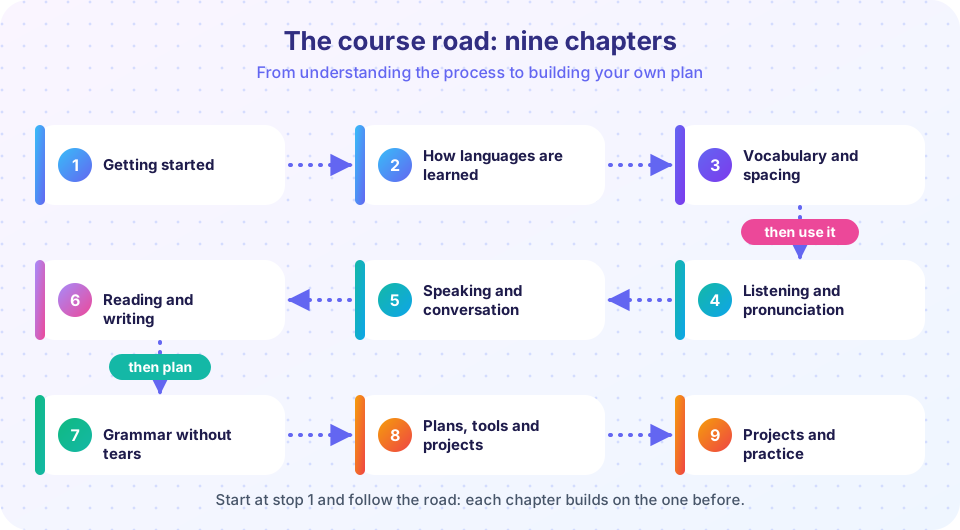
The chapters follow a simple logic. First you learn how acquisition works, because every later decision depends on it. Then you train the building blocks: vocabulary and sound. Then the skills you use in the world. Finally you plan and practice.
Foundations
Memory and ears
Using the language
Structure
Your plan
Chapter 1 sets goals and expectations: what "fluent" means, how long different languages take, and what age and talent really do. Chapter 2 explains the main theories of how languages are learned, from Stephen Krashen's input hypothesis to modern work on practice. Chapter 3 is about vocabulary and the best-supported memory technique we have, spaced repetition. Chapter 4 trains your ears and your pronunciation. Chapters 5 and 6 turn to speaking, reading and writing. Chapter 7 treats grammar as a tool rather than a punishment. Chapters 8 and 9 help you build a weekly plan, choose tools and finish with projects.
How to study this course
A course about learning should use its own advice. Here is how.
- Read a lesson once, then close it and write down what you remember. Researchers call this retrieval practice. It feels harder than rereading, and it works better. You will meet the evidence in Chapter 3.
- Come back after a day, then after a week. Spacing your reviews is the single most reliable way to remember. A lesson read three times in one evening is remembered worse than one read three times over three weeks.
- Run the demonstrations. Every Try it block is a small model or tool. They are demonstrations of ideas, not tests of your ability, and they run in your browser.
- Use the quizzes honestly. Answer before you look at the explanation. A wrong answer you notice is worth more than a right answer you guessed.
- Apply one idea per week to your own language. Reading about methods does not teach you Portuguese. Time with Portuguese does.
What "evidence-based" means here
The claims in this course come from published research, and each lesson names the main studies. That does not mean every question is settled. Second-language acquisition is a young field. Many studies involve university students learning for a few weeks, which may not match your situation. Some famous results have been hard to replicate, and some debates, such as how much explicit grammar teaching helps, are still open. When that is true, the lesson says so.
Evidence also cannot choose your goals. Whether you want to read poetry, chat with relatives or pass an exam, the research can tell you which methods tend to work, not which goal is worth having.
"There is a secret method." No method in this course will teach you a language in a month. The research consistently finds that time on task, quality of that time, and consistency matter most. Methods change how efficiently you spend the hours; they do not remove them.
"Reading about learning is learning." Understanding the theory of spaced repetition does not put a single word in your memory. Treat this course as a map, and walk the road.
Try it
The first demonstration helps you see how many weeks a study plan really takes. It uses a rough hour target and your weekly study time. The numbers are adjustable assumptions, not predictions.
Press Run (or Ctrl + Enter) to see the console output here.
No output.
The second is a simple chapter picker. Tick what matters to you and see where to start. It stores nothing; it only calculates in the page.
Check your understanding
Quick check · 4 questions
of 4 answered You scored / 4 · perfect!
-
1. Which description best fits this course?
The course is about methods and the research behind them, and it works with any target language. -
2. Why does the course suggest closing a lesson and writing down what you remember?
Trying to recall information strengthens memory more than simply looking at it again. -
3. What does 'evidence-based' NOT promise in this course?
Several questions, such as the value of explicit grammar teaching, are still debated, and the lessons say so. -
4. Which spacing for reviewing a lesson is best supported?
Spacing reviews over time is among the most reliable findings in memory research.
Summary
- The course teaches the process of learning any language, using second-language acquisition and memory research.
- Nine chapters move from foundations, to vocabulary and sound, to using the language, to planning.
- Study the lessons the way the course recommends you study a language: recall, space, practice.
- Evidence tells you what tends to work, not what is certain, and the course flags open debates.
Track your progress
Create a free account to tick off lessons and pick up where you left off on any device.
of How to Learn a Language lessons completed