


















Lesson 39 of 48 · Plans, Tools and Projects
Apps, tools and AI: choosing by the job they do
A framework for evaluating language apps, flashcard systems, subtitles and AI tutors by the job they do, with an honest summary of what the research shows.
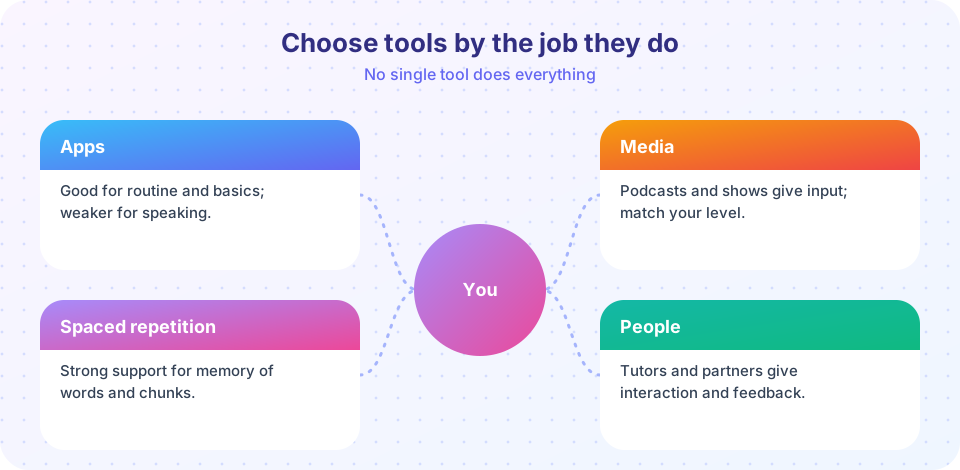
There are thousands of language-learning products, and each promises results. A better question than "which app is best?" is "which job do I need done, and which tool does that job?" A flashcard program is excellent at repetition. A conversation partner is excellent at interaction. No single product is excellent at everything.
This lesson gives you a way to compare tools, summarizes what research says about apps and mobile learning, and shows how to put a small set of tools together so that all four strands of a balanced plan are covered.
What you will learn
- A five-question framework for judging any tool.
- What studies of language apps and mobile learning have found, with their limits.
- How subtitles, spaced repetition and AI tutors fit into a plan.
- How to check that your set of tools covers all four strands.
Key terms
Spaced repetition system (SRS): software that schedules reviews at increasing intervals to strengthen memory.
MALL: mobile-assisted language learning.
Same-language subtitles: captions in the audio's language, also called intralingual subtitles.
Task transfer: whether skill with an exercise carries over to real use.
Five questions for any tool
- What job does it do? Input, output, study or fluency?
- How much of the language do you actually produce or hear? Count minutes of real use, not time spent in menus.
- Does it adapt to your level? Good tools make material comprehensible without being too easy.
- Does it give feedback you can trust? Accuracy of corrections matters.
- Will you keep using it? Cost, friction and enjoyment decide this more than features do.
Press Run (or Ctrl + Enter) to see the console output here.
No output.
The scores are examples, not ratings of real products. Change them to reflect your own experience.
What the research says about apps
Evidence about language apps is limited, and some of it comes from the companies themselves.
- A widely cited study by Roumen Vesselinov and John Grego (2012) on the Duolingo app reported that learners improved on a placement test, with about 34 hours of use equivalent to a university semester. The study was funded by the company, did not use a control group in the usual sense and relied on learners who stayed with the program, so it is limited.
- Reviews and meta-analyses of mobile-assisted language learning, such as Sung, Chang and Yang (2015), found moderate positive effects compared with non-mobile approaches, but studies were short, small and varied in what they measured.
- Reviews suggest apps often help with vocabulary and basic reading and less with speaking and conversation.
Reading this evidence critically leads to a balanced conclusion: apps can be a helpful part of a plan, mainly for routine and vocabulary, and are unlikely to be sufficient alone.
Spaced repetition
Spaced repetition has far stronger support than app marketing. The research on spaced practice and the testing effect, summarized by Cepeda and colleagues (2006) and others, shows that retrieving information at increasing intervals leads to longer retention than rereading or massed review. Programs such as Anki implement this. Use them for words and chunks with their example sentences, and keep your review session short and daily. If your review load becomes huge, reduce new cards rather than skipping days.
Audio, video and subtitles
Watching shows and listening to podcasts gives large amounts of input. Subtitles can help, but which subtitles matters. Holger Mitterer and James McQueen (2009) found that same-language subtitles helped viewers adapt to an unfamiliar accent, while subtitles in the viewer's first language did not and could even interfere. Other studies find that learners at lower levels benefit from first-language subtitles for comprehension but gain less for listening skill. A progression many teachers suggest is first-language subtitles for understanding, then same-language subtitles for linking sound to spelling, then none.
AI tutors
Conversational AI can play a patient partner, explain an idea in several ways or generate practice texts at your level. Use it for:
- Rehearsal before a real conversation.
- Practice texts at a chosen level with words you are learning.
- Explanations of a sentence you do not understand.
Cautions are practical rather than moral. Explanations can be wrong without warning, so double-check surprising claims. Models may be too polite to point out errors unless you ask. And interaction with an AI does not carry the same social stakes or surprises as talking to a person. The research on long-term outcomes is still limited.
Covering all four strands
Press Run (or Ctrl + Enter) to see the result here.
Program input · what you'd type while the program runs
Type the answers before you press Run, one per line. Each time the program reads a line (with input()), it gets the next line from this box.
The output highlights lopsided plans. If speaking (output) is the missing piece, adding tutor time or an exchange will do more than adding another app.
A decision guide for three common situations
The right combination of tools depends on your situation. These are suggestions to adapt, not prescriptions.
The beginner with three hours a week. Your biggest problem is getting started and building a base. A structured course or app gives you a path, and a spaced repetition deck keeps the first few hundred words alive. Add one graded reader, and as soon as you can say a few sentences, book a short weekly session with a tutor or partner so speaking does not wait until later. The tool kit is small on purpose: three tools, one for each of input, study and output.
The intermediate learner on a plateau. If progress feels slow, the problem is often that your practice no longer stretches you. Replace app lessons with material you care about: podcasts, series with same-language subtitles, a book. Increase output: two speaking sessions a week and one piece of writing with feedback. Review your vocabulary deck so that it holds words from your reading rather than from a generic list.
The busy commuter. Time is fragmented, so choose tools that work in ten-minute pieces: flashcards, short podcast episodes, a reader on your phone. Anchor each to a cue, such as a train departure. Protect one longer weekly session for speaking, because speaking is the skill that short fragments serve least.
In all three cases, check the four strands after a month. If one strand is almost empty, fix that before adding a new app.
Common misconceptions
"A streak means I am learning." Streaks measure showing up, which is useful, but not the quality or difficulty of the practice.
"Free apps are inferior; paid apps are better." Price does not predict learning. Judge by the job and your usage.
"Immersive shows teach everything." Without understanding, input is noise. Match level, use subtitles wisely and review words.
"AI explanations are always right." They are useful and fallible; verify.
Trying a new tool without losing a month
New tools are exciting, and learners can spend more time comparing apps than using them. A simple trial rule helps. Pick one tool for a specific job, use it for two weeks in the slot you have planned, and then ask three questions: did I use it on most days, did I do real work with the language rather than tapping through menus, and can I point to something I can now do? If the answers are yes, keep it. If not, drop it without guilt and try one alternative. Resist trying several at once, because you will not know which one helped.
Check your understanding
Quick check · 5 questions
of 5 answered You scored / 5 · perfect!
-
1. What is a good first question when evaluating a tool?
Match tools to the job: input, output, study or fluency. -
2. What is a key limitation of the Vesselinov and Grego (2012) study?
Company funding and attrition limit what can be concluded. -
3. What did Mitterer and McQueen (2009) find about subtitles?
Same-language subtitles linked sound to spelling and supported adaptation. -
4. Spaced repetition is supported by research on:
Spaced retrieval leads to better long-term retention than massed review. -
5. Which is a caution for AI tutors?
Verify explanations and ask for correction explicitly.
Summary
- Judge tools by the job they do and by how much real use they give you.
- App research is limited and often company-funded; apps help most with vocabulary and routine.
- Spaced repetition has strong support for memory; keep reviews daily and manageable.
- Same-language subtitles help listening more than first-language subtitles for most goals.
- Use AI for rehearsal and explanations with verification, and make sure your kit covers all four strands.
Next: Motivation and habits
Track your progress
Create a free account to tick off lessons and pick up where you left off on any device.
of How to Learn a Language lessons completed