


















Lesson 45 of 48 · Projects and Practice
Practice: Four learners, four diagnoses
Practice diagnosing four imaginary learners with common problems, a streak without speaking, anxiety, rules without fluency and texts that are too hard.
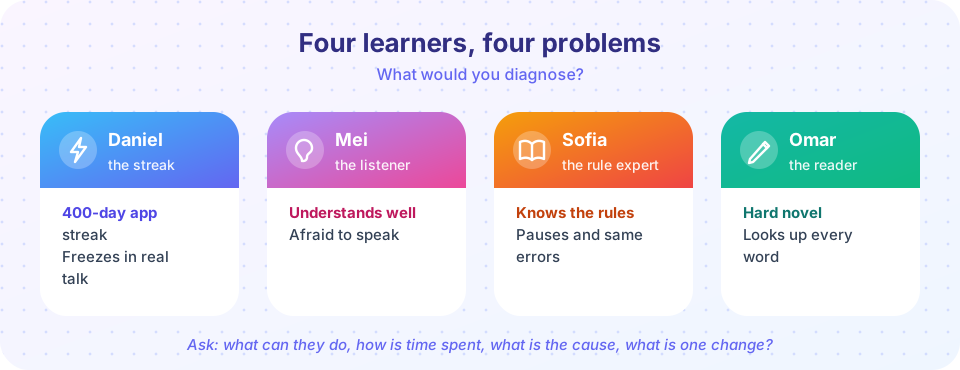
Doctors learn partly by working through cases. You can do the same with language learning. This lesson presents four imaginary learners with problems that are common in real life. For each one, decide what is going wrong using the research in this course, then compare your diagnosis with ours.
These are invented examples to practice reasoning, not real people or studies. Each prescription is a hypothesis to try, since individual cases differ.
What you will learn
- A four-question method for diagnosing a learning problem.
- How the research on output, anxiety, explicit knowledge and coverage applies to cases.
- How to write a one-change prescription.
Key terms
Diagnosis: an explanation of what is limiting progress.
Prescription: one concrete change to test.
Strand balance: how time divides between input, output, study and fluency.
Hypothesis: a prediction you test by trying the change and checking the result.
A four-question method
Ask these in order:
- What can the learner do, and what can they not do? Define the gap precisely.
- How is time spent? Count minutes by strand.
- What is the likely cause? Choose among missing practice, wrong level, anxiety, or lack of feedback.
- What is one change to test for four weeks? One change makes the effect visible.
Case 1: Daniel and the 400-day streak
Daniel has used a gamified app every day for more than a year. He enjoys it and knows many words and sentences. When his coworker speaks to him in the language, he freezes and gives one-word answers.
Think first. What is the imbalance?
Diagnosis. His practice is almost entirely recognition and translation inside the app. He is getting little meaning-focused output or interaction, so the retrieval needed for speaking is barely trained. Streaks measure consistency, not what the practice is.
Prescription. Keep a short app session but add a weekly 30-minute tutor or exchange session, and prepare three topics to speak about. After four weeks, record a one-minute talk and compare it with a recording from before.
Case 2: Mei, the quiet listener
Mei understands most podcasts at her level and reads well. She almost never speaks, because she is afraid of mistakes and being judged. She delays speaking "until I am better".
Diagnosis. Her comprehension is a strength. The barrier looks like language anxiety, with avoidance that keeps the fear alive. Waiting means no speaking practice, so retrieval stays slow and the anxiety does not decrease.
Prescription. Graduated exposure: first shadow audio and send voice messages to a patient partner, then a scripted tutor session where she chooses the topic, then open conversation. She asks the tutor to correct only the top three errors. She keeps a list of "mistakes fixed" to see growth.
Case 3: Sofia, who knows the rules
Sofia scores well on grammar tests and can explain tenses. In conversation she pauses a lot and makes the same tense errors she can easily correct in writing.
Diagnosis. Strong explicit knowledge with limited automaticity. The knowledge is declarative; she needs procedural practice with familiar material to make it fast. This pattern is compatible with the skill acquisition view and with the fluency strand being missing.
Prescription. Replace some study time with fluency work: the 4/3/2 technique with one familiar story, then a chunk collection for the tenses she misses, practiced aloud. Use her rule knowledge as a monitor in writing, not in speech.
Case 4: Omar and the hard novel
Omar chose a famous novel because he wanted to read "real" literature. He looks up almost every second word, reads two pages an evening and feels discouraged.
Diagnosis. The text is far above his level. Coverage is too low for inference, and lookup time slows comprehension. He is doing intensive reading at volume.
Prescription. Move to graded readers or easier novels at about 95 to 98 percent coverage for extensive reading, and keep a short intensive session with the novel for ten minutes. Look up only recurring or blocking words.
Press Run (or Ctrl + Enter) to see the result here.
Program input · what you'd type while the program runs
Type the answers before you press Run, one per line. Each time the program reads a line (with input()), it gets the next line from this box.
The numbers are invented, and the balanced target is a guide rather than a law. Still, a quick comparison often shows what a feeling hides.
Press Run (or Ctrl + Enter) to see the console output here.
No output.
What the cases teach
- A long streak or a high test score is information, not proof of ability.
- Many problems come from a strand imbalance.
- Anxiety can hide behind "not ready yet".
- Level mismatch makes effort fruitless.
- One change at a time keeps cause and effect visible.
A fifth case: your own
The most useful case is yours. Use the same four questions.
- What can I do, and what can I not do? Write three specific tasks, such as "I can read a menu but cannot ask the waiter about ingredients".
- How do I spend my time? For one week, log minutes in the four strands. Most people are surprised by the pattern.
- What is the likely cause? Look at the cases above for a match: practice imbalance, anxiety, knowledge without automaticity, or level mismatch. Several may apply.
- What is one change to test? Make it small, specific and measurable.
What if there are two causes?
Real learners often combine problems. Mei, for example, might also have a small vocabulary. When several causes are plausible, start with the one that blocks the most: if you cannot practice speaking because of fear, fix that first, because it limits everything that follows. Test one change for four weeks, then decide whether to add a second.
How will you know it worked?
Each prescription should name a measure.
- Daniel: compare a one-minute recording before and after four weeks of weekly speaking sessions, counting pauses and hesitations.
- Mei: count the number of times she spoke live in the week, and note her tension on a 0 to 10 scale before and after each.
- Sofia: measure retelling speed (words per minute) of the same story at the start and end.
- Omar: count unknown words per 100 in the new books and pages read per week.
A change that cannot be measured is hard to learn from. If the measure does not move after four weeks, revisit the diagnosis rather than abandoning the learner or the language.
Common misconceptions
"These learners are lazy." They work hard at the wrong thing. Effort and effectiveness are different.
"One cause explains everything." Real learners often have several; start with the most likely and change one thing.
"A prescription works for everyone." Test it for four weeks and look at your own results.
Practicing with a partner
Case studies work even better in a pair. Share your own problem with a friend, a tutor or an online study group and ask them to run the four questions on you, while you do the same for them. An outside view often spots what you cannot: the strand you have quietly avoided for months, the level of material you chose out of pride, or the fear you have called a lack of time. Treat each diagnosis as a hypothesis, write down the prescription and the measure, and meet again in four weeks to see what changed.
Check your understanding
Quick check · 5 questions
of 5 answered You scored / 5 · perfect!
-
1. What is the most likely issue in Daniel's case?
His practice is mostly recognition inside the app, so retrieval for speaking is untrained. -
2. What is a good first step for Mei?
Gradual, low-stakes speaking lowers avoidance and builds retrieval. -
3. Sofia's problem is best described as:
She knows the rules but needs fluency practice to use them quickly. -
4. Why does Omar's novel fail him?
Too many unknown words make the text too hard for extensive reading. -
5. Why prescribe one change at a time?
One change makes the effect visible.
Summary
- Diagnose in four steps: gap, time use, cause, one change.
- Strand imbalance, anxiety, missing automaticity and level mismatch are common causes.
- Write a prescription with a measure and a review date.
- Test for four weeks, then adjust.
Next: Glossary
Track your progress
Create a free account to tick off lessons and pick up where you left off on any device.
of How to Learn a Language lessons completed