


















Lesson 29 of 48 · Reading and Writing
Intensive reading, dictionaries and reading tools
How to study a short text closely, when to look words up, what research says about glosses and dictionaries, and how to check a text's difficulty.
Extensive reading is about volume. Intensive reading is the opposite: a short text, read closely, with attention to words, grammar and how the writer built the passage. Done well it is where you notice constructions you would otherwise skim past. Done badly, it turns into slow word-by-word translation that teaches little.
This lesson gives a routine for intensive reading, explains what research says about dictionaries, glosses and other tools, and offers a small program that measures how hard a text is for you.
What you will learn
- A four-pass routine for studying a text.
- What studies say about dictionary use and glosses.
- How to decide when to look a word up and when to guess.
- How to measure the coverage of a text with a short script.
Key terms
Gloss: a short translation or definition placed next to a word in a text.
Inference: guessing a word's meaning from context and word parts.
Collocation: a pair or group of words that often appear together, such as make a decision.
Parallel text: a text printed with a translation alongside it.
A four-pass routine
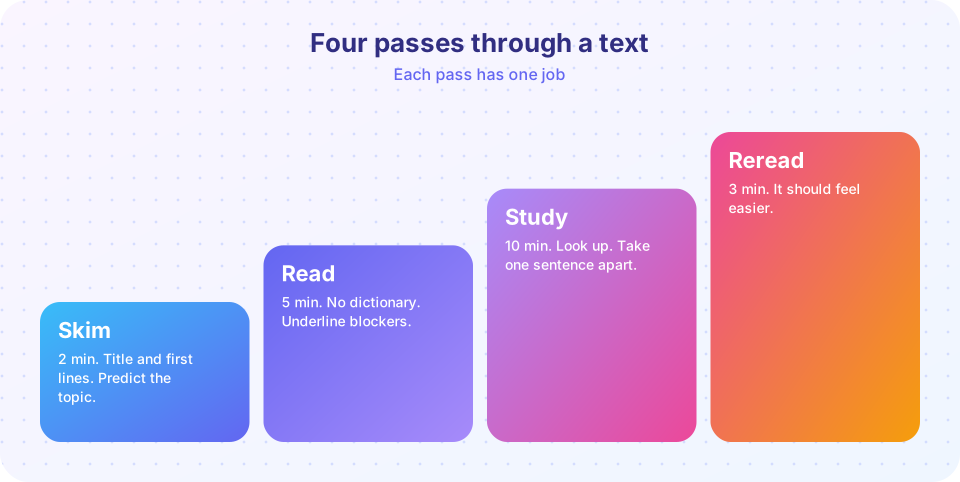
This routine is a practical suggestion built from common teaching practice, not a method proven by a single study. Choose a text of one or two pages that is a little above your comfortable level, perhaps 92 to 95 percent coverage.
- Skim (2 minutes). Read the title, first lines and any pictures. Say in your own words what you think the text is about. This activates what you know.
- Read for meaning (5 minutes). Read straight through without a dictionary. Underline words that blocked you, up to about ten.
- Study (10 minutes). Now look up the underlined words, but also notice grammar: find one sentence you did not fully understand and take it apart. Write the words you want in a vocabulary list with the sentence they came from.
- Reread (3 minutes). Read the text again from the start. It should feel noticeably easier, and that feeling is the reward.
If you also want speaking practice, summarize the text aloud afterwards without looking at it.
Looking up or guessing?
Learners often wonder whether to reach for the dictionary at every unknown word. Research gives a balanced answer.
Reading with glosses (meanings offered right in the text) tends to produce better vocabulary learning than reading with no help. A study by Jan Hulstijn, Merel Hollander and Tine Greidanus (1996) found that learners who had access to glosses or dictionaries learned more words than those who did not, and that words that learners actually looked up were remembered better than those they ignored. Lookups, though, cost reading time and interrupt the story, and heavy lookup can reduce comprehension of the whole text. The more often you stop, the harder it becomes to follow the plot.
A reasonable rule:
- Look up a word if it blocks understanding of the sentence and it appears again, or looks important.
- Guess if you understand the sentence without it, and mark it for later if it reappears.
- Skip names and rare technical words.
Press Run (or Ctrl + Enter) to see the console output here.
No output.
The figures are assumptions. The point is that every lookup is a small tax on volume, so spend it on words that matter.
Inference: using what you know
Guessing is a skill you can train. Use three sources:
- Word parts. If you know re- means again and write, you can read rewrite. Many languages have such patterns; learn the common ones.
- Context. The surrounding words and the situation narrow the possibilities.
- Similar words. Cognates with your first language can help but beware of false friends: the Spanish embarazada means pregnant, not embarrassed.
Guesses are often only approximate. Treat them as drafts and revise them when you meet the word again.
Tools worth knowing
- Pop-up dictionaries in browsers and e-readers reduce the cost of lookup to a tap.
- Learner dictionaries use simple definitions from a limited vocabulary and give example sentences; for the same word they are often easier to use than a big bilingual dictionary.
- Parallel and bilingual texts show a translation next to the original. They can reduce frustration, but the research on their effect on learning is limited; the risk is reading only the translation. One approach is to read the original paragraph first and check afterwards.
- Reading aloud can help pronunciation and attention to sentence rhythm.
- AI assistants can explain a sentence or suggest a gloss. They are convenient, but explanations can be wrong or overconfident, so check anything surprising in a dictionary or with a teacher.
Press Run (or Ctrl + Enter) to see the result here.
Program input · what you'd type while the program runs
Type the answers before you press Run, one per line. Each time the program reads a line (with input()), it gets the next line from this box.
This is a toy version. Real tools use frequency lists and word families, but even a rough check helps you pick texts.
A worked example of the four passes
Here is a short passage written for a learner of English, to show what each pass looks like in practice.
The city council has decided to close the old bridge for three months. Engineers found cracks in the supports, and repairs cannot begin until the river level drops. Meanwhile, buses will take a longer route through the north of the town.
Skim. The title and first line say that a bridge will close. You predict that the text is about transport disruption. You have not read details, but you are ready.
Read. You read straight through. You understand most of it, but you underline supports and drops, and you are not sure of meanwhile. Three words, no dictionary yet.
Study. Now you look up supports (here, parts that hold the bridge up), and notice that drops means the water level goes down, not that something falls. You take one sentence apart: repairs cannot begin until the river level drops. You see the pattern cannot ... until ... and write it in your notebook as a chunk with a slot: cannot begin until ___. You add meanwhile to your list with the sentence it came from.
Reread. You read the passage again. You now read it at normal speed, and you feel that the second sentence is easy. That ease is a sign that the words and the pattern are beginning to stick.
Notice what the routine avoided: you did not look up every word, you did not translate the whole passage, and you left with a useful chunk and three new words in context.
Common misconceptions
"Looking up every word is the careful way." It makes reading slow and can weaken comprehension. Selective lookup is usually better.
"Translation next to the text is cheating." It is a tool. Use it after you try, not instead of trying.
"Guessing from context always works." It works when you know most of the surrounding words; if not, guesses are often wrong.
Keeping a useful vocabulary notebook
Intensive reading produces words, and the notebook is where they either become learning or disappear. For each word you decide to keep, write the full sentence where you found it, the meaning in the target language if you can, a short note on the form (for example, the verb it goes with), and the date. Avoid copying long lists without context: a word without its sentence is much harder to remember and to use. Review the notebook with spaced repetition rather than rereading it, and promote the words you meet again in extensive reading, since a second meeting in a new context is exactly what deepens knowledge.
Check your understanding
Quick check · 5 questions
of 5 answered You scored / 5 · perfect!
-
1. What is the job of the second pass (read for meaning) in the four-pass routine?
The second pass reads for the gist and marks problems, up to about ten, without stopping. -
2. What did Hulstijn, Hollander and Greidanus (1996) find?
Learners with glosses or dictionaries learned more words, and looked-up words were retained better. -
3. When should you guess instead of looking up a word?
If the sentence still makes sense, guess and move on; mark it for later if it returns. -
4. What is a risk of parallel texts?
Reading only the translation removes the effort that produces learning. -
5. Why check AI explanations of a sentence?
Assistants are useful but fallible; verify surprising claims.
Summary
- Intensive reading studies a short text in passes: skim, read, study, reread.
- Glosses and dictionaries help vocabulary learning, but heavy lookup slows reading and can hurt comprehension.
- Look up words that block meaning and recur; guess the rest.
- Word parts, context and cognates support inference, with false-friend caution.
- A short script can estimate a text's coverage and help you choose.
Next: Writing and feedback
Track your progress
Create a free account to tick off lessons and pick up where you left off on any device.
of How to Learn a Language lessons completed