


















Lesson 19 of 48 · Listening and Pronunciation
Listening practice: extensive, intensive, dictation and shadowing
Evidence-based listening methods: extensive and intensive listening, dictation, captions and transcripts, shadowing and speech rate, with a weekly plan and honest limits.
Listening is the skill that most often feels stuck. You study for months and a native conversation still sounds like a blur. The temptation is to "just listen more," and the opposite temptation is to give up and rely on subtitles. The research suggests a more precise approach: different kinds of listening do different jobs, and the main task for most learners is to get faster and more accurate at recognizing words in the stream.
This lesson sets out the main methods, what the studies found, and how to combine them into a weekly routine. It also makes clear what is well supported and what rests on a handful of small studies.
What you will learn
- The difference between extensive and intensive listening and when to use each
- How dictation, transcripts and captions can help, and their limits
- What shadowing is, and what studies say about it
- How to choose material by speech rate and comprehension
Key terms
Extensive listening: listening to a lot of easy material, mostly for meaning and enjoyment.
Intensive listening: listening closely to short passages, repeatedly, to work out exactly what is said.
Dictation: writing down what you hear, in full or with gaps.
Shadowing: repeating speech aloud a moment after you hear it, following closely.
Speech rate: the speed of speech, usually measured in words per minute.
Extensive listening: volume at the right level
Extensive listening mirrors extensive reading (Chapter 2, lesson 2): you listen to large amounts of material that you can mostly understand, without stopping to analyze. Willy Renandya and Thomas Farrell (2011) argued in a well-known article that many classes rely on difficult recordings and comprehension questions, which test listening but do not build it, and that learners need a lot more easy listening. The same coverage principle applies: if you understand most of the words, you will meet the unknown ones in context and can learn them with repetition.
Good extensive material:
- Podcasts and videos for learners, with clear speech and known vocabulary.
- Graded audio, such as audiobooks of graded readers.
- Content on topics you already know, so that top-down knowledge helps.
- Repeated material: narrow listening, a term from Stephen Krashen (1996) for listening to many short recordings on one topic, so that vocabulary recurs.
Evidence on extensive listening is thinner than on extensive reading. Studies are mostly small classroom trials with modest improvements. The rationale is strong, because exposure and automatization are well established, but the exact amounts are not known.
Intensive listening: working out what was said
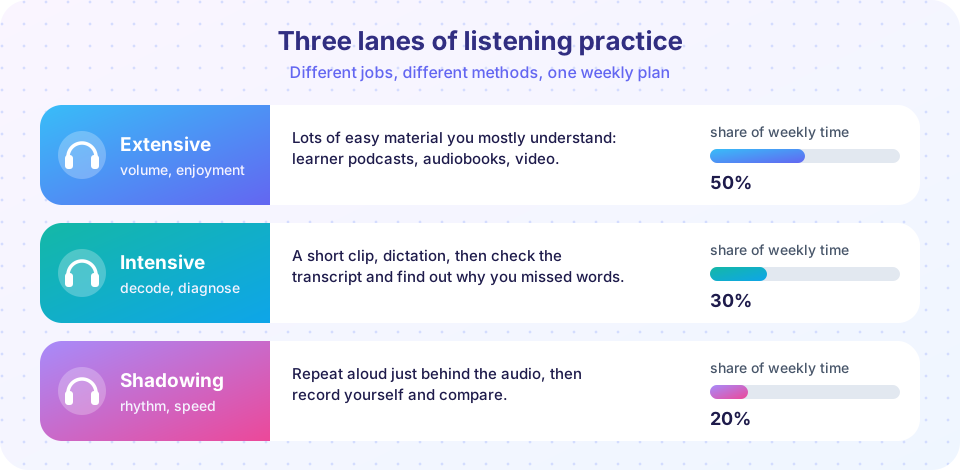
Intensive listening is the opposite: a short passage (one to three minutes), played many times, with the goal of understanding every word. A reasonable cycle:
- Listen once for the gist. Note what you understood.
- Listen again in short segments, writing down what you hear (full or partial dictation).
- Check against the transcript. Mark each place where you misheard or missed a word.
- Diagnose. For each error, decide why: unknown word, known word in a reduced form, a blend of two words, or a sound you cannot discriminate.
- Relisten to the same passage without the transcript.
John Field (2008) has argued that this kind of diagnostic work is the missing piece in many courses, because it trains decoding. The key is step 4: finding out why you missed it. A word you know but did not recognize is a decoding failure and is solved by exposure and attention to reduced forms; a word you do not know is a vocabulary gap and goes on a flashcard.
Dictation has a long record in language teaching and a respectable research base as a form of noticing: the act of writing exposes gaps. Partial dictation (filling gaps in a transcript) is a gentler version and works well for beginners.
Transcripts and captions
Reading while listening is a common and effective support, with caveats.
- Use transcripts after listening, not instead of listening. If you read first, you are reading, not listening. Listen first, then check.
- Captions in the target language. Reviews of research on captioned video, such as the meta-analysis by Maribel Montero Perez and colleagues (2013), found that captions generally improve comprehension and vocabulary learning compared with no captions. Same-language captions seem to help especially with word recognition, because they link sound to written form.
- Subtitles in your first language help you follow the story, but evidence suggests they pull attention from the sounds, so they are a poorer tool for building listening skill.
- Fade the support. Move from transcripts to captions to nothing as your comprehension grows.
Shadowing
In shadowing, you listen to a recording and repeat it aloud almost simultaneously, a fraction of a second behind, imitating rhythm, stress and intonation. It was developed in interpreter training and has become popular among self-learners.
What the studies say: experiments with Japanese learners of English, for example by Hiroyuki Hamada (2016), found that shadowing practice improved listening comprehension and word recognition over several weeks compared with other listening practice, with effects thought to come from better phonological processing. Other studies suggest improvements in pronunciation and fluency. Samples are small and mostly from a few classrooms, so conclusions should be modest: shadowing is a promising, low-cost technique, not a proven cure.
How to shadow:
- Choose a short clip (30 to 60 seconds) with a transcript, at a speed where you understand most of it.
- Listen once, then read the transcript.
- Shadow with the text in front of you, then without it, repeating three to five times.
- Record yourself and compare your rhythm with the original.
"Background audio will teach me." Music or podcasts playing while you do other things give little learning unless you attend. Attention is required.
"Slow audio is always better." Slowing speech can help at first, but speech that is unnaturally slow differs in rhythm and reductions. Move toward natural speed gradually.
"If I can read it, I can hear it." Reading and listening use partly different skills. Many learners read well and cannot recognize the same words in speech.
Choosing material by speech rate
Speech rate is a quick way to match material to your level. Typical conversational speech in English runs at roughly 150 to 200 words per minute for native speakers, while material made for learners is often slower. Rates vary by language, speaker and style, and what matters more than the number is your comprehension. A simple rule of thumb (not a research threshold): choose material where you understand most of the words on first listen. If you catch only fragments, step down; if it feels effortless and teaches nothing, step up.
A weekly plan
A plan for five hours a week:
- Extensive listening (about 2.5 hours). Learner podcasts, audiobooks and video, spread over days.
- Intensive listening (about 1.5 hours). Two or three short passages through the five-step cycle.
- Shadowing (about 1 hour). Short sessions after intensive work, with passages you already know well.
Adjust to your level and goal, and keep a log of unknown-word and decoding failures: the log shows what to practice next.
Try it
The first demonstration is a shadowing guide. It highlights words at the speed you choose, so you can follow along aloud. Start slow, then increase. It is a pacing tool and has no audio.
The second demonstration computes speech rate for material you are considering, then labels it relative to your own comfortable range. Edit the numbers with your own transcripts.
Press Run (or Ctrl + Enter) to see the console output here.
No output.
Check your understanding
Quick check · 5 questions
of 5 answered You scored / 5 · perfect!
-
1. Extensive listening means
It builds volume and automatization using material you can mostly understand. -
2. Why use a transcript after, not before, listening?
You want to train listening, so check with the transcript after you try. -
3. In the intensive cycle, what is the diagnosis step for?
Different causes need different fixes, so you need to know which applies. -
4. What is shadowing?
You imitate rhythm and sounds while following the audio closely. -
5. What is a fair summary of the evidence on shadowing?
Studies such as Hamada (2016) are encouraging but small and limited to a few settings.
Summary
- Combine extensive listening for volume with intensive listening for decoding.
- Use dictation, transcripts and same-language captions after you try listening unaided.
- Shadowing is a promising technique for rhythm and word recognition, with modest evidence.
- Choose material by what you understand; speech rate is a useful guide.
- Keep a log of decoding failures and let it guide the next week.
Next: Pronunciation training
Track your progress
Create a free account to tick off lessons and pick up where you left off on any device.
of How to Learn a Language lessons completed