


















Lesson 44 of 48 · Projects and Practice
Project: Build immersion into your day at home
Audit one day, find hidden minutes, make five changes to your phone, media and habits, and learn what study-abroad research does and does not say about immersion.
Living in a country where people speak your target language gives you thousands of small contacts every day: signs, overheard conversations, shop questions, television in the background. Most learners cannot move abroad, but many can raise their daily contact a lot with a few changes at home.
This project asks you to audit one ordinary day, find where the language could fit, make five changes, and then measure the result. It also takes a careful look at what research on immersion and study abroad shows, because the story is more nuanced than "just live there".
What you will learn
- What study abroad research says about immersion, and what it cannot say.
- How to audit your day for language minutes.
- Five types of change that add contact.
- How to measure your result.
Key terms
Immersion: a setting in which the target language is used around you and for real purposes.
Study abroad: living and studying in a place where the target language is the community language.
Passive input: exposure while your attention is elsewhere, such as background audio.
Active input: attentive listening or reading where you try to understand.
What the research says about immersion
Reviews of study abroad research, such as Llanes (2011) and Yang (2016), find that learners tend to make gains in speaking fluency and listening while abroad, often larger than comparable time at home, while gains in grammar accuracy are less consistent. The individual differences are large. Those who gain most are generally learners who actually interact with local people, rather than socializing in their first language with other visitors.
Robert DeKeyser (2007) argued that study abroad is most effective for learners who already have a solid foundation, because they can use the contact; beginners may find the environment overwhelming and fall back on their first language. This is an influential argument, but not every study agrees.
Three lessons for the home version:
- Contact is not enough; interaction is. Aim for conversation, not only exposure.
- Foundations matter. A beginner benefits from guided, comprehensible input more than from being flooded with fast native speech.
- Amount and engagement count. Hours of attentive use matter more than the setting.
There is also a limit on passive exposure. Background audio you do not attend to has little evidence for vocabulary or grammar learning, though it may help you get used to the sound of the language. Treat it as a supplement to active listening, not as a substitute.
Step 1: Audit one day
Choose a typical weekday. Divide it into 30-minute blocks from waking to sleeping. For each block, write what you were doing and mark whether it involved your hands and eyes but not much thinking (commute, washing dishes, walking), or required full attention (meetings, reading), or was free time.
Press Run (or Ctrl + Enter) to see the console output here.
No output.
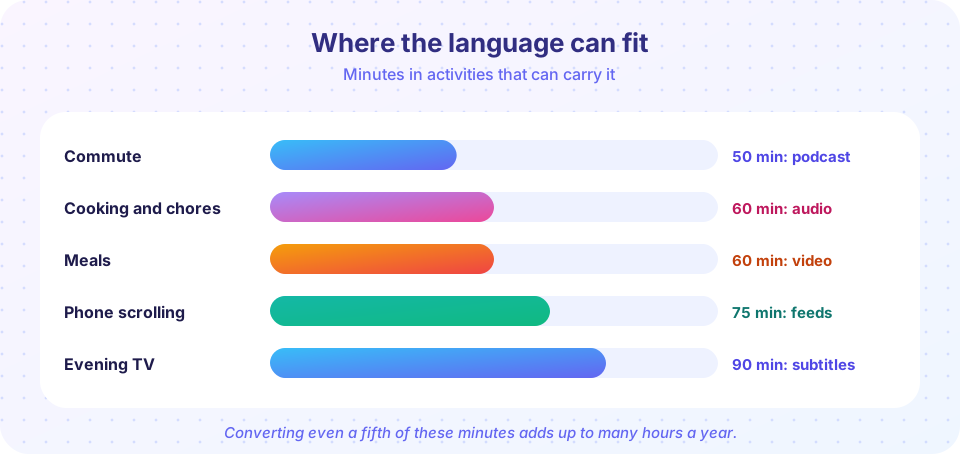
Notice that the count looks large only because it includes time you may not want to change. Converting even a fifth of it is significant.
Step 2: Make five changes
Pick one from each group.
1. Phone and devices. Switch the phone language and one social feed to the target language. This forces many short, useful encounters with everyday words.
2. Media diet. Replace one daily media habit with the language: a podcast on the commute, one show with same-language subtitles in the evening, one playlist with lyrics you look up.
3. Reading. Keep a graded reader on your phone and read for ten minutes in waiting moments.
4. Writing and speaking. Write one sentence a day in a notes app, or send a weekly voice message to a partner. Tell your partner or friend you want to speak the language for ten minutes a day.
5. Interests. Follow a hobby in the language: recipes, a sport, a game community, a craft channel. Content you care about holds attention.
Optional: labeling objects at home is popular. The evidence for its value is limited, and it works best for beginners with concrete nouns.
Step 3: Make it comprehensible
Immersion only works when you understand enough. Choose content at about 90 to 98 percent coverage, and choose a pace you can follow, including slowed audio or subtitles. If something is too hard, set it aside and return later. Too much frustration turns contact into noise.
Step 4: Measure
Track minutes of attentive contact for two weeks before and after your changes.
Press Run (or Ctrl + Enter) to see the result here.
Program input · what you'd type while the program runs
Type the answers before you press Run, one per line. Each time the program reads a line (with input()), it gets the next line from this box.
The data are invented to show the idea. Your real numbers will wobble, and that is fine. What matters is the average over weeks.
Common problems and fixes
| Problem | Likely cause | Fix |
|---|---|---|
| I stopped after a week | Plan too ambitious | Keep one change and add another each week |
| I understand nothing | Content too hard | Move to graded or slowed material |
| It feels like noise | Passive listening | Choose a short clip and listen with attention |
| No speaking | Contact is mostly input | Add a weekly exchange or tutor |
A week-by-week rollout
Trying to change everything at once usually fails. Add one change a week for five weeks.
- Week 1: phone. Switch the phone and one app to the target language. Keep an easy way back if you get stuck, such as a note of where the language setting is.
- Week 2: audio. Add one podcast or audio series to a fixed daily slot, such as the commute.
- Week 3: reading. Install a graded reader or news app in the language and read for ten minutes a day.
- Week 4: output. Write one sentence a day or record a daily 30-second voice note. Share one weekly voice message with a partner.
- Week 5: interests. Replace one hobby-related video, game or forum with a version in the language.
If a change does not stick after a week, make it smaller rather than dropping it. For example, if podcasts are too hard, try a slower learner podcast or one with a transcript.
When home is not helpful
Sometimes the home environment gets in the way. If you share devices with family, ask before changing settings. If you work from home with little social contact, an online exchange or class can supply the people. If you live somewhere with a community that speaks the language, such as a neighborhood or club, joining an activity that is not about language, like a cooking class or a sports group, can give real interaction with purposeful talk. The aim is to find where the language is already used, or can be used, in your life.
Common misconceptions
"Immersion means being surrounded by the language; if I am not abroad, it does not count." What counts is attentive, comprehensible contact and use, which you can create at home.
"Background audio all day will teach me." Evidence for passive exposure is weak. Use it for sound familiarity and add active listening.
"I should only use native-level content." If you cannot follow it, you will not learn from it. Match the level.
Check your understanding
Quick check · 5 questions
of 5 answered You scored / 5 · perfect!
-
1. What do reviews of study abroad research generally find?
Benefits vary, and actual interaction with local speakers is a key factor. -
2. What was DeKeyser's (2007) argument?
A foundation helps learners make use of the contact. -
3. What is the evidence for background audio you do not attend to?
Passive exposure may help sound familiarity but is a weak substitute for attention. -
4. Which counts as attentive contact?
Attention is what makes input useful. -
5. What should you do if content is too hard?
Immersion works only when comprehension is high enough.
Summary
- Study abroad research shows benefits for fluency and listening that depend on actual interaction.
- At home, audit a day, find hidden minutes and make five changes: phone, media, reading, writing or speaking, and interests.
- Choose comprehensible content; passive exposure alone has weak support.
- Measure attentive minutes before and after.
Next: Case studies
Track your progress
Create a free account to tick off lessons and pick up where you left off on any device.
of How to Learn a Language lessons completed