


















Lesson 6 of 48 · How Languages Are Learned
Chapter 2 overview: How languages are learned
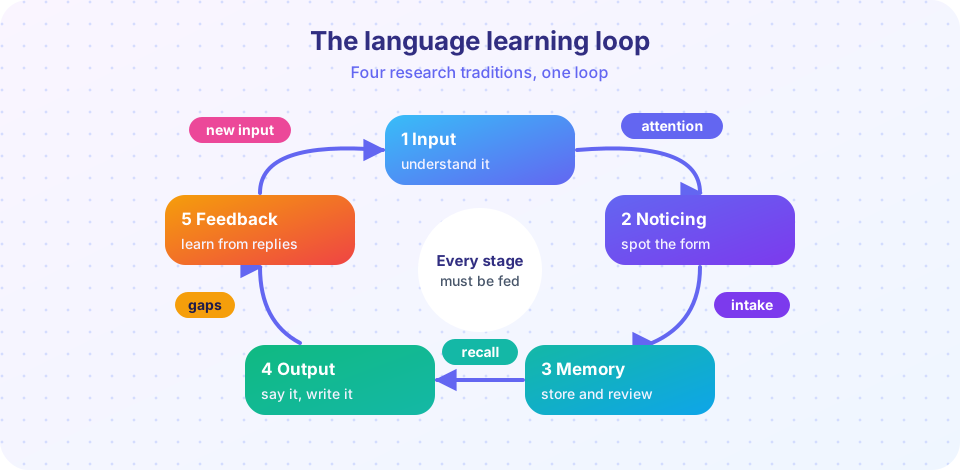
A map of the main ideas in second-language acquisition research: comprehensible input, interaction, noticing, and practice, and how they fit into one learning loop.
Everyone who learns a language successfully has done a few things in common: they met a great deal of language they could partly understand, they used it to do things, they noticed how it works, and they practiced until it became easy. Over about fifty years, researchers have given these four activities names and tested them. The result is not one grand theory but a set of complementary ideas, each strong in some places and weak in others.
This overview gives you the big picture of Chapter 2 so that the individual lessons slot into place.
What you will learn
- The four ingredients of language learning that research supports
- The people and ideas attached to each ingredient
- How the ingredients fit together in a loop you can use to audit your own study
- What the lessons in this chapter cover
Key terms
Acquisition versus learning: Stephen Krashen's distinction between unconscious picking-up of a language and conscious study of rules. Many researchers now think the line is blurrier than he proposed.
Comprehensible input: language you understand most of, slightly above your current level.
Interaction: conversation in which speakers work to understand one another.
Noticing: consciously registering a feature of the input, which Richard Schmidt argued is needed for it to become part of your knowledge.
Automatization: practice that makes a skill fast and effortless.
Four ingredients
1 Input
2 Interaction and output
3 Noticing
4 Practice
Input. Without understood language, nothing starts. Krashen's input hypothesis said that we acquire language when we understand messages containing structure a little beyond our current level, which he called i + 1. Almost everyone agrees that input is necessary. The dispute is whether it is sufficient.
Interaction and output. Merrill Swain studied Canadian students who spent years in French immersion classes. They understood French very well but produced it with errors. She argued that producing language forces you to process grammar, not just meaning. Michael Long argued that conversation helps because speakers repair misunderstandings, which gives learners input tuned to their needs and feedback on errors.
Noticing. Richard Schmidt kept a diary while learning Portuguese in Brazil and found that forms he consciously noticed in speech were the ones that later appeared in his own talk. He proposed that noticing is necessary for input to be turned into learning. Meta-analyses of teaching studies, notably by John Norris and Lourdes Ortega (2000), found that explicit instruction generally produces bigger measured gains than implicit approaches, with caveats about how tests are designed.
Practice. Robert DeKeyser applied skill-acquisition theory: knowledge starts as explicit facts, becomes procedural through use, and becomes automatic after much practice. Anders Ericsson's work on deliberate practice adds that practice must be focused on weaknesses and include feedback.
The loop
You can picture the four ingredients as a loop. Input gives raw material. Noticing selects pieces for your memory. Memory stores them. Output tests them and produces feedback, which sends you back to better-targeted input. If any stage is starved, the loop stops. A learner who only reads grammar books has plenty of noticing and no input or output. A learner who only watches TV has plenty of input and not much noticing, memory work or output.
The most valuable use of this chapter is as an audit. Ask of any week of study: how many minutes went to understanding, noticing, producing and practicing? If one is near zero, you have found your next change.
"One of these four is the whole answer." Each camp has partial evidence. Input-only approaches stall in production, output-only approaches lack material, and rule study alone does not create fluency.
"These theories are settled." They are working models. Some predictions held, some failed, and the lessons mark which.
The lessons in this chapter
| Lesson | What it covers |
|---|---|
| Comprehensible input | Krashen's hypotheses, evidence for and against, how much understanding is enough |
| Output and interaction | Swain, Long, recasts and why speaking matters |
| Noticing and explicit knowledge | Schmidt, rule teaching, implicit and explicit knowledge |
| Time and deliberate practice | Skill acquisition, power law of practice, what good practice looks like |
| Chapter 2 review | One picture and a ten-question quiz |
Try it
Audit your week. The first demonstration categorizes a list of activities and shows how your time splits across the four ingredients. The activities are examples; edit the array.
Press Run (or Ctrl + Enter) to see the console output here.
No output.
The second demonstration steps through the loop. Click Next to walk through the stages and see a one-line example for each.
Check your understanding
Quick check · 3 questions
of 3 answered You scored / 3 · perfect!
-
1. Which of these is NOT one of the four ingredients in this chapter's model?
The ingredients are input, interaction/output, noticing and practice; memorizing a book is not one of them. -
2. Merrill Swain's immersion studies suggested that
Her observation that long exposure did not guarantee accurate output led to the output hypothesis. -
3. Why does the chapter suggest 'auditing' your week?
A loop with one stage starved will stall, so finding the thin stage tells you what to change.
Summary
- Four ingredients have research support: input, interaction and output, noticing, and practice.
- No single ingredient is the whole story; the loop runs only when all are fed.
- Use the model as an audit of how your hours are really spent.
- The next lessons examine each ingredient and its evidence in turn.
Next: Comprehensible input
Track your progress
Create a free account to tick off lessons and pick up where you left off on any device.
of How to Learn a Language lessons completed