


















Lesson 26 of 48 · Speaking and Conversation
Chapter review: Speaking and conversation
Recap of output, interaction, partners, fluency and anxiety, with a one-page picture, a summary table, a speaking-plan tool and a ten-question quiz.
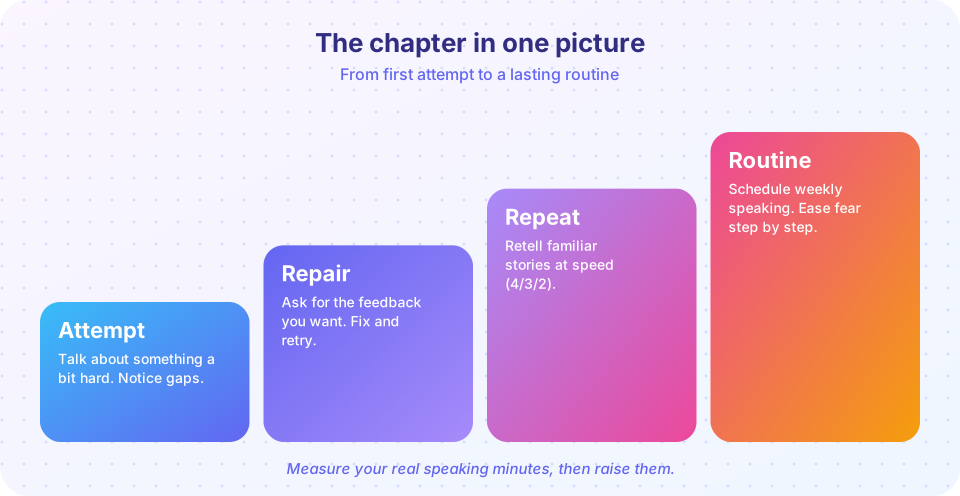
This chapter argued that speaking is a separate skill with its own practice, and that good speaking practice is measured by how much you talk, whether you notice and repair gaps, whether you repeat familiar material for speed, and whether the situation feels safe enough to keep going.
What you will learn
- A recap of the chapter's main findings in one table.
- How to turn those findings into a weekly speaking plan.
- Where your understanding is solid and where to revisit.
Recap
| Idea | Key point | Where to revisit |
|---|---|---|
| Output | Producing language shows gaps and tests forms (Swain) | Output and interaction |
| Interaction | Repairing breakdowns focuses attention on forms (Long) | Output and interaction |
| Feedback | Recasts are common; prompts often lead to more repair | Output and interaction |
| Formats | Compare by talk time, feedback, cost and staying power | Partners and tutors |
| Fluency | Smooth speech needs repetition of familiar material | Fluency and anxiety |
| Anxiety | Moderate negative link with achievement; exposure helps | Fluency and anxiety |
Build a weekly plan
A balanced week mixes feedback-rich practice with volume and fluency. The tool below splits a weekly minutes budget across Nation's four strands, adapted to speaking: meaning-focused output (conversation), language-focused repair (reviewing errors), fluency work (4/3/2 or shadowing) and low-stakes self-talk.
Press Run (or Ctrl + Enter) to see the result here.
Program input · what you'd type while the program runs
Type the answers before you press Run, one per line. Each time the program reads a line (with input()), it gets the next line from this box.
The shares are a starting point you can change; the research supports mixing kinds of practice but does not give exact percentages.
Key studies revisited
- Swain (1985). In Canadian French immersion classes, students understood well but their speaking and writing showed persistent gaps, leading to the output hypothesis. Limits: observational, and it describes a particular school setting.
- Long (1996). The interaction hypothesis says that negotiation of meaning helps acquisition by focusing attention on form. Limits: the evidence is strongest for specific forms in short tasks.
- Lyster and Ranta (1997). In immersion classrooms, recasts were the most frequent feedback but led to repair less often than prompts. Limits: classroom setting; later one-to-one studies found recasts can work well.
- Kormos and Dénes (2004). Speech rate, mean length of run and the proportion of time spent speaking predicted fluency ratings. Limits: small sample of one learner group.
- Horwitz, Horwitz and Cope (1986) and later meta-analyses. Moderate negative correlation between language anxiety and achievement. Limits: correlation, not cause.
Worked example: a speaking week
Nadia speaks about 3 minutes a week in her group class. She adds two sessions: a 30-minute tutor lesson where she speaks about 15 minutes, and a 25-minute exchange in which she speaks about 10 minutes. Her weekly speaking time goes from about 3 minutes to about 28 minutes, nearly ten times as much. She asks her tutor to correct only verb tense, logs three new words after each session, and does one 4/3/2 round on Sunday. In three months she has spoken for more than six hours instead of about 40 minutes. The research does not promise an exact outcome, but it explains why such a change is worth trying: more output, targeted feedback and repetition of familiar material attack the three weakest points of most self-study plans.
What to do next
Before you start the next chapter, do three small things. First, count your real speaking minutes for one week. Second, book one conversation session for next week and prepare three topics. Third, record a one-minute talk on a simple subject and save it; in a month you will record the same subject again and listen to both. This costs about an hour in total, and it gives you a baseline and a reason to speak, which are the two things that most plans for speaking lack.
Check your understanding
Quick check · 10 questions
of 10 answered You scored / 10 · perfect!
-
1. Which problem in French immersion classrooms inspired the output hypothesis?
Swain observed strong comprehension but persistent production problems. -
2. Which is an example of a clarification request?
A clarification request asks the speaker to explain or restate. Repeating with rising tone is a confirmation check. -
3. Which format typically gives the least learner talk time per hour?
Talk time is shared among many students. -
4. What is the best first step in building a speaking plan?
Real speaking time is usually lower than expected; measuring shows what to change. -
5. What does the 4/3/2 technique train?
Repeating the same content under shrinking time builds speed and smoothness. -
6. Why is a recast sometimes less effective than a prompt?
Lyster and Ranta found recasts led to less repair, partly because they may not be noticed as feedback. -
7. What is the best-supported statement about language anxiety?
Meta-analyses find a moderate negative correlation without proving one-way causation. -
8. Which request is a prompt?
A prompt invites the learner to self-correct. -
9. According to Skehan's trade-off idea, what should you do to improve fluency?
Familiar content frees attention so that speed can improve. -
10. What is circumlocution?
It is a communication strategy to keep talking.
Summary
- Speaking improves through output, interaction, feedback and repetition.
- Compare formats by your talk time, feedback and sustainability.
- Fluency needs familiar material; accuracy needs attention and correction.
- Anxiety falls with gradual exposure; treat errors as information.
- Plan a weekly mix and measure your real minutes.
Track your progress
Create a free account to tick off lessons and pick up where you left off on any device.
of How to Learn a Language lessons completed