


















Lesson 47 of 48 · Projects and Practice
Cheat sheet: How to learn a language on one page
A one-page recap of the main findings of this course on speaking, reading, writing, grammar and planning, with a problem and fix lookup you can run.
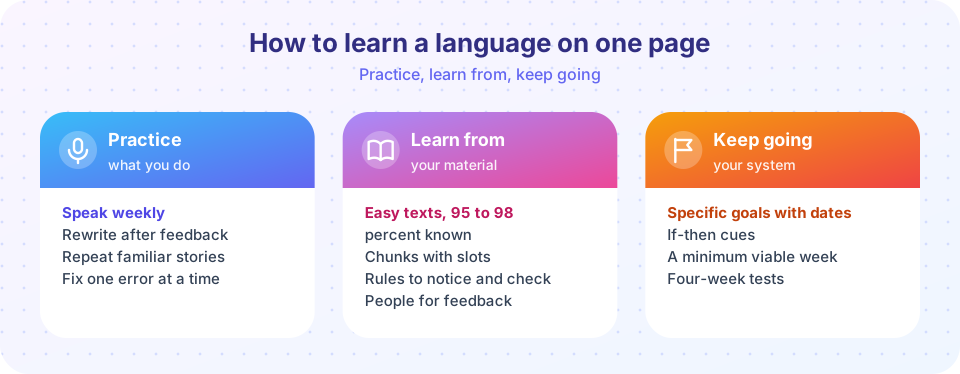
This is the whole second half of the course on one page. Use it before a study session, when you feel stuck, or when you are planning the next month. Each line points to the lesson that explains the evidence, and each line is a rule of thumb rather than a law.
What you will learn
- The key rule of thumb for each skill.
- A quick way to look up a fix for a common problem.
- Which lesson to reread for each topic.
Key terms
Strand balance: dividing time across input, output, study and fluency.
Coverage: the share of a text's words you know; aim for 95 to 98 percent when reading for volume.
Minimum viable week: the smallest plan you keep in bad weeks.
Four-week test: try one change for four weeks before judging it.
The rules of thumb
Speaking
- Measure your real speaking minutes; aim to raise them first. (Overview)
- Producing language shows gaps and tests forms; ask for the kind of correction you want. (Output and interaction)
- Compare formats by your talk time, feedback, cost and staying power. (Partners and tutors)
- Build fluency by repeating familiar material at speed; lower anxiety by gradual exposure. (Fluency and anxiety)
Reading and writing
- Read a lot at a level where you know about 95 to 98 percent of the words. (Extensive reading)
- For close study use four passes; look up words that block meaning and recur. (Intensive reading)
- Close the feedback loop by rewriting; log errors and fix the top one or two. (Writing and feedback)
Grammar
- Rules help you notice and check; practice and input make use automatic. (Explicit and implicit)
- Collect chunks with slots and vary the fillers. (Patterns and chunks)
- Errors show your developing system; fix one persistent error at a time. (Errors and interlanguage)
Plans and habits
- Goal = task + standard + date; hours depend on language distance and practice quality. (Goals and time)
- Judge tools by the job they do; app evidence is limited, so mix with people. (Tools and apps)
- Expect motivation to fluctuate; use if-then cues and a minimum week. (Motivation and habits)
Problem and fix lookup
Press Run (or Ctrl + Enter) to see the console output here.
No output.
The weekly template
A balanced week, at about 5 hours:
| Strand | Minutes | Example |
|---|---|---|
| Input | about 105 | graded reader, podcast |
| Output | about 75 | tutor or exchange, writing |
| Study | about 60 | spaced repetition, one grammar point |
| Fluency | about 60 | shadowing, repeating a story |
Move minutes toward your weakest skill each month.
How to use the cheat sheet
Print it or pin it where you study. Before a session, read the line for the strand you are about to practice. After a session, tick the strand in your log. Once a week, look at which lines you have not touched and plan a session for them. When you feel stuck, run the problem and fix lookup, or the strand balance check from the planning chapter. The sheet is deliberately short so that you will actually use it, and the lessons linked from each line are there when you need the evidence behind a rule of thumb.
Common misconceptions
"One page replaces the lessons." It is a reminder, not an explanation; the lessons give the evidence and limits.
"Rules of thumb are rules." They are starting points; test them for four weeks.
Check your understanding
Quick check · 4 questions
of 4 answered You scored / 4 · perfect!
-
1. What coverage should you aim for when reading for volume?
Research suggests 95 to 98 percent supports comfortable reading. -
2. What closes the writing feedback loop?
Rewriting makes you apply the correction. -
3. How many persistent errors should you target at once?
One at a time keeps practice manageable. -
4. What is the four-week test?
It keeps cause and effect visible.
Summary
- Raise real speaking time; use repetition for fluency and graduated exposure for anxiety.
- Read at 95 to 98 percent coverage; use four passes for close study.
- Rewrite after feedback and fix one error at a time.
- Use rules for noticing, chunks for speed and if-then plans for habits.
- Test changes for four weeks.
Next: Further study
Track your progress
Create a free account to tick off lessons and pick up where you left off on any device.
of How to Learn a Language lessons completed