


















Lesson 18 of 48 · Listening and Pronunciation
Sound perception: how your ears get tuned to one language
Why some foreign sounds are hard to hear: infant perceptual narrowing, categorical perception, the r and l problem, and the models that predict which contrasts will be hard.
Play the English words rock and lock to a native Japanese speaker who has never studied English, and many will report hearing the same word twice. Play a Mandarin tone pair to an English speaker and they may hear two identical syllables. Neither listener is deaf or careless. Their ears have been trained, since before their first birthday, to treat certain differences as important and others as noise.
This is the root of most difficulties with foreign sounds, and understanding it changes how you should train. This lesson covers how infants tune their perception, how adults hear sound categories, and which contrasts are hardest, and it ends with a promising point: the tuning can be changed.
What you will learn
- What phonemes and sound categories are, and why listeners hear categories
- How infants narrow their perception in the first year, and the evidence
- Why contrasts such as English r and l are hard for some listeners
- Models that predict which second-language sounds will be hard
Key terms
Phoneme: a sound category that distinguishes words in a language, such as /r/ and /l/ in English.
Categorical perception: hearing a smooth range of sounds as belonging to separate categories, with sharp boundaries.
Voice onset time (VOT): the time between the release of a consonant and the start of vocal fold vibration; it separates sounds like /b/ and /p/.
Perceptual narrowing: the decline in sensitivity to contrasts that are not used in the languages an infant hears.
Formant: a resonance of the vocal tract that shows up as a band of energy in the speech signal and distinguishes vowels.
Sounds are categories
Speech sounds vary continuously. A consonant like /p/ can be produced with many slightly different timings and breath amounts. Listeners do not hear that smooth variation; they hear categories. In the 1950s and 1960s, researchers at Haskins Laboratories (Alvin Liberman and colleagues) built synthetic stimuli that changed in small, equal steps from /ba/ to /pa/ by changing only the voice onset time. Listeners heard /ba/ for the first several steps, then suddenly /pa/: a sharp boundary, with differences within a category being hard to notice and differences across the boundary being easy. This is categorical perception.
The key point for learners: where the boundary falls depends on your language. Leigh Lisker and Arthur Abramson (1964) measured voice onset times across languages and showed that languages divide the range differently. English separates a short-lag /b/ from a long-lag /p/. Spanish /b/ is often voiced before the release (a negative VOT), and Spanish /p/ is short-lag, close to the English /b/. So an English speaker listening to Spanish may hear a Spanish /p/ as a /b/, and a Spanish speaker may do the reverse with English. Each is using a boundary tuned by their native language.
Infants: narrowing in the first year
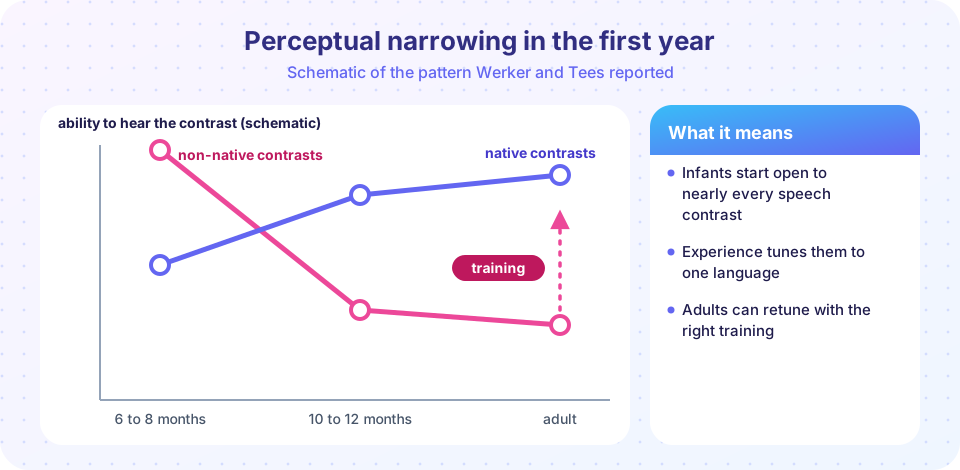
Newborns are sensitive to contrasts from many languages. Janet Werker and Richard Tees (1984) tested English-learning infants on contrasts from Hindi (a retroflex versus dental stop) and from Nthlakampx, a Salish language of North America (a contrast between two glottalized sounds). Infants of 6 to 8 months discriminated both contrasts. By 10 to 12 months, English-learning infants no longer did, while Hindi-learning and Salish-learning infants of the same age still discriminated their own contrasts. English-speaking adults also failed on these contrasts, so the decline had happened in the first year.
Patricia Kuhl and colleagues (1992) found a related effect for vowels: by 6 months, infants in the United States and in Sweden already showed different perceptual patterns for vowels that are typical of their language, consistent with a "perceptual magnet" around native categories. Meanwhile, sensitivity to native-language contrasts improves as non-native sensitivity declines. The system is not losing ability; it is specializing, and the specialization helps in learning words in the native language.
A key later experiment: Kuhl, Tsao and Liu (2003) gave American infants of about 9 months twelve sessions of play with Mandarin speakers. Infants who interacted with live speakers kept the ability to distinguish a Mandarin consonant contrast, while infants who got the same Mandarin by audio or video only did not. The study is small and about infants, but it suggests that social interaction plays a role in tuning perception, which is one more reason to practice with real people.
Why adults hear categories wrongly
The best-known example is the English /r/ and /l/ contrast for Japanese speakers. Japanese has one liquid sound, a tap, that falls somewhere between the English sounds. Studies, including Kuniko Miyawaki and colleagues (1975) and later work by Paul Iverson and colleagues (2003), found that Japanese listeners are less sensitive to the acoustic cue that best separates English /r/ and /l/ (the third formant), and rely on other cues that are not reliable. Notice that the difficulty is perceptual: it is not that they cannot move their tongues correctly.
Other well-known difficulties:
- English speakers hearing Mandarin tones, or Spanish speakers hearing the English vowels in ship and sheep, which Spanish does not distinguish.
- Speakers of languages without a voicing contrast in some position (for example, final consonants in Mandarin) missing the difference in back and bag.
- Speakers of non-tonal languages needing training on the pitch patterns of Mandarin or Thai.
Models that predict difficulty
Researchers have built models to predict which second-language sounds will be hard.
Catherine Best's Perceptual Assimilation Model. Foreign sounds are heard in terms of the nearest native categories. If two foreign sounds both map to the same native category, they are hard to discriminate (Japanese /r/ and /l/ both map to the Japanese liquid). If they map to different native categories, they are easy. If a sound is unlike any native sound, it may be easy to hear as speech-but-not-native.
James Flege's Speech Learning Model. Learners tend to treat L2 sounds that are similar to an L1 sound as equivalent, so the L2 sound is not given its own category and stays inaccurate. L2 sounds that are clearly new may be easier to learn precisely because they are not confused with an L1 sound. The model also says that perception and production are linked: improved perception tends to bring improved production.
Both models agree on the practical point: the contrasts that cause the most trouble are those that fall inside one of your native categories, and learning them means building a new category boundary where your ears currently hear one sound.
"I cannot hear it because I am too old." Adults can learn new contrasts. The next lessons describe training methods that work, though gains in natural listening usually take many sessions.
"Pronunciation problems are about the mouth." Often they begin in the ear. If you cannot hear the difference, you cannot tell whether you made it.
"If I know the spelling, I know the sound." Spelling can mislead. Spanish b and v are usually spelled differently but pronounced alike, and English spelling hides many sounds.
What helps
- Attend to contrasts that matter. Find out from a pronunciation guide which sounds in your target language fall inside one of your native categories.
- Listen to many speakers. Training with several voices produces more flexible categories than listening to one (lesson 4).
- Pair listening with feedback. Choose a word, say which of two sounds it contains, and check the answer.
- Interact. The infant study hints that real interaction tunes perception more than passive audio.
Try it
The first demonstration is a model of categorical perception. Move the slider to change the voice onset time and see how likely a listener with each language's boundary would hear /pa/ rather than /ba/. The boundaries are illustrative values, not measurements.
The second demonstration plots the same idea as identification curves for two listeners, which makes the boundary shift visible. The curves are simulated.
Press Run (or Ctrl + Enter) to see the result here.
Program input · what you'd type while the program runs
Type the answers before you press Run, one per line. Each time the program reads a line (with input()), it gets the next line from this box.
Check your understanding
Quick check · 5 questions
of 5 answered You scored / 5 · perfect!
-
1. Categorical perception means that listeners
A gradual change in voice onset time is heard as an abrupt change from one category to another. -
2. Werker and Tees (1984) found that English-learning infants
Perceptual narrowing: sensitivity to non-native contrasts declines in the second half of the first year. -
3. According to the Perceptual Assimilation Model, which pair is hardest to discriminate?
When both foreign sounds fall inside one native category, listeners tend to treat them as the same. -
4. In the Kuhl, Tsao and Liu (2003) study, infants kept the Mandarin contrast best when they
Live social interaction produced learning that audio and video alone did not. -
5. The difficulty of English /r/ and /l/ for many Japanese listeners is mainly
Studies point to differences in which acoustic cues listeners attend to.
Summary
- Listeners hear speech in categories, and the category boundaries are language-specific.
- Infants narrow their perception between about 6 and 12 months, specializing in their native sounds.
- Foreign contrasts are hardest when they fall inside one native category (Best, Flege).
- Difficulties are often perceptual, so train the ear and the mouth together.
- Adults can retune with the right practice, as the next lessons show.
Next: Listening practice
Track your progress
Create a free account to tick off lessons and pick up where you left off on any device.
of How to Learn a Language lessons completed