


















Lesson 7 of 48 · How Languages Are Learned
Comprehensible input: Krashen's hypothesis and its limits
Krashen's input hypothesis, the evidence from extensive reading and book floods, the 95 to 98 percent coverage findings, and why input alone is not enough.
If you had to choose one thing that every successful language learner has in common, it would be a very large amount of language that they understood. Children get it from the people around them. Adults who learn well get it from books, audio, video, conversation and travel. The idea that understanding messages is the engine of language learning has been the most influential, and the most argued over, in the field. It belongs to the linguist Stephen Krashen, who put it forward in the late 1970s and 1980s.
This lesson explains the hypothesis in its original form, shows what evidence supports it, shows where it fails, and ends with a practical rule: how much of a text you need to understand for reading and listening to teach you something.
What you will learn
- The five hypotheses in Krashen's theory, in plain language
- What evidence supports the importance of input, such as extensive reading and book floods
- What the "95 to 98 percent coverage" findings mean and what they do not
- Why the strong version of the theory is criticized, and what survives
Key terms
Input hypothesis: the claim that we acquire language by understanding messages that contain structure just beyond our current level (i + 1).
Affective filter: Krashen's idea that anxiety and low motivation block input from being used for learning.
Extensive reading: reading a lot of easy material for meaning and enjoyment, rather than studying a few hard texts closely.
Lexical coverage: the percentage of the running words in a text that you already know.
Graded reader: a book written or simplified for learners at a given level, using a controlled vocabulary.
Krashen's five hypotheses
Krashen's theory, laid out in Principles and Practice in Second Language Acquisition (1982), has five parts.
- Acquisition versus learning. Acquisition is an unconscious process like a child's; learning is conscious study of rules. Only acquisition, he said, produces fluent speech.
- The monitor. Learned rules can only edit what you say, and only when you have time, know the rule and focus on form.
- The natural order. Grammar features are acquired in a predictable sequence regardless of teaching. Studies such as Heidi Dulay and Marina Burt's (1974) found that children learning English as a second language acquired certain grammatical endings in a similar order, whatever their first language.
- The input hypothesis. Acquisition happens when you understand input that contains i + 1, where i is your current level and +1 is the next step.
- The affective filter. A tense, unmotivated learner has a high filter and acquires less of the available input.
The practical message: make input your main activity, keep it comprehensible, keep anxiety low, and do not expect grammar study to turn into fluent speech.
What supports the importance of input
Book floods. Warwick Elley and Francis Mangubhai (1981) studied primary schools in Fiji where children learned English as a second language. Some schools received large numbers of interesting books and ran shared reading, while others kept a conventional audio-lingual program. After two years, the book-flood children improved more in reading and showed larger gains in English language skills. The study was in a particular setting, but it became a landmark because the improvement came from volume of meaningful reading.
Extensive reading studies. Reviews and meta-analyses of reading programs, such as one by Akio Nakanishi (2015), found positive effects of extensive reading on reading ability and other language measures, with moderate effect sizes. The strongest effects are for reading itself and for vocabulary and fluency; effects on speaking are less clear.
Everyday learning of words. People pick up many words from context, a process called incidental vocabulary learning. Each encounter adds a little, which is why repeated reading of easy material builds a large vocabulary over time (Chapter 3 returns to this).
Naturalistic input. Immigrants who live and work in the language community, and learners who consume hours of media daily, often reach good comprehension without formal study.
How much understanding is enough?
If input must be comprehensible, how comprehensible? Researchers have measured lexical coverage, the share of words in a text that the reader already knows.
- Batia Laufer (1989) found that about 95% coverage gave many readers adequate comprehension of academic text.
- Hu and Nation (2000) found that at 80% coverage readers did not understand fiction passages adequately, and concluded that about 98% was needed for most readers to understand without help.
- Norbert Schmitt, Xiangying Jiang and William Grabe (2011) found a steady, nearly linear relationship: more coverage meant more comprehension, with no sharp threshold. Around 98% gave better comprehension than 95%.
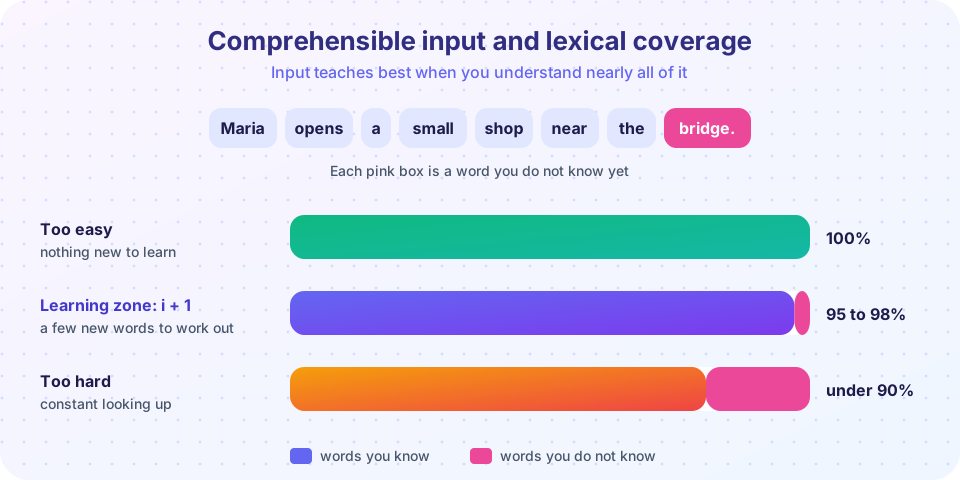
What this means for you. At 95% coverage you meet a new word in every twenty running words, about 15 unknown words on a 300-word page. At 98%, about six. The first feels like constant looking-up; the second feels like reading. Plan your reading around that edge: texts at 95% to 98% are the sweet spot for learning, texts below 90% are mostly frustrating, and texts at 100% are comfortable but teach little new.
This also explains why graded readers and learner podcasts are so useful. They hold the unknown words to a level where meaning is clear and the new items can be guessed or looked up in seconds.
Where the theory fails
The input hypothesis is influential, and it has well-known problems.
It is hard to test. Michael Long and Barry McLaughlin pointed out that i + 1 is not defined well enough to measure, since no one can say what a learner's i is. A claim that cannot be measured cannot easily be disproved.
Input alone does not produce accurate output. Merrill Swain's studies of French immersion students in Canada (1985) found that children with thousands of hours of French input understood it well but spoke with persistent grammatical errors. Lesson 3 of this chapter looks at this in more detail.
The acquisition-learning line is too sharp. Evidence from experiments (for example, Norris and Ortega, 2000) suggests that explicit instruction can speed up learning and that conscious knowledge can turn into automatic skill with practice. Krashen's claim that learned knowledge can never become acquired is not well supported.
Adults do not simply pick up grammar from exposure. Many adult learners hear a form thousands of times without ever using it correctly unless they notice it (Chapter 2, lesson 4).
The affective filter is hard to measure. Anxiety does correlate with lower achievement, but whether it works as a filter on input is not clearly established.
So the supportable version is: comprehensible input is necessary, large amounts of it are very helpful, but it is not by itself sufficient.
"If I understand it, I am learning." Understanding with the help of context, pictures or translation can happen without noticing the form of the words. You can watch hundreds of hours of a series and learn little if you only follow the plot.
"Input must be at exactly the right level." There is no exact measure of i. Aim for a broad range where most is understood and a little is new.
"Passive exposure is enough." Background audio that you do not attend to has little evidence of benefit. Attention matters.
Making input work for you
- Choose by coverage, not by prestige. A novel for natives may sit at 85% coverage and teach little; a graded reader at 98% will teach more.
- Re-read and re-listen. Repetition with the same material is not wasteful. It lifts coverage and lets you notice more.
- Pair input with noticing. After a session, look back at a few sentences and ask why they were built that way.
- Keep it enjoyable. If you hate the material, you will not do the hours.
Try it
The first demonstration measures lexical coverage. Paste a text, list the words you know, and see the percentage. The text here is a short paragraph about a market; your own readings would be longer.
Press Run (or Ctrl + Enter) to see the console output here.
No output.
The second demonstration shows what coverage means on a real page. It computes how many unknown words you meet on a page of a chosen length at different coverage levels.
Press Run (or Ctrl + Enter) to see the result here.
Program input · what you'd type while the program runs
Type the answers before you press Run, one per line. Each time the program reads a line (with input()), it gets the next line from this box.
Check your understanding
Quick check · 5 questions
of 5 answered You scored / 5 · perfect!
-
1. In Krashen's theory, 'i + 1' stands for
i is your current level; +1 is the next step, which you can understand with the help of context. -
2. Elley and Mangubhai's Fiji study is cited as evidence for
Children in schools with a flood of books improved more in English than those in the audio-lingual program. -
3. At 98% lexical coverage, about how many unknown words are on a 300-word page?
300 words times 2% equals 6 unknown words. -
4. Which is a well-known criticism of the input hypothesis?
The claim is hard to test and Swain's immersion studies showed that large input did not prevent errors in output. -
5. Which finding did Schmitt, Jiang and Grabe (2011) report?
They found no single threshold; more known words meant better comprehension, with 98% giving better results than 95%.
Summary
- Krashen's input hypothesis says we acquire language by understanding messages slightly above our level.
- Evidence from book floods and extensive reading supports large amounts of meaningful input.
- Reading teaches best at around 95 to 98 percent known words; coverage and comprehension rise steadily together.
- The strong claims (input alone suffices, rules never help) are not well supported.
- Use input as the base and add noticing, output and practice.
Next: Output and interaction
Track your progress
Create a free account to tick off lessons and pick up where you left off on any device.
of How to Learn a Language lessons completed