


















Lesson 9 of 48 · How Languages Are Learned
Noticing and explicit knowledge: do grammar rules help?
Schmidt's noticing hypothesis, the difference between implicit and explicit knowledge, what meta-analyses say about teaching rules, and how to notice more in your input.
Two learners hear the same sentence, "She works at the hospital," many times. One day the first realizes that the verb ends in -s because the subject is she. The second never does and continues to say "She work." Same input, different learning. The difference lies in what each person noticed.
This lesson looks at the role of attention and conscious knowledge. It answers three common questions: Do I need to notice things to learn them? Do grammar rules help or hurt? And how can I notice more without turning every conversation into a grammar lecture?
What you will learn
- Schmidt's noticing hypothesis and the diary study behind it
- The difference between implicit and explicit knowledge, and the three "interface" positions
- What the main meta-analyses say about explicit instruction
- Practical habits that increase noticing
Key terms
Noticing: consciously registering a specific feature of the input, such as a word ending or a sound.
Intake: the part of the input that you have actually processed and that can change your knowledge.
Implicit knowledge: knowledge you use automatically without being able to state the rule.
Explicit knowledge: knowledge you can state as a rule, such as "add -s to verbs after he, she, it."
Focus on form: briefly drawing attention to language form during a meaning-focused activity.
Schmidt's noticing hypothesis
Richard Schmidt, an applied linguist, spent several months in Brazil in the 1980s learning Portuguese while keeping a diary of what he heard and what he used, a study he later published with Sylvia Frota (1986). Schmidt recorded forms he noticed in other people's speech and compared them with what he began to use. He found that forms he had consciously noticed in the input were much more likely to appear in his own speech afterwards. Forms that he heard often but did not notice mostly did not.
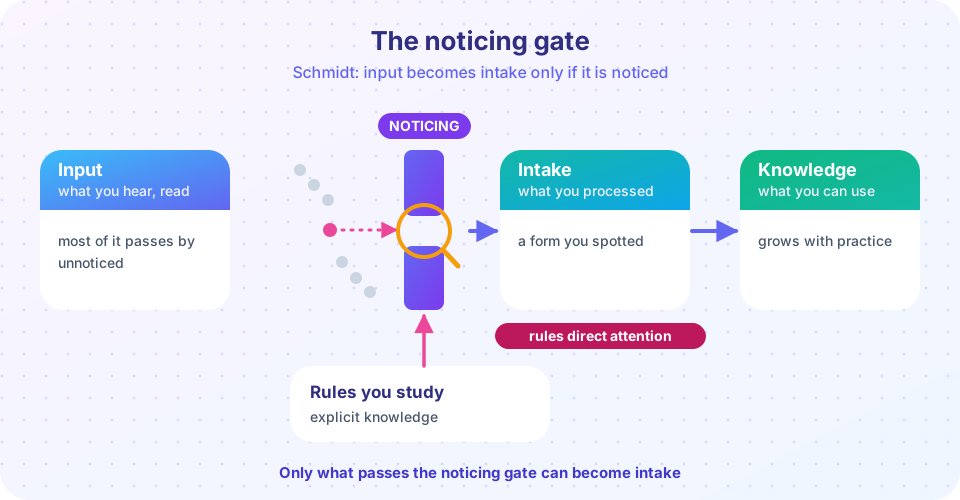
This led Schmidt (1990) to the noticing hypothesis: input becomes intake only if it is noticed. He did not claim you must know the rule, only that you must be consciously aware of the instance, such as "the waiter said quer where I would say quero." Understanding the rule can come later or never.
A single case study cannot prove a general theory: Schmidt was an unusually reflective learner who was documenting everything. But later experiments supported the general idea. Eye-tracking and other studies show that learners who attend to a form learn it better than those who do not, and the hypothesis fits many everyday observations: we do not learn what we fail to attend to.
Why might things go unnoticed?
- Low salience. The third-person -s in English is short, unstressed and redundant (the pronoun already tells you the subject), so it is easy to miss.
- Meaning shortcuts. When context gives the meaning, listeners need not process the form.
- Overload. Fast speech and unknown vocabulary leave no attention for details.
- Language transfer. Features that your first language lacks, such as articles for a Russian speaker, do not draw attention because you have no slot for them.
Implicit and explicit knowledge
When you speak your first language, you use grammar without being able to explain it. That is implicit knowledge: fast, automatic, and mostly beyond conscious access. Explicit knowledge is what you can state, such as a rule from a textbook. Rod Ellis (2005) developed tests to measure each kind, using, for example, timed grammaticality judgments for implicit knowledge and untimed ones with rule explanations for explicit knowledge.
Can explicit knowledge become implicit? Researchers take three positions:
| Position | Claim | Main proponent |
|---|---|---|
| Non-interface | Conscious knowledge never turns into automatic knowledge; only acquisition builds fluent speech | Stephen Krashen |
| Strong interface | Explicit knowledge becomes automatic through meaningful practice | Robert DeKeyser |
| Weak interface | Explicit knowledge helps indirectly: it directs attention and supports noticing, and it can speed development | Rod Ellis and others |
The weak-interface position has the widest support. Explicit knowledge may not directly become implicit knowledge, but it helps you notice what you otherwise would not, it lets you monitor writing and careful speech, and it saves time when a rule is hard to induce from examples.
What do the meta-analyses say?
Three bodies of evidence point in the same general direction.
Norris and Ortega (2000) combined 49 studies of instructional effects and found that instruction directed at specific forms was effective, and that explicit instruction (including explaining rules) produced larger gains on average than implicit instruction. A caution: many of the tests in these studies were more like classroom exercises than spontaneous conversation, which favors explicit teaching.
Spada and Tomita (2010) examined 41 studies and found that explicit instruction led to larger gains than implicit instruction for both simple and complex features, and the gains showed up on both controlled and free-production tasks.
Input enhancement studies test whether making a form visually prominent (bolding, color) helps. Meta-analyses, such as one by Lee and Huang (2008), found only small benefits for reading comprehension and learning of the highlighted forms. Highlighting a form helps a little if the learner is already attending but does not substitute for meaningful use.
Taken together: explicit teaching helps, especially for learners who study as adults and for features that are hard to notice from input. It is not a replacement for exposure and practice, and the amount of difference depends on how learning is tested.
"Grammar study is a waste of time." Evidence supports the opposite for many adult learners: rules speed up noticing and learning of features that are subtle in speech.
"If I know the rule, I know the language." Explicit knowledge is slow to apply in speech. Knowing the rule for -s does not mean you will say it in time during a conversation.
"Everything needs a rule." Some patterns, like many collocations (make a decision, not do a decision), are best learned as chunks from input.
Habits that increase noticing
- Read and listen twice. First for meaning, second for form. On the second pass, pick one feature, such as how past events are described, and watch for it.
- Keep a noticing notebook. When you hear something that is not what you would have said, write it down with its context. Later, ask what rule or pattern explains it.
- Notice the gap. When you say something and the reply uses different wording, compare the two. This is Schmidt's "noticing the gap" between your output and the target.
- Study the rule after meeting examples. Seeing a form in several real sentences first makes the rule memorable; reading the rule first can work if examples follow quickly.
- Use short, specific focus. One feature per week beats a vague intention to "notice more grammar."
Chapter 7 returns to grammar with practical methods for learning rules without tears.
Try it
The first demonstration shows how a feature disappears when you do not look for it. Use the checkbox to switch highlighting on and off, and count how many times you actually notice the target pattern (the -ed past endings) with highlighting off.
The second demonstration counts regular -ed and some irregular past forms in a short text, to show how often learners meet a target feature in ordinary input. Real corpora are much larger; this is only a sample.
Press Run (or Ctrl + Enter) to see the result here.
Program input · what you'd type while the program runs
Type the answers before you press Run, one per line. Each time the program reads a line (with input()), it gets the next line from this box.
Check your understanding
Quick check · 5 questions
of 5 answered You scored / 5 · perfect!
-
1. According to Schmidt's noticing hypothesis, input becomes intake
Schmidt required awareness of the instance, not necessarily knowledge of the rule. -
2. Which kind of knowledge is fast and automatic and usually cannot be explained?
Implicit knowledge is what you use automatically, as in a first language. -
3. Which interface position is best supported and says explicit knowledge helps indirectly by directing attention?
The weak interface view says rules help noticing and monitoring, even if they do not directly become automatic. -
4. What did Norris and Ortega (2000) find on average?
Their meta-analysis favored explicit instruction, while noting that tests often favored explicit knowledge. -
5. Why is the English third-person -s easy to miss?
Low salience and redundancy mean listeners can understand the meaning without processing it.
Summary
- Schmidt's noticing hypothesis says features must be consciously noticed to become learning.
- Implicit knowledge is automatic; explicit knowledge can be stated; most researchers favor a weak interface.
- Meta-analyses find explicit instruction at least as effective as implicit, with testing caveats.
- Visual highlighting helps a little; deliberate noticing habits help more.
- Use rules to direct attention, not to replace exposure and practice.
Track your progress
Create a free account to tick off lessons and pick up where you left off on any device.
of How to Learn a Language lessons completed