


















Lesson 4 of 48 · Getting Started
Age, aptitude and motivation: what research says about you
Is there a critical age for languages? Does talent matter? Weigh the evidence on age, aptitude, motivation and learning styles, and see what is within your control.
Almost every adult learner starts with a private worry: "I am too old," or "I am just bad at languages." These beliefs are powerful, and they are partly wrong and partly right. Research on age, aptitude and motivation gives a more useful answer than either "anyone can learn anything" or "it is too late."
This lesson sorts the findings into three groups: what the evidence supports, what it contradicts, and what remains debated. The aim is not reassurance for its own sake. It is to help you spend your effort on the things that actually move the result.
What you will learn
- What the "critical period" idea says and what studies of age actually found
- What language aptitude is, and how much it predicts
- How motivation relates to results, and how to protect it
- Why the learning-styles idea has not held up
Key terms
Critical period (or sensitive period): a stretch of development during which learning a skill is easier or more complete than later.
Ultimate attainment: the highest level a learner eventually reaches, as opposed to the speed of early progress.
Aptitude: a bundle of cognitive abilities that predicts how quickly someone learns a language, such as sound discrimination and memory for new associations.
Integrative and instrumental motivation: wanting to join the language community versus wanting a practical benefit like a job.
Learning styles: the claim that people learn better when teaching matches a preferred modality, such as visual or auditory.
Age: the evidence is mixed in an informative way
The idea of a critical period for language comes from Eric Lenneberg (1967), who proposed that language learning gets harder after puberty. First-language cases such as children isolated from language support the idea of an early sensitive period. For second languages, three kinds of evidence matter.
Rate: older learners are often faster at first. Catherine Snow and Marian Hoefnagel-Höhle (1978) tested English speakers learning Dutch in the Netherlands. Over the first year, adolescents and adults generally learned faster than young children, and the youngest children did not overtake them quickly. Adults bring literacy, strategies and the ability to study deliberately.
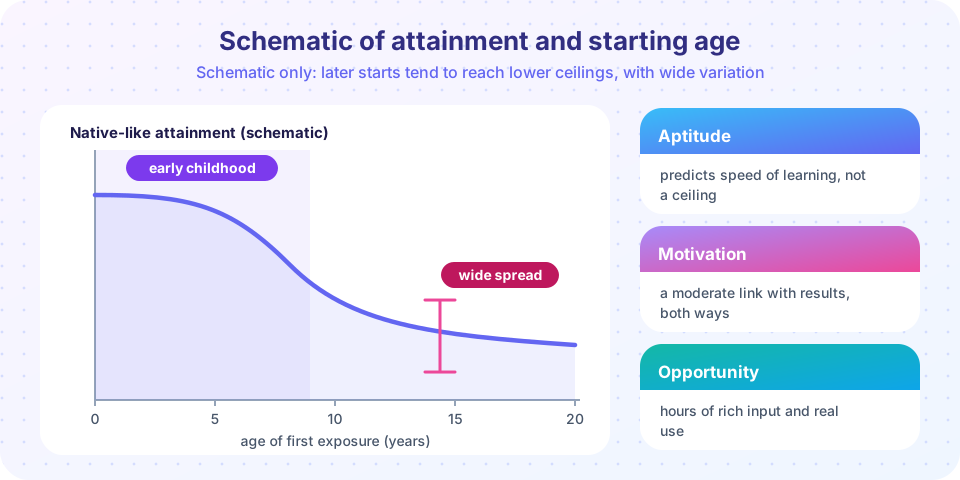
Ultimate attainment: earlier starters tend to go further. Jacqueline Johnson and Elissa Newport (1989) tested Chinese and Korean immigrants to the United States on English grammar judgments. Among those who arrived before about age seven, scores resembled native speakers. Scores then declined with later arrival ages, and among adult arrivals they varied widely and were unrelated to age. The pattern fits a gradual decline rather than a sharp cliff.
More recently, Joshua Hartshorne, Joshua Tenenbaum and Steven Pinker (2018) analyzed data from several hundred thousand people who took an online English grammar quiz. Their results suggested that the ability to learn grammar stays strong until about the late teens and then declines, and that reaching native-like grammar needs a start in childhood together with many years of exposure. This was a large, self-selected online sample, so it shows a pattern across many people, not a verdict on any one person.
Pronunciation is the most age-sensitive. James Flege and colleagues showed that foreign accent increases with age of arrival even among people who lived in the new country for decades. Adults can improve pronunciation a lot, but a fully native accent is rare.
What this adds up to:
- Children are not faster; they are better at reaching native-like final levels, mainly because they get more years of rich input.
- Adults are not doomed. They learn fast early and can reach levels that are excellent for almost every purpose. David Birdsong and others have documented a small minority of very late learners who are hard to distinguish from natives on many tests.
- The mechanism of the decline is debated. Some researchers favor biological change, others point to changes in experience (an adult's first language is entrenched, adults get less simple input and less time).
"Children learn languages effortlessly." Children get thousands of hours of simplified, repeated, emotionally rich input and have no other job. The effort is hidden, not absent.
"Adults cannot reach high levels." The evidence supports a lower probability of native-like attainment, not a ceiling on useful proficiency. Most goals sit well below that ceiling.
Aptitude: real, partial, and not destiny
Language aptitude has been studied since John Carroll and Stanley Sapon created the Modern Language Aptitude Test in 1959. Carroll proposed four components: phonemic coding (hearing and remembering new sounds), grammatical sensitivity (recognizing the roles words play), rote memory for new associations, and inductive learning (working out rules from examples).
Meta-analyses show that these abilities predict achievement in language courses to a moderate degree. Aptitude correlates positively with how fast people learn and with the results of instruction. Two important cautions follow.
- Aptitude predicts rate better than eventual success. High-aptitude learners get there faster, but with enough time and good practice many lower-aptitude learners also get there. This is consistent with the idea that language learning is mostly a matter of accumulated, well-spent time.
- Aptitude is not fixed in the way people imagine. Working memory and sound-discrimination abilities contribute, and a learner can compensate with better study habits, as Chapter 3 will show for memory.
If you scored poorly on a language test at school, that tells you something about how you did in that classroom, and little about what you can do with 500 hours of well-structured practice.
Motivation: the variable you can influence
Robert Gardner and Wallace Lambert (1959) studied English-speaking students in Canada and proposed two kinds of motivation: integrative (a wish to connect with the language community) and instrumental (practical benefits). Later reviews, including a meta-analysis by Masgoret and Gardner (2003), found moderate positive correlations between motivation and achievement. Correlation is not causation: successful learners become more motivated, and motivated learners succeed, and the relationship runs both ways.
Zoltán Dörnyei extended this in the 2000s with the L2 Motivational Self System: you learn more persistently when you can picture a future self who uses the language (your ideal L2 self), and when that picture feels achievable. Evidence for this comes mostly from questionnaire studies, which have limits, but it matches common experience.
What helps in practice:
- A concrete future scene (a job, a relative, a trip) rather than a general wish.
- Small wins that you can see, such as understanding one more episode.
- Social ties to the language: a tutor, a community, a friend. Isolation is the most common quiet killer of motivation.
- Habits that need little willpower: the same time, the same place, a 10-minute minimum.
Learning styles: a popular idea with poor evidence
Many people believe they are "visual learners" or "auditory learners" and that teaching in their preferred mode helps. A major review by Harold Pashler and colleagues (2008) looked for studies that showed the key prediction: that matching teaching to a learner's style produces better results than not matching. They found essentially no adequate evidence for it. People do have preferences, and a mix of modes (see it, hear it, say it) helps everyone, but the idea of matching instruction to a fixed style has not been supported.
The practical lesson is to use all channels for everyone: read the word, hear it, say it, use it.
Bilingual advantages: a cautionary tale
You will also read that learning languages makes you smarter or protects against dementia. Early studies suggested bilinguals had better executive control. Later large studies and meta-analyses found small or no effects once publication bias was considered (see, for example, Paap and colleagues, and Lehtonen and colleagues, 2018). Whether bilingualism delays dementia symptoms is still debated. Learn a language because it is worth knowing, not because it will raise your IQ.
Try it
The first demonstration is a schematic model, not data. It shows how an older starter can learn faster at first while a younger starter keeps a higher ceiling, which is the pattern described above. Both curves are invented from a simple formula.
Press Run (or Ctrl + Enter) to see the result here.
Program input · what you'd type while the program runs
Type the answers before you press Run, one per line. Each time the program reads a line (with input()), it gets the next line from this box.
The second demonstration shows how weak, moderate and strong correlations look. Many findings in this lesson (motivation and achievement, aptitude and rate) are moderate correlations, so it is useful to know what "moderate" looks like. The data are simulated.
Press Run (or Ctrl + Enter) to see the result here.
Program input · what you'd type while the program runs
Type the answers before you press Run, one per line. Each time the program reads a line (with input()), it gets the next line from this box.
Check your understanding
Quick check · 5 questions
of 5 answered You scored / 5 · perfect!
-
1. Snow and Hoefnagel-Höhle (1978) found that over the first year in the Netherlands
Older learners had an advantage in rate early on, which is why 'children learn faster' is a myth about speed. -
2. What does the research on age most strongly support?
Studies such as Johnson and Newport's show a decline in ultimate attainment with later starts, while adults can still reach high levels. -
3. Aptitude is best described as
Aptitude predicts rate moderately and can be compensated for with more time and better habits. -
4. What did Pashler and colleagues (2008) conclude about learning styles?
People have preferences, but the key matching prediction has not been supported. -
5. A correlation of about 0.3 between motivation and achievement means
A moderate correlation shows a real link without proving cause, and many other factors remain.
Summary
- Adults often learn faster at first; childhood starts tend to reach higher native-like levels, especially in pronunciation.
- Large decline findings come from specific samples; they describe patterns, not your limit.
- Aptitude predicts speed moderately and can be offset by time and good practice.
- Motivation relates moderately to achievement, in both directions; a concrete future self and social ties help.
- Learning-styles matching and bilingual-brain-boost claims have weak support.
Next: Chapter 1 review
Track your progress
Create a free account to tick off lessons and pick up where you left off on any device.
of How to Learn a Language lessons completed