


















Lesson 23 of 48 · Speaking and Conversation
Output and interaction: why talking teaches
What Swain's output hypothesis and Long's interaction hypothesis say, what the evidence supports, and how to turn conversations into learning.
If you could absorb a language only by listening, speaking would be a way to show off what you had already learned. Second language acquisition research suggests something more interesting: producing language is itself a learning event. When you try to say something you cannot quite say, your brain registers the gap, and the next piece of input can fill it.
This lesson covers the two best-known ideas on the topic, the output hypothesis and the interaction hypothesis, what studies have found, and what both mean for how you practice. It also explains where the evidence is weaker than the textbooks sometimes suggest.
What you will learn
- What the output hypothesis claims and the three functions Swain proposed for output.
- What negotiation of meaning is and how the interaction hypothesis uses it.
- What studies of corrective feedback, including recasts, have found.
- How to design speaking practice that produces noticing and repair.
Key terms
Comprehensible input: language you can mostly understand but that contains something slightly beyond your current level.
Pushed output: speech that demands more precision or complexity than you would produce with little effort.
Negotiation of meaning: the adjustments partners make when understanding breaks down, such as repeating, rephrasing or asking for clarification.
Recast: a correct reformulation of what a learner said, without explicitly pointing out the error.
From input to output
In the late 1970s and 1980s, Stephen Krashen argued that acquisition happens when learners understand input that is slightly above their level, which he abbreviated i+1. The idea convinced many teachers that listening and reading come first, and it remains widely accepted that large amounts of comprehensible input are necessary. Critics pointed out that i+1 is hard to measure and that Krashen's claim that output plays almost no direct role was never convincingly shown.
Merrill Swain gathered evidence from Canadian French immersion programs, where students were taught school subjects in French from early ages. They became strong listeners and readers, yet their speaking and writing still showed grammatical problems. Swain's reading, published in 1985, was that comprehension can often be achieved without paying attention to grammar, because meaning, context and vocabulary are enough. Production does not allow that shortcut: you must choose a form.
She proposed three functions of output:
- Noticing. Trying to say something shows you what you cannot yet say.
- Hypothesis testing. You try a form and learn from the response whether it works.
- Metalinguistic reflection. Talking about language, with a partner or to yourself, makes rules explicit.
Notice the first function. The benefit of speaking is not mainly that you rehearse what you know. It is that failing to express an idea creates a need and makes the next relevant input more meaningful.
Interaction and negotiation of meaning
Michael Long, drawing on studies of native and non-native speaker conversations, proposed in the 1980s and 1990s the interaction hypothesis: conversation helps acquisition when understanding breaks down and the speakers work to repair it. These repairs are called negotiation of meaning. Common moves include:
- Clarification request: "Sorry, what do you mean?"
- Confirmation check: "You went to the market?"
- Comprehension check: "Do you follow?"
- Recast: the partner repeats your sentence correctly.
The reasoning is that these moves make input more comprehensible and also direct your attention to forms. Studies, mostly short laboratory tasks with pairs, find that interaction does improve learning of targeted structures and vocabulary more than non-interactive controls. Reviews also remind us that the setting matters: effects are clearer in short tests close to the task than in long-term, general proficiency.
Press Run (or Ctrl + Enter) to see the console output here.
No output.
This dialogue is invented for illustration. Look at the last line: the learner used the new word and the correct past form. That is uptake, and it is one visible sign that interaction did its job.
What research says about feedback
Feedback is the part of interaction we can study most precisely. In a well-known classroom study of French immersion lessons, Roy Lyster and Leila Ranta (1997) recorded teacher responses to student errors. Teachers recast most often, in more than half of cases, yet recasts led to learner repair less often than prompts such as asking "Can you say that another way?" or giving a clue about the rule. A plausible reason is that learners may hear a recast as simply continuing the conversation rather than as a correction.
Later work complicated this picture. In one-to-one settings and in studies where recasts are consistent and the learner is ready for the form, recasts can work well. Meta-analyses generally find that corrective feedback of several kinds helps, with prompts and explicit corrections often producing larger measured gains on tests that ask learners to use explicit knowledge. There is no single best type of feedback, and the best choice depends on the learner, the target and the timing.
When you ask a partner for correction, say which kind you want: "Please repeat my sentence correctly" (a recast) or "Please just stop me when something sounds odd, and let me try again" (a prompt).
What the evidence does not say
Be careful with oversimplifications you may meet online:
- Interaction research does not show that you can learn a language only by chatting. Most studies measure specific forms after short sessions.
- The output hypothesis does not say that more speaking is always better. Fluent repetition of what you already know builds speed but may add few new forms.
- Negotiation of meaning is useful but not magic: a conversation where you never get stuck may feel pleasant and teach little.
Designing practice that uses the loop
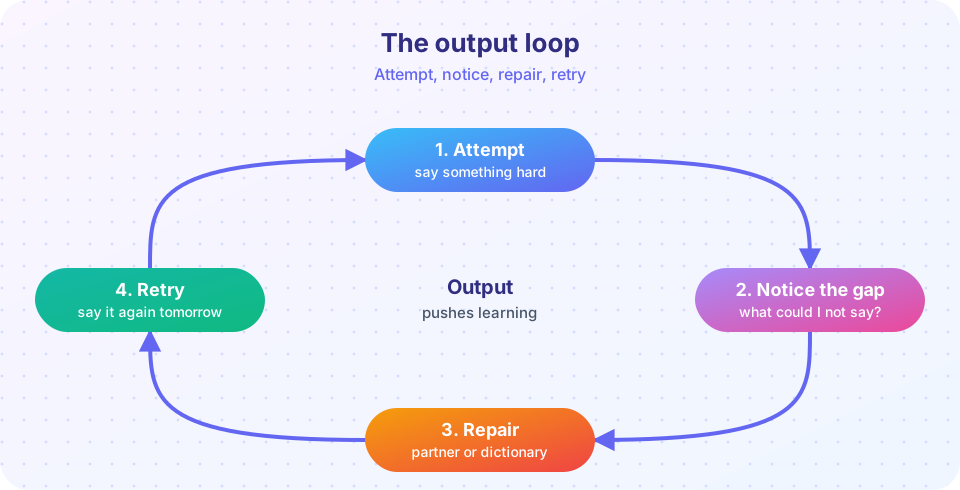
Use the loop shown at the top of the lesson:
- Attempt something slightly beyond comfort, such as describing last weekend in detail.
- Note the gaps: write down words you could not find and forms you doubted.
- Close the gap by checking a dictionary or asking your partner.
- Retry the same message the next day.
Press Run (or Ctrl + Enter) to see the result here.
Program input · what you'd type while the program runs
Type the answers before you press Run, one per line. Each time the program reads a line (with input()), it gets the next line from this box.
The curves come from assumptions you can change, not from measured data. The slopes show the practical point: twice-a-week conversation changes your total speaking by an order of magnitude compared with class alone.
Putting it together: a short worked example
Suppose you want to describe a trip. Your first attempt is: "I go to the mountains with friends and we sleep in a tent." While speaking, you notice that you do not know the word for "campfire" and that you are unsure about the past tense of "sleep". That is the noticing function of output at work: the attempt itself revealed two gaps.
Next, your partner recasts: "You slept in a tent? Nice. Did you light a campfire?" You now have the word and the form, supplied at exactly the moment you needed them. A day later you retell the trip and try, "We slept in a tent and made a campfire." Attempt, gap, repair, retry.
A single five-minute exchange produced two items you are likely to remember better than if they had come from a word list, because they answered a need you felt. The same logic explains why a partner who only says "good, good" helps less than one who asks follow-up questions: questions create more chances for gaps to appear, and each gap is a learning opportunity.
Common misconceptions
"If my partner understood me, my sentence was fine." Understanding can succeed even when grammar is wrong, which is exactly why errors persist. Ask for feedback explicitly.
"Corrections always hurt confidence." Learner surveys often show that many learners want correction; what matters is how and when it is given, and whether you chose it.
Check your understanding
Quick check · 5 questions
of 5 answered You scored / 5 · perfect!
-
1. Which of these is one of Swain's three functions of output?
Swain proposed noticing, hypothesis testing and metalinguistic reflection. -
2. What is negotiation of meaning?
Speakers repeat, rephrase or ask for clarification to make themselves understood. -
3. What did Lyster and Ranta (1997) find about recasts in French immersion classrooms?
Recasts made up more than half of feedback but led to less learner repair than prompts. -
4. Why does a conversation without any breakdowns give limited learning?
Learning through interaction often comes from repairing trouble spots; smooth talk may only reuse what you know. -
5. Which request asks your partner for a prompt rather than a recast?
A prompt invites the learner to self-correct instead of supplying the correct form.
Summary
- Output pushes you to notice gaps, test forms and reflect on language.
- Interaction helps when a breakdown leads to repair and attention to form.
- Feedback research supports several types; recasts are frequent but not always the strongest.
- Evidence is strongest for specific forms in short studies, not for whole-language claims.
- Build a loop: attempt, note gaps, repair, retry.
Next: Partners and tutors
Track your progress
Create a free account to tick off lessons and pick up where you left off on any device.
of How to Learn a Language lessons completed