


















Lesson 38 of 48 · Plans, Tools and Projects
Goals, levels and how many hours it takes
Understand CEFR levels, the hour estimates from Cambridge and the FSI, why they vary, and how to set a specific goal and a weekly schedule you can keep.
"How long will it take?" is the question every learner asks, and the honest answer is: it depends, but not unpredictably. Language learning has some well-known benchmarks. They are rough, based on classroom hours rather than individual self-study, and sensitive to how far your first language is from the new one. Still, they let you plan more realistically than a vague hope of becoming fluent.
This lesson introduces the CEFR levels, shows two widely quoted sets of hour estimates, explains why they should be treated as ranges, and walks through setting a goal and a schedule.
What you will learn
- What the CEFR levels A1 to C2 mean in plain terms.
- What hour estimates exist, where they come from and what they leave out.
- How to write a specific goal and convert it into a weekly plan.
- Why intensity, language distance and study quality change the numbers.
Key terms
CEFR: a scale from A1 (beginner) to C2 (near-native mastery) describing what learners can do, such as order food or write a report.
Can-do statement: a short description of a task the learner can perform, like "I can describe my daily routine".
FSI: the Foreign Service Institute, the US agency that trains diplomats and publishes learning time estimates.
Time on task: hours you actually spend practicing, not the length of the course.
The CEFR in plain terms
The Common European Framework of Reference for Languages groups proficiency into three bands.
| Band | Levels | Rough description |
|---|---|---|
| Basic user | A1, A2 | Simple everyday phrases, routine tasks, short exchanges |
| Independent user | B1, B2 | Main points of clear speech, travel, work discussions, longer texts |
| Proficient user | C1, C2 | Flexible, fluent use for study and work; precision and subtlety |
The strength of the CEFR is that it describes what you can do, which helps set goals: "A2 for a holiday, B2 for studying at a university abroad". It is a framework, not a test. Several exams and courses are aligned to it, with differing difficulty and methods.
Two sets of hour estimates
Cambridge English publishes estimates of the guided learning hours learners of English typically need. These are cumulative and commonly cited: about 180 to 200 hours for A2, 350 to 400 for B1, 500 to 600 for B2, 700 to 800 for C1 and 1,000 to 1,200 for C2. The ranges reflect the fact that learners differ.
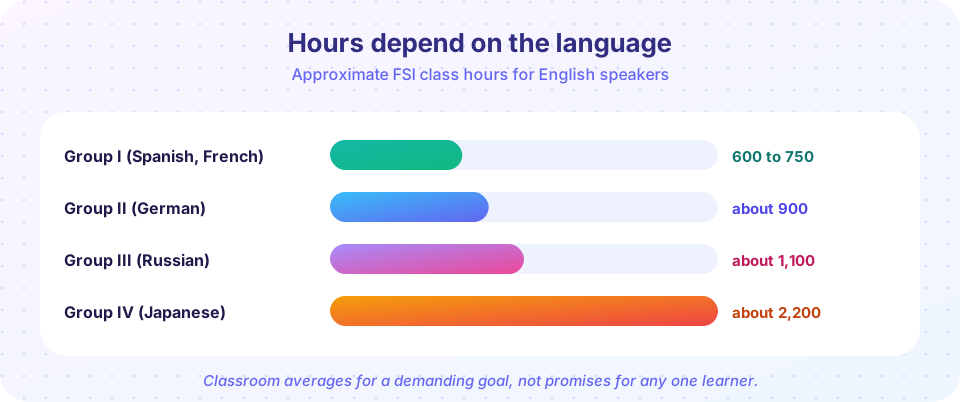
The US Foreign Service Institute (FSI) groups languages by the time needed for English-speaking diplomats to reach professional working proficiency. The commonly quoted classroom hours are:
| Group | Examples | Approximate class hours |
|---|---|---|
| I | Spanish, French, Italian, Portuguese | 600 to 750 |
| II | German, Indonesian, Swahili | about 900 |
| III | Many languages, such as Russian, Turkish, Hindi | about 1,100 |
| IV | Arabic, Chinese, Japanese, Korean | about 2,200 |
Both sets come with caveats you should keep in mind.
- They are averages for classroom learners in organized programs, usually with homework on top. The FSI estimates assume full-time study with trained teachers.
- FSI targets are demanding: working proficiency for professional use, not conversational ability.
- First language and prior learning matter. A Spanish speaker learning Portuguese will progress faster than an English speaker learning Korean.
- Quality of practice matters as well as quantity. An hour of active conversation is not equal to an hour with a flashcard app on a train.
So treat these figures as ranges for planning, not promises.
Press Run (or Ctrl + Enter) to see the result here.
Program input · what you'd type while the program runs
Type the answers before you press Run, one per line. Each time the program reads a line (with input()), it gets the next line from this box.
The plot uses benchmarks for English learners in classroom settings, so your language and format may differ. It is useful mainly for showing the shape of the job: a year of steady practice at a modest pace gets you an A2 to B1 range, and higher levels take years.
Making a goal specific
A good goal has three parts.
- A task. What will you do? For example: "chat with a tutor for 15 minutes about everyday topics" or "read a short novel without a dictionary".
- A standard. How well? "Understand 90 percent of what they say" or "finish in two weeks".
- A date. When? "By 1 September."
Goal-setting research in organizations by Edwin Locke and Gary Latham found that specific, challenging goals lead to better performance than vague "do your best" goals. The evidence comes mostly from work tasks rather than languages, but the principle is widely applied.
Then work backward. If you have 20 weeks, your target requires about X hours, so you need Y hours a week. If that does not fit your life, change the goal or the date, not the arithmetic.
Scheduling the hours
Distribute practice rather than cramming. Studies of spacing, summarized by Nicholas Cepeda and colleagues (2006), show that spreading study over time generally leads to better long-term retention than massing it. A schedule of 45 minutes on six days beats one 4.5-hour Sunday session.
| Day | Activity | Time |
|---|---|---|
| Mon | Vocabulary review and extensive reading | 45 min |
| Tue | Speaking session | 45 min |
| Wed | Listening and shadowing | 45 min |
| Thu | Grammar point and writing | 45 min |
| Fri | Speaking or exchange | 45 min |
| Sat | Projects or media in the language | 60 min |
Adjust to your life. A small number you can repeat is better than an ambitious one you abandon.
Press Run (or Ctrl + Enter) to see the result here.
Program input · what you'd type while the program runs
Type the answers before you press Run, one per line. Each time the program reads a line (with input()), it gets the next line from this box.
Nation's balance of four roughly equal strands is a guide; many self-learners are heavy on study and light on output, and shifting minutes towards speaking often helps.
Review points
Every month, answer three questions: what can I do now that I could not do a month ago, what is the weakest skill, and what will I change? Record one example, such as a voice recording or a paragraph, so you can compare with last month.
A worked example
Suppose Leila can already do A2 tasks in her target language and wants to reach B1 so that she can follow a university lecture. Using the Cambridge-style figures quoted earlier, B1 sits at about 350 to 400 guided hours and A2 at about 180 to 200. The difference is therefore roughly 160 to 220 hours, say 190 on average.
If she studies 4 hours a week, 190 divided by 4 is about 48 weeks, or between 10 and 11 months. If she raises her pace to 6 hours a week, the same job takes about 32 weeks, around 7 months. At 2 hours a week it takes nearly two years, and the habit will probably not survive that long without help.
Notice what the calculation does: it turns a vague hope into a choice between concrete trade-offs. Leila can lower the target (a narrower goal, such as reading news articles), raise the weekly time, or accept the longer timeline. Because the hour estimates are rough, she should treat the result as a range, check her progress after three months, and adjust.
Common misconceptions
"The FSI categories say how fast I will learn." They are averages for a specific kind of training. Your hours, language and format will differ.
"Fluency is one finish line." The CEFR shows that proficiency is a ladder with many useful stops.
"Immersion alone does it." Immersion gives exposure but not always practice; time abroad helps most when you use the language actively.
Check your understanding
Quick check · 5 questions
of 5 answered You scored / 5 · perfect!
-
1. What does the CEFR describe?
It describes proficiency by can-do statements, not by a single test. -
2. About how many class hours does the FSI estimate for group I languages such as Spanish and French?
Group I languages are the easiest for English speakers, at roughly 600 to 750 class hours. -
3. Which is NOT a reason hour estimates vary?
Language distance and practice quality matter; notebook color does not. -
4. Why is spacing recommended?
Cepeda and colleagues' review found spacing generally improves retention. -
5. What are the three parts of a specific goal?
A task, a standard of performance and a deadline make a goal specific.
Summary
- The CEFR describes levels by what you can do.
- Cambridge and FSI hour estimates are rough, classroom-based and vary with language distance and practice quality.
- Set specific goals with a task, standard and date, then work backward to weekly hours.
- Spread practice over days rather than cramming.
- Review monthly and adjust.
Next: Tools and apps
Track your progress
Create a free account to tick off lessons and pick up where you left off on any device.
of How to Learn a Language lessons completed