


















Lesson 24 of 48 · Speaking and Conversation
Finding speaking time: partners, tutors and yourself
Compare classes, tutors, language exchanges and talking to yourself by speaking time, cost and feedback, with a structure for productive sessions.
Knowing that speaking matters does not put a conversation in your calendar. Most learners reach for whichever option is easiest to find, such as a class, an app or a friend who speaks the language, and then discover that only a small slice of the session is actually theirs to speak. This lesson compares the main sources of speaking practice and shows how to get more out of each.
No format is best for everyone. The useful questions are how much you speak, how much feedback you get, what it costs in money and effort, and whether you will still be doing it in three months.
What you will learn
- How to compare speaking formats by learner talk time, feedback quality and cost.
- A structure for a productive tandem (language exchange) session.
- What to ask a tutor so lessons target your needs.
- How to use self-talk, shadowing and AI chat as supplements, and their limits.
Key terms
Tandem learning: two people, each learning the other's language, who split time equally between the two languages.
Talk time: the share of a session in which the learner is speaking.
Scaffolding: help from a partner or tutor that lets you say more than you could alone, such as supplying a missing word.
Circumlocution: describing a word you do not know with words you do know ("the thing you cut bread with").
Group classes
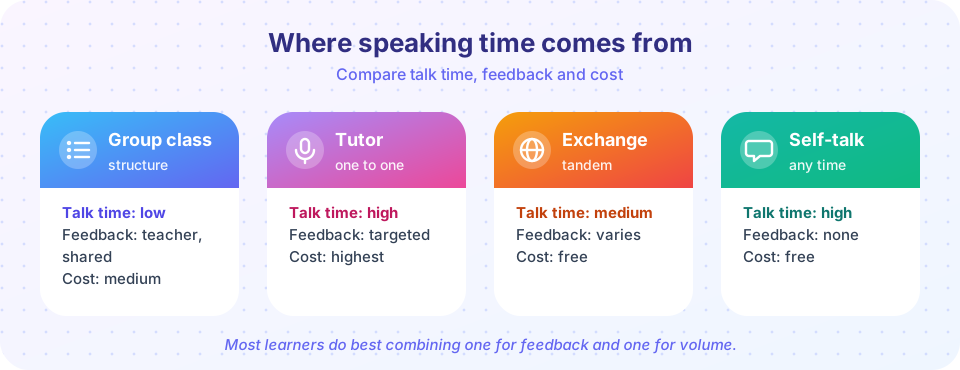
A class gives structure, a teacher with training, and a built-in schedule. It also gives the least speaking per hour, because talk time is shared. Many classes make up for this with pair work, which can raise your talk time considerably. When choosing a class, ask how many students there are and how much of the lesson is pair or group speaking. A small class of four to six with frequent pair work can be much richer than a lecture-style class of twenty.
One-to-one tutors
With a tutor, the arithmetic changes: you can speak for half the lesson or more, and the tutor can give targeted feedback on your errors. Cost is the main limit. Online platforms list tutors at a wide range of prices; community tutors, who are enthusiastic native speakers without teaching qualifications, are usually cheaper, while professional teachers typically cost more but plan lessons and explain grammar.
Studies of tutoring in language classrooms and of one-to-one corrective feedback generally find positive effects, but most are small, short and conducted by researchers who control the setting. Treat the research as support for the idea rather than as a price list.
What to ask a tutor:
- "Please correct my most frequent errors, not every error."
- "Send me a list of new words and sentences after each session."
- "Let me do more of the talking. Ask open questions."
- "Use the last ten minutes to repeat something I struggled with."
Language exchange (tandem)
In a language exchange you help someone learn your language and they help you learn theirs. It is free, which is its great advantage, and it has well-known problems: partners cancel, one person dominates, and sessions drift into the language both speak best. Pioneers of the tandem method emphasized two principles, reciprocity (both learn equally) and learner autonomy (each decides what to practice and what feedback to ask for).
A reliable session structure:
| Minutes | Activity |
|---|---|
| 0-5 | Warm up: say what you did this week |
| 5-25 | Language A: speaker A talks, partner B corrects only what A asked |
| 25-45 | Language B: roles swap |
| 45-50 | Each writes three useful phrases to review |
Keep sessions to one language at a time and use a visible timer. If your partner is a beginner too, the time and format matter even more, because you will often need to simplify.
Press Run (or Ctrl + Enter) to see the console output here.
No output.
Cost per speaking minute is only one measure. A lower price does not help if you stop attending after three weeks.
Talking to yourself
Self-talk sounds silly and works well for a specific purpose: it lets you practice message preparation without fear. You can narrate your day, describe objects around the room, or rehearse a conversation you will have tomorrow. The research on private speech in second-language learning shows that learners naturally use self-directed speech to work through tasks, and teachers have used it as a deliberate technique.
Two useful routines:
- Daily description: two minutes describing what you did, then write down every word you wanted and lacked.
- Shadowing: play a short audio clip and speak along a half-second behind. Studies of shadowing report gains in listening and pronunciation, though much of this work is on Japanese university learners and results vary by study.
AI conversation tools
Chatbots can talk at any hour, never get tired and are patient with mistakes. They offer a low-stakes place to practice. The research on them is young, so treat claims cautiously. Limitations include occasional wrong explanations, over-politeness that hides your errors, and the lack of real-world stakes: a bot will not misunderstand you the way a stranger will. Use them to rehearse, then test the result with a person.
Press Run (or Ctrl + Enter) to see the result here.
Program input · what you'd type while the program runs
Type the answers before you press Run, one per line. Each time the program reads a line (with input()), it gets the next line from this box.
Getting the most from any session
The format matters less than how you use the time. A good session has three parts: preparation, the conversation and a review.
Before. Choose one or two topics and write five words or phrases you expect to need. Preparing a little reduces the nervous scramble and lets you try slightly more ambitious language. Tell your partner what you want: "Today I would like to practice describing my job. Please ask me questions and correct only verb tense."
During. Keep a scrap of paper or a notes window open. Write down words you could not find, and corrections you want to remember, as single words or short phrases so you do not interrupt the flow. If you freeze, use a circumlocution rather than switching to your first language: describe the word you want and let your partner supply it.
After. Within a day, go through your notes. Add the useful words and the whole sentences they came from to your spaced repetition deck, and say the corrected sentences aloud. At the next session, try to use them. This closes the loop from the output lesson and turns a pleasant chat into learning.
If your partner is also a beginner, keep topics concrete, speak slowly, and use a visible timer so both languages get equal time. If you feel uncomfortable with a partner, you can always end a session, and it is wise to keep personal information private until you know someone well.
Common misconceptions
"Any native speaker is a good partner." Native speakers without training may switch to your language, correct nothing, or talk too fast. Agree on a format first.
"Self-talk does not count because nobody answers." It cannot replace interaction, but it builds retrieval speed and shows you which words you lack.
Check your understanding
Quick check · 5 questions
of 5 answered You scored / 5 · perfect!
-
1. Why is a group class often the lowest format for learner talk time?
With twelve students and a teacher, each student speaks only a few minutes per hour. -
2. What are the two principles associated with tandem learning?
Both partners learn equally, and each decides what to practice and what feedback to request. -
3. Which request helps a tutor give useful feedback?
Correcting everything overwhelms; focusing on frequent errors is more manageable and effective. -
4. What is a limit of practicing with an AI chatbot?
Bots can be over-polite and occasionally inaccurate; real misunderstandings with people teach different lessons. -
5. Circumlocution means:
It is a communication strategy that keeps a conversation going when you cannot find a word.
Summary
- Compare formats by learner talk time, feedback, cost and how likely you are to keep going.
- Group classes give structure but little talk time; tutors raise talk time at a price.
- Language exchanges are free and need structure: timer, one language at a time, agreed corrections.
- Self-talk and shadowing build retrieval speed; AI chat is a rehearsal space, not a replacement for people.
- Combine two formats, one with feedback and one with volume.
Next: Fluency and anxiety
Track your progress
Create a free account to tick off lessons and pick up where you left off on any device.
of How to Learn a Language lessons completed