


















Lesson 40 of 48 · Plans, Tools and Projects
Motivation and habits: how to keep going
What research says about language learning motivation, the L2 motivational self system, self-determination theory and habit formation, with practical if-then plans.
Every language learner has a story about a plan that faded. The first weeks are exciting, then a busy week breaks the streak, and then the app stays closed. Researchers who study motivation and habits do not treat this as a character flaw. They treat it as a predictable pattern that can be designed around.
This lesson summarizes the main theories of language learning motivation, then turns to evidence on habit formation, and ends with specific techniques you can set up in ten minutes.
What you will learn
- What integrative, instrumental and future-self motivations are.
- What self-determination theory says about autonomy, competence and relatedness.
- What a habit-formation study found about time and missed days.
- How to build if-then plans and make practice easy to start.
Key terms
Instrumental motivation: learning for a practical benefit, such as a job or exam.
Integrative motivation: learning to connect with speakers and their culture.
Ideal L2 self: the picture of yourself as a successful user of the language.
Automaticity: how little effort and thought an action needs.
Theories of motivation
In the 1950s, Robert Gardner and Wallace Lambert studied English-speaking students in Canada learning French. They distinguished integrative motivation, a wish to engage with the community, from instrumental motivation, a wish for practical benefits. Early research suggested integrative motivation was important; later work found that the picture was more complicated and that both can help.
Zoltán Dörnyei proposed the L2 motivational self system (2005). It has three parts:
- The ideal L2 self: the person you hope to become as a speaker. A vivid picture of using the language, such as chatting with a friend or working abroad, motivates effort.
- The ought-to L2 self: duties and pressures, such as what your family expects.
- The L2 learning experience: the immediate setting, including the teacher, materials and success.
Studies in many countries find that the ideal L2 self correlates with effort and intended effort. The correlation does not prove cause, but the idea gives a practical tip: define and revisit the vision of yourself using the language.
Self-determination theory (Edward Deci and Richard Ryan) points to three needs: autonomy (feeling you choose), competence (feeling you can do it) and relatedness (feeling connected). Applied to languages, this suggests choosing content you like, picking tasks you can succeed at and finding a community.
Motivation fluctuates
Dörnyei and Ottó (1998) described motivation as a process that changes over time, and later studies show that it rises and falls within a single lesson, across weeks and over years. This is normal. Plan for the dips: they are part of the pattern, not evidence that you chose the wrong language.
What habits are and how long they take
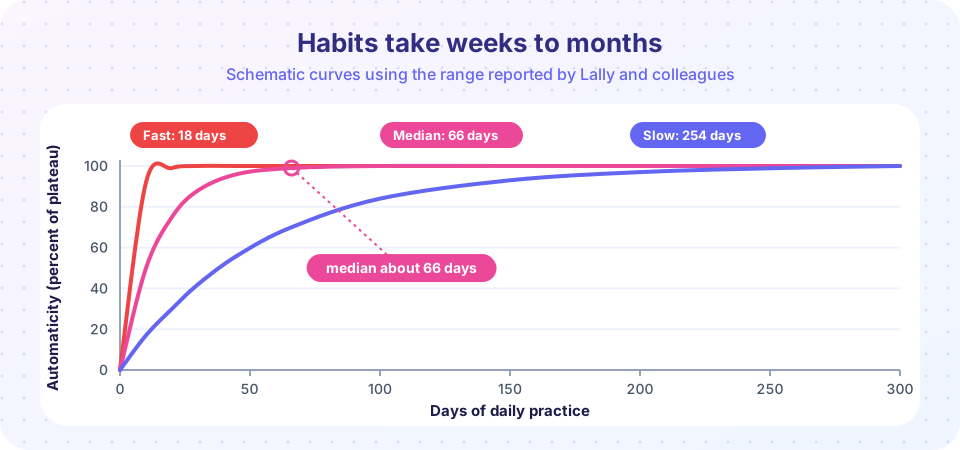
A habit is behavior triggered by a cue with little thought. In a study by Phillippa Lally and colleagues (2010), 96 volunteers chose a simple daily behavior, such as drinking a glass of water after breakfast, and reported each day how automatic it felt over 12 weeks. The results:
- The median time to reach a plateau of automaticity was about 66 days, with a very wide range of 18 to 254 days.
- Missing a single day did not materially affect the long-run habit formation.
- Simpler behaviors became automatic faster than more complex ones.
The popular claim that "habits take 21 days" has no support in this research. The study used simple behaviors rather than languages, so the numbers are a guide: expect weeks to months, and expect it to vary.
Press Run (or Ctrl + Enter) to see the result here.
Program input · what you'd type while the program runs
Type the answers before you press Run, one per line. Each time the program reads a line (with input()), it gets the next line from this box.
The curves are a schematic built from the reported range. Real data are noisy and individuals do not follow a smooth line.
Design a plan that survives
Make the cue specific. Peter Gollwitzer's research on implementation intentions shows that plans of the form "If X, then I will Y" help people follow through. A meta-analysis by Gollwitzer and Sheeran (2006) reported a medium-to-large effect on goal attainment across many studies, mostly on health and academic goals. For languages: "If I pour my morning coffee, then I will review ten flashcards."
Make it small. The minimum version should take two minutes. On bad days, doing the minimum keeps the cue and the behavior linked.
Attach it to an existing routine. Use something you already do daily as the cue.
Prepare the environment. Put the book on your pillow, the app on your home screen, the headphones by the door.
Track lightly. A tick on a calendar is enough. Streaks can motivate but can also cause all-or-nothing thinking, so plan a "never miss twice" rule: if you miss a day, do the minimum the next day.
Press Run (or Ctrl + Enter) to see the console output here.
No output.
Build in enjoyment and people
Motivation research keeps returning to the same practical advice: choose content you enjoy, set tasks you can succeed at and involve other people. A weekly exchange partner, a class or an online community gives accountability and relatedness. Rewards such as finishing a graded reader or ordering a meal in the language make competence visible.
When motivation drops: a troubleshooting list
Almost every learner meets a dip somewhere between week three and month three. When it comes, work through these questions rather than concluding that you have lost interest for good.
- Is the task too hard or too easy? Frustration and boredom both erode motivation. Adjust the level of your material so that you succeed most of the time but still meet some challenge.
- Is the schedule realistic? If you have missed more than a third of your sessions, shrink the plan instead of promising to try harder.
- Have I lost my reason? Reread your goal, and imagine a concrete scene in which you use the language, with a place and a person. Dörnyei's ideal L2 self is useful because a vivid picture can be revisited.
- Am I alone? Add a person: a class, an exchange partner or an online group with a regular meeting. Relatedness is one of the three needs in self-determination theory.
- Is there a reward? Mark progress with something visible: a finished reader, a recording to compare, a first real conversation.
Another useful idea comes from Bonny Norton's research on investment. She argued that learners invest in a language when it gives them access to people, resources and identities they value, and that a learner can be motivated in general yet disengaged in a particular setting if the setting makes them feel excluded or silenced. If a class or group makes you feel small, the problem may be the situation, not you, and changing the situation is a legitimate fix.
Common misconceptions
"Real learners do not need motivation tricks." Everyone's motivation fluctuates. Systems protect you on low days.
"Missing a day ruins everything." The habit study suggests a single missed day made little difference. Resuming matters.
"If I do not love it, I should quit." Interest can grow with competence. Check whether the problem is the language, the method or the schedule.
Check your understanding
Quick check · 5 questions
of 5 answered You scored / 5 · perfect!
-
1. What are the three parts of Dörnyei's L2 motivational self system?
The system combines the ideal self, the ought-to self and the learning experience. -
2. What did Lally and colleagues (2010) find about the median time to a habit plateau?
The median was about 66 days with wide variation, and the 21-day claim has no support. -
3. Missing one day in that study:
A single missed opportunity did not materially affect the process. -
4. Which is an implementation intention?
It links a specific cue to a specific action. -
5. What three needs does self-determination theory emphasize?
Feeling you choose, can succeed and are connected supports motivation.
Summary
- Motivation fluctuates; plan for the dips.
- The ideal L2 self, autonomy, competence and relatedness support effort.
- Habits take weeks to months; one missed day matters little, so resume.
- Use if-then plans, tiny minimums, existing routines and light tracking.
- Add enjoyment and people.
Track your progress
Create a free account to tick off lessons and pick up where you left off on any device.
of How to Learn a Language lessons completed